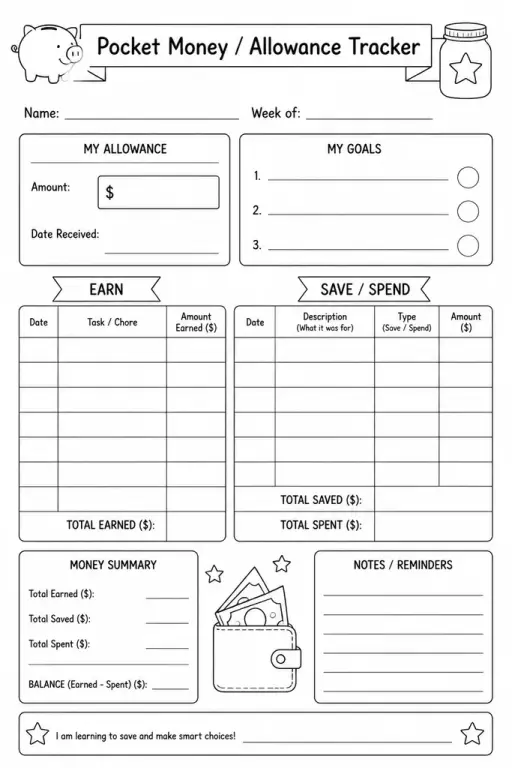
Pocket Money / Allowance Tracker
Parent & Home Printables
Ages 4–11
——
KiwiBee uses optional Google Analytics, Google Ads, and Meta Pixel cookies to understand adult visitors, measure completed sign-ups, and improve campaigns. Essential cookies always stay on. OpenAI’s ChatGPT Ads Pixel also measures page views and completed enquiries after advertising consent, and may use hashed contact details for matching. Privacy policy

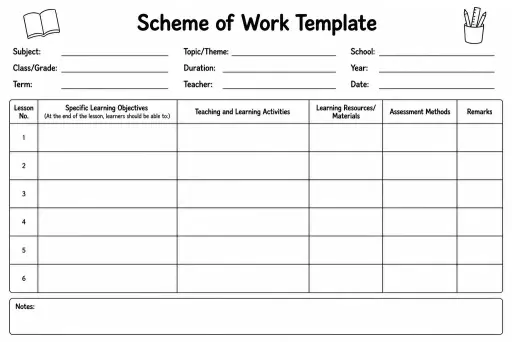
A Medium-Term Plan template is a half-term planning grid that sits between the high-level yearly overview and the day-to-day lesson plan. It covers roughly five to eight weeks and maps out the sequence of lessons, learning objectives, key activities, and resources for one subject or unit during a single half-term block. Because it spans the complete teaching arc for that period, it is the most commonly requested document in lesson observations, performance reviews, and school inspections. Teachers complete the grid in planning week before the half-term begins, which frees daily planning sessions to focus on fine-tuning individual lessons rather than deciding what comes next. Subject leaders use blank copies during department planning days to ensure consistency across parallel classes. The template is subject-neutral — the same grid structure works for primary literacy, secondary science, or any subject across any key stage.
Typically one row per lesson or week, depending on how detailed you work. A standard UK half-term of six weeks with five lessons per week might use a per-week row for brevity, or a per-lesson row for a more granular plan.
They are closely related. A unit plan is organised around a thematic or conceptual unit, which may not align neatly with term boundaries. A medium-term plan is explicitly tied to a half-term calendar period — it may contain one unit or bridge the end of one unit and the start of another.
Yes. Mark the assessment lesson or task clearly in the grid — typically in the last row — so that the whole sequence is designed with the assessment in mind, not added as an afterthought.
Yes, with minor adaptation. Early years practitioners can use the rows to record continuous provision themes, key experiences, and developmental objectives for each week rather than formal lesson content.
See what other teachers think and share a helpful note.
Generate a fresh worksheet for any grade, topic and language. Free.
 Home
Home All solutions
 Pricing
 About us
 KiwiBee for Non-profits
 Events & webinars
 For big organisations
 For schools
 For centers
 For team leaders
 For teachers
 AI and resources
 Resources
 Printable worksheets
 Lesson Packs
 Interactive simulations
 Teacher tools
 AI studio
 Ideas and research