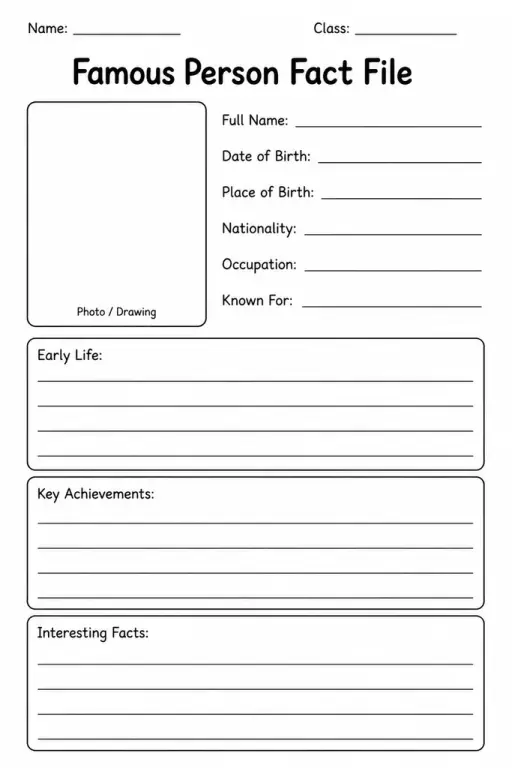
Famous Person Fact File
Social Studies Templates
Ages 4–11
——
KiwiBee uses optional Google Analytics, Google Ads, and Meta Pixel cookies to understand adult visitors, measure completed sign-ups, and improve campaigns. Essential cookies always stay on. OpenAI’s ChatGPT Ads Pixel also measures page views and completed enquiries after advertising consent, and may use hashed contact details for matching. Privacy policy

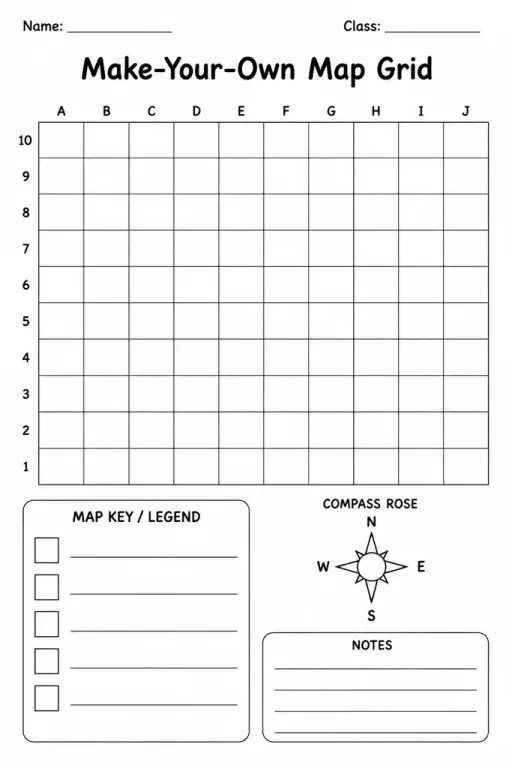
The Map Key / Legend Template provides a structured blank frame for students to design and document their own map symbols. It features a bordered legend box divided into two columns — one for drawing or affixing a symbol and one for writing its meaning — alongside a separate symbols practice box where students can sketch rough ideas before committing. Grades 2–6 use it whenever they create hand-drawn maps, whether of their classroom, neighbourhood, an imagined island, or a historical region. Teachers appreciate that it teaches cartographic convention explicitly: students learn that every map communicates through a shared code, and they must define that code before their map can be read by others. The template is intentionally minimal so it works with any mapping task across the curriculum — geography projects, history timelines mapped to place, and even creative writing world-building exercises all benefit from a clearly filled-in legend.
The standard template has rows for up to eight symbols. For larger projects, simply print two copies and staple them together.
It is designed for hand-drawn maps, but you can also print it, fill it in digitally with a PDF annotation tool, and attach it to a digital map file.
The terms are interchangeable in most primary and middle-school curricula. Both refer to the box that explains what each symbol on a map represents.
With teacher scaffolding — such as pre-choosing two or three symbols together as a class — grade 2 students can use the template successfully.
See what other teachers think and share a helpful note.
Generate a fresh worksheet for any grade, topic and language. Free.
 Home
Home All solutions
 Pricing
 About us
 KiwiBee for Non-profits
 Events & webinars
 For big organisations
 For schools
 For centers
 For team leaders
 For teachers
 AI and resources
 Resources
 Printable worksheets
 Lesson Packs
 Interactive simulations
 Teacher tools
 AI studio
 Ideas and research