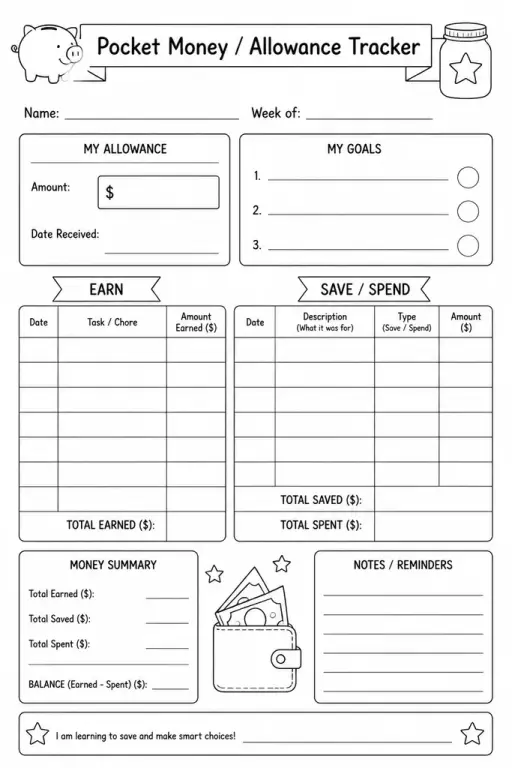
Pocket Money / Allowance Tracker
Parent & Home Printables
Ages 4–11
——
KiwiBee uses optional Google Analytics, Google Ads, and Meta Pixel cookies to understand adult visitors, measure completed sign-ups, and improve campaigns. Essential cookies always stay on. OpenAI’s ChatGPT Ads Pixel also measures page views and completed enquiries after advertising consent, and may use hashed contact details for matching. Privacy policy

A Long-Term / Yearly Overview template is a term-by-term planning grid that lets teachers and school leaders see the shape of an entire academic year on a single page. Each cell represents one term or half-term and is left blank for the teacher to record the main topic, unit, or theme being taught in each subject area during that period. The format is intentionally high-level — it is a roadmap, not a detailed plan. School leaders use yearly overviews during curriculum design to check balance, identify gaps, and ensure progression year-on-year. Class teachers use them to brief parents, align with colleagues, and prevent two teachers scheduling the same heavy assessment window. The blank grid works for any year group and any national curriculum framework, making it a universally reusable planning tool that can be reprinted and completed from scratch each academic year.
A timetable shows the fixed weekly schedule of lessons; a yearly overview shows the content — which topic or unit occupies which term — across the whole academic year.
Yes, many teachers add a row specifically for key assessments, reports, or parents' evenings so that planning clusters are visible at the same scale as the curriculum content.
You can add year-group rows within the grid, or print one copy per year group and display them side by side. The latter approach makes vertical progression (what students learn in Year 4 before Year 5) much easier to check.
Most schools revisit it once per year before the new academic year begins, then make small amendments at the start of each term if scheduling changes. It is a living document, not a locked plan.
See what other teachers think and share a helpful note.
Generate a fresh worksheet for any grade, topic and language. Free.
 Home
Home All solutions
 Pricing
 About us
 KiwiBee for Non-profits
 Events & webinars
 For big organisations
 For schools
 For centers
 For team leaders
 For teachers
 AI and resources
 Resources
 Printable worksheets
 Lesson Packs
 Interactive simulations
 Teacher tools
 AI studio
 Ideas and research