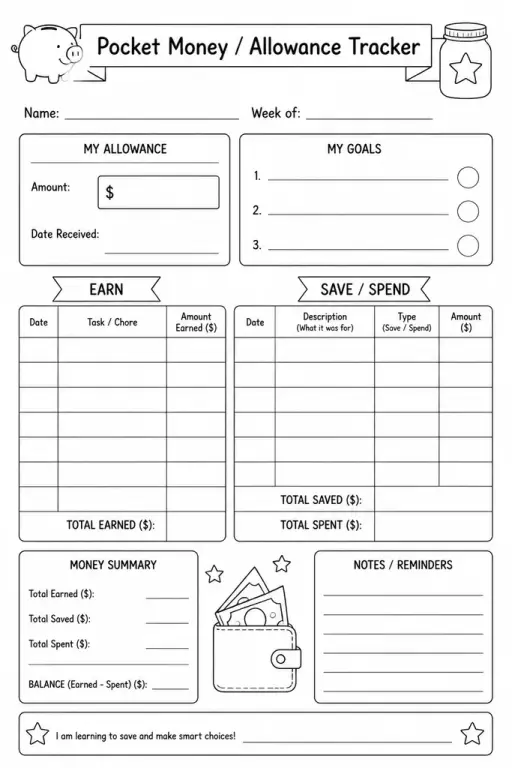
Pocket Money / Allowance Tracker
Parent & Home Printables
Ages 4–11
——
KiwiBee uses optional Google Analytics, Google Ads, and Meta Pixel cookies to understand adult visitors, measure completed sign-ups, and improve campaigns. Essential cookies always stay on. OpenAI’s ChatGPT Ads Pixel also measures page views and completed enquiries after advertising consent, and may use hashed contact details for matching. Privacy policy

A Learning-Intentions Board is a blank WALT (We Are Learning To) and WILF (What I'm Looking For) display template that teachers print, laminate, and mount in the classroom to communicate the purpose of every lesson to students. The large-format layout provides clearly framed boxes for the learning intention, the success criteria, and an optional 'Why are we learning this?' purpose statement — giving students a transparent view of what the lesson is about and how they will know when they have succeeded. Kindergarten through to secondary teachers use the board as a daily anchor for explicit teaching. It is particularly effective at the start of a lesson when the teacher refers to it during the orientation phase, and again at the end when students self-assess against the stated criteria. Because the template is entirely blank, teachers can write on it with a whiteboard marker each day, replenishing content for every new session without printing a new copy.
WALT (We Are Learning To) states the skill or knowledge being developed. WILF (What I'm Looking For) describes the observable evidence or quality indicators that show the learning has occurred.
Yes — consistency is key. Even a brief two-minute reference to the board at the start and end of each lesson builds the routine that makes it effective for student self-regulation.
Absolutely. The blank design works as a projected slide template too. Print the laminated version for permanent display and replicate the layout in your slideshow for screen projection.
Yes. For younger students, supplement the written intention with a simple illustration or a verbal explanation, and keep the WILF criteria to one or two concrete, observable actions.
See what other teachers think and share a helpful note.
Generate a fresh worksheet for any grade, topic and language. Free.
 Home
Home All solutions
 Pricing
 About us
 KiwiBee for Non-profits
 Events & webinars
 For big organisations
 For schools
 For centers
 For team leaders
 For teachers
 AI and resources
 Resources
 Printable worksheets
 Lesson Packs
 Interactive simulations
 Teacher tools
 AI studio
 Ideas and research