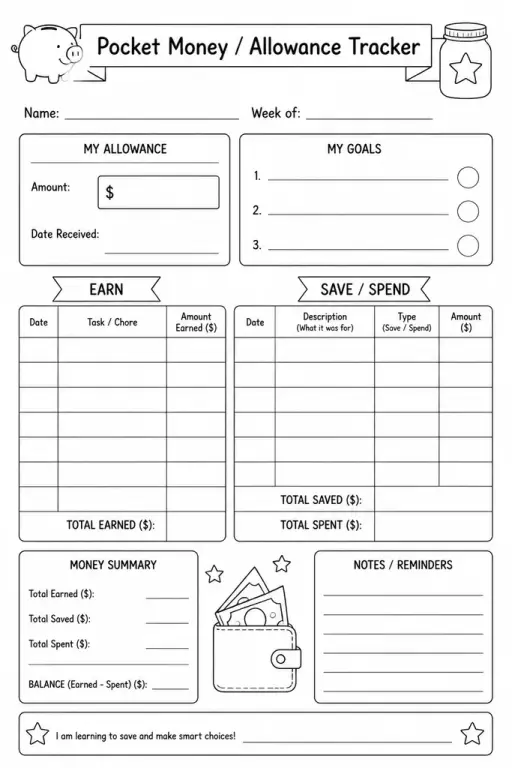
Pocket Money / Allowance Tracker
Parent & Home Printables
Ages 4–11
——
KiwiBee uses optional Google Analytics, Google Ads, and Meta Pixel cookies to understand adult visitors, measure completed sign-ups, and improve campaigns. Essential cookies always stay on. OpenAI’s ChatGPT Ads Pixel also measures page views and completed enquiries after advertising consent, and may use hashed contact details for matching. Privacy policy

A homework planner for home is a blank assignment-and-due-date grid that parents and students keep at the kitchen table or in a homework station. Each row represents one subject or task, with columns for the assignment description, the due date, any materials needed, and a checkbox for completion. Unlike a school-issued planner, this version is designed for the home environment — larger print, fewer columns, and plenty of write-in space so a child can fill it in independently during the after-school rush. Parents use this planner to stay informed about upcoming deadlines without relying on a child's word that everything is done. Students from Grade 2 upward benefit from writing out their own assignments as a metacognitive habit that improves task initiation. The blank grid covers a single week on one sheet, making it easy to cycle a fresh copy each Monday.
A school planner is often small, used during class transitions, and managed by the teacher. The home version is larger-format, lives at the study desk, and is designed for parents and children to review together without the pressure of a timed school period.
The blank grid works from Grade 2 (when most children begin formal homework) through middle school. For younger children, a parent can pre-fill the assignments; older students should fill it in themselves as part of building independence.
It depends on your family's system. A parent signature confirms the child completed work and reviewed it with an adult, which some teachers require. If self-directed study is the goal, the checkbox alone is sufficient.
The weekly grid is best for short assignments due within the week. For long-term projects, add a row labelled with the project name and due date, then break it into milestone steps on subsequent weeks' planners.
See what other teachers think and share a helpful note.
Generate a fresh worksheet for any grade, topic and language. Free.
 Home
Home All solutions
 Pricing
 About us
 KiwiBee for Non-profits
 Events & webinars
 For big organisations
 For schools
 For centers
 For team leaders
 For teachers
 AI and resources
 Resources
 Printable worksheets
 Lesson Packs
 Interactive simulations
 Teacher tools
 AI studio
 Ideas and research