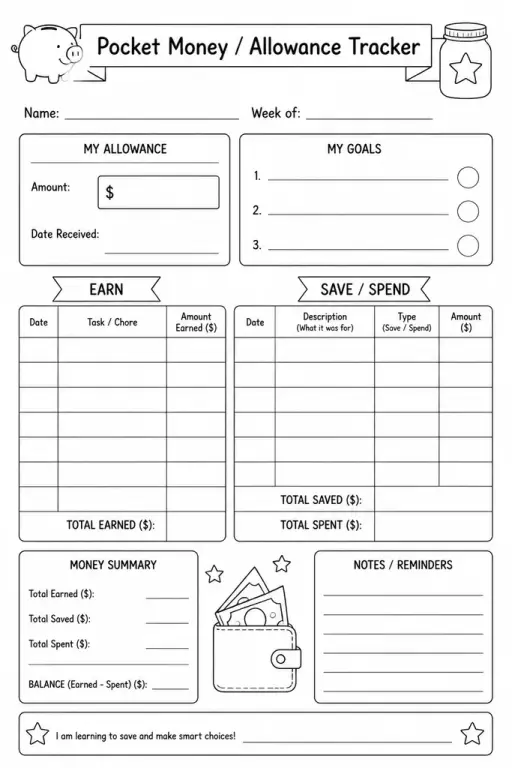
Pocket Money / Allowance Tracker
Parent & Home Printables
Ages 4–11
——
KiwiBee uses optional Google Analytics, Google Ads, and Meta Pixel cookies to understand adult visitors, measure completed sign-ups, and improve campaigns. Essential cookies always stay on. OpenAI’s ChatGPT Ads Pixel also measures page views and completed enquiries after advertising consent, and may use hashed contact details for matching. Privacy policy

The Guided Reading Plan template provides a blank frame for teachers to record the reading group, the selected text, the teaching focus, and the planned activities for a single guided reading session. Sections for before-reading, during-reading, and after-reading prompts ensure the lesson has a clear arc rather than drifting into unstructured read-aloud time. Teachers also note the text level, any word-study targets, and a quick observation space for jotting what individual students demonstrate during the session. Literacy teachers and reading specialists in Kindergarten through middle school use this template to run small-group instruction efficiently. Because it is entirely blank, it suits any guided reading approach — whether following Fountas and Pinnell levels, the Daily 5 framework, or a school-developed literacy block — and works for fiction, non-fiction, and poetry texts alike.
Most guided reading groups contain three to six students who are at a similar instructional reading level. The template has a group name field but no fixed number of student slots, so it flexes to your group size.
The teaching focus is the one specific reading strategy or skill you want to explicitly teach and coach during this session — for example, monitoring for meaning, identifying main idea, or reading dialogue with expression.
It is designed for small-group guided reading, but the three-phase structure (before, during, after) works well for any reading lesson. For whole-class use, simply leave the group-level fields general.
Yes. Even if you are continuing the same book, the teaching focus and prompts should be updated to reflect what you observed last time and what the group needs next.
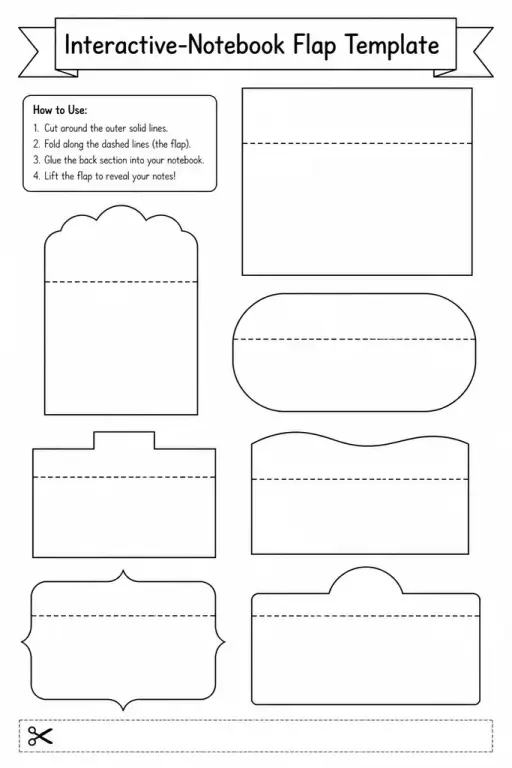
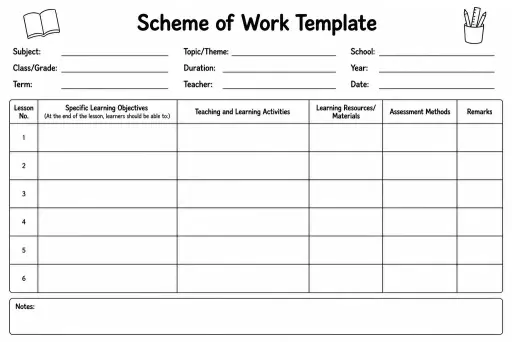
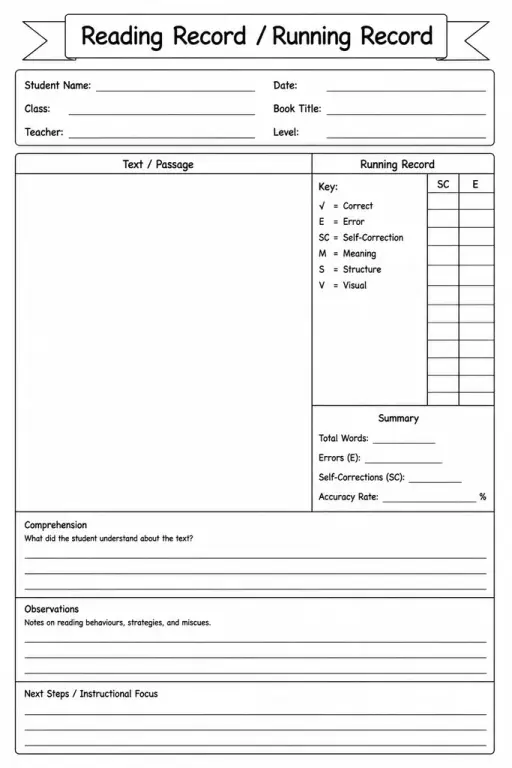
See what other teachers think and share a helpful note.
Generate a fresh worksheet for any grade, topic and language. Free.
 Home
Home All solutions
 Pricing
 About us
 KiwiBee for Non-profits
 Events & webinars
 For big organisations
 For schools
 For centers
 For team leaders
 For teachers
 AI and resources
 Resources
 Printable worksheets
 Lesson Packs
 Interactive simulations
 Teacher tools
 AI studio
 Ideas and research