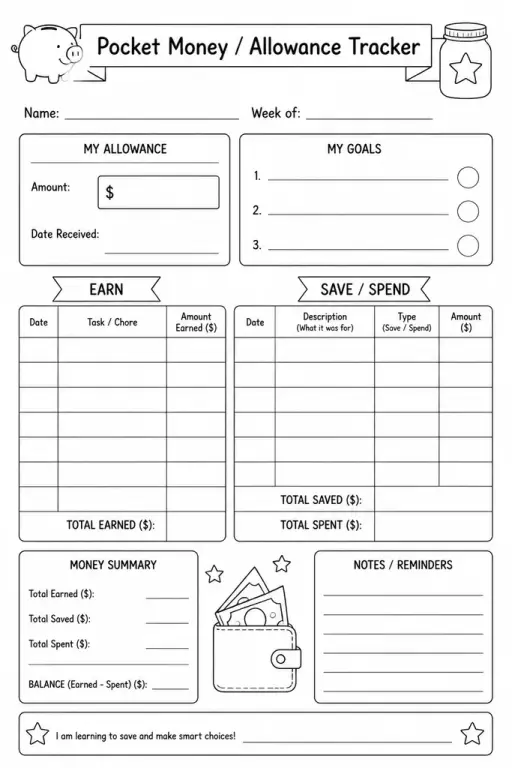
Pocket Money / Allowance Tracker
Parent & Home Printables
Ages 4–11
——
KiwiBee uses optional Google Analytics, Google Ads, and Meta Pixel cookies to understand adult visitors, measure completed sign-ups, and improve campaigns. Essential cookies always stay on. OpenAI’s ChatGPT Ads Pixel also measures page views and completed enquiries after advertising consent, and may use hashed contact details for matching. Privacy policy

The Guided-Reading Group Tracker is a blank group-progress grid built for teachers who run multiple guided reading groups simultaneously and need a single-page record of where every group stands. Rows list group names or book-band levels; columns capture the current text, session date, teaching focus, observed strengths, and next steps — all in a compact format that fits on one A4 or US Letter sheet. Because no groups, levels, or session topics are pre-filled, the tracker adapts to any reading programme, from PM Benchmark bands to Biff and Chip stages to Reading Recovery groupings. Teachers managing four to six rotating groups find it especially useful for keeping session notes tidy and ensuring no group is accidentally overlooked across a busy teaching week.
The blank grid comfortably fits six to eight groups on a single A4 landscape sheet. If you run more groups, print two sheets or reduce the row height slightly in your PDF viewer before printing.
Yes. The group-progress grid structure works equally well for maths guided groups, science investigation groups, or any rotation where you need to track multiple small groups across sessions.
The group-level template keeps one row per group to stay compact. For individual pupil observations within a group, pair this sheet with an anecdotal notes template completed at the same session.
Most teachers update it at each guided session — it takes under a minute to fill in the date, text, and one-line observation. A weekly review then uses the whole sheet to plan the next rotation.
See what other teachers think and share a helpful note.
Generate a fresh worksheet for any grade, topic and language. Free.
 Home
Home All solutions
 Pricing
 About us
 KiwiBee for Non-profits
 Events & webinars
 For big organisations
 For schools
 For centers
 For team leaders
 For teachers
 AI and resources
 Resources
 Printable worksheets
 Lesson Packs
 Interactive simulations
 Teacher tools
 AI studio
 Ideas and research