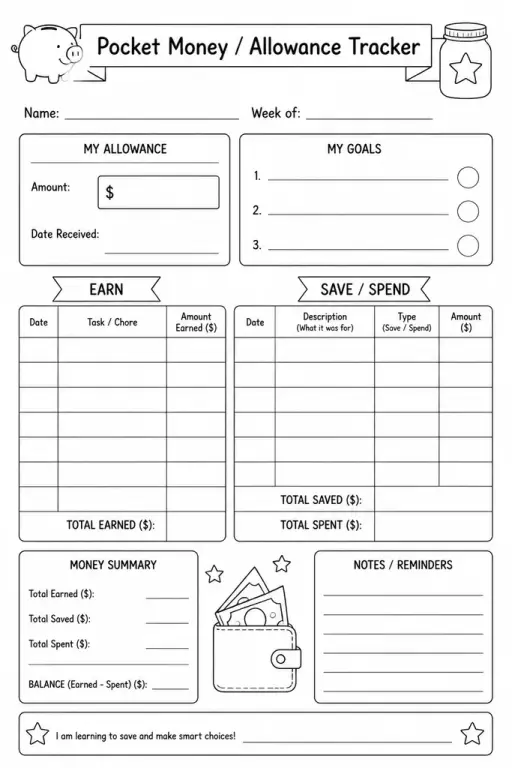
Pocket Money / Allowance Tracker
Parent & Home Printables
Ages 4–11
——
KiwiBee uses optional Google Analytics, Google Ads, and Meta Pixel cookies to understand adult visitors, measure completed sign-ups, and improve campaigns. Essential cookies always stay on. OpenAI’s ChatGPT Ads Pixel also measures page views and completed enquiries after advertising consent, and may use hashed contact details for matching. Privacy policy

This blank house-rules poster gives families a structured but fully customisable space to write down the values and expectations that matter most in their home. Rather than a list of don'ts, the template's open design encourages families to frame rules positively — 'We speak kindly', 'We help each other', 'We tell the truth' — creating a shared agreement that everyone helped create. Displaying the finished poster in a common area like the kitchen or hallway means house rules are never forgotten or disputed; they are simply there on the wall. The blank format works for families with toddlers who scribble their name at the bottom and families with teenagers who negotiate every line. Print one to draft together, then print a second clean copy for the final display version.
Four to six rules is the sweet spot for most families. Fewer than four can feel incomplete; more than eight is hard to remember, especially for young children.
Disagreement is part of the process. Try to find the underlying value you share (e.g. everyone agrees on respect, even if they phrase it differently) and write that instead.
Yes — families grow and circumstances shift. Print a fresh copy whenever the family agrees a rule no longer fits or a new one is needed.
Absolutely. Add a rule like 'Screens off at 8 pm on school nights' or use one line specifically for digital habits if that is a priority for your household.
See what other teachers think and share a helpful note.
Generate a fresh worksheet for any grade, topic and language. Free.
 Home
Home All solutions
 Pricing
 About us
 KiwiBee for Non-profits
 Events & webinars
 For big organisations
 For schools
 For centers
 For team leaders
 For teachers
 AI and resources
 Resources
 Printable worksheets
 Lesson Packs
 Interactive simulations
 Teacher tools
 AI studio
 Ideas and research