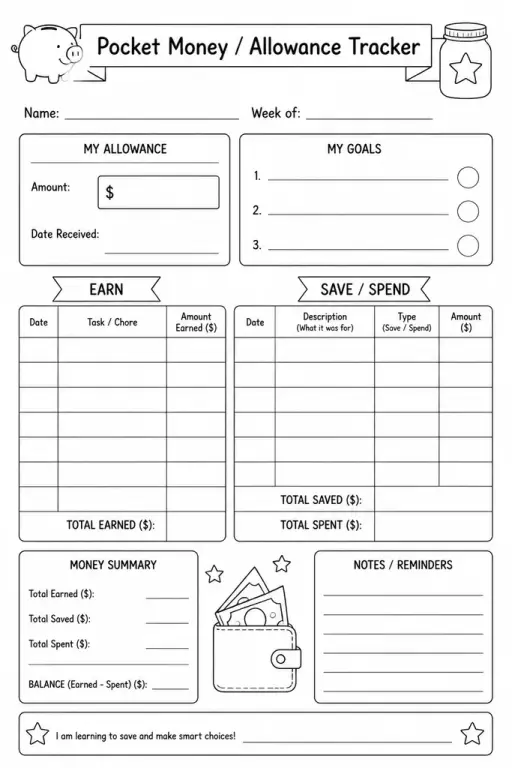
Pocket Money / Allowance Tracker
Parent & Home Printables
Ages 4–11
——
KiwiBee uses optional Google Analytics, Google Ads, and Meta Pixel cookies to understand adult visitors, measure completed sign-ups, and improve campaigns. Essential cookies always stay on. OpenAI’s ChatGPT Ads Pixel also measures page views and completed enquiries after advertising consent, and may use hashed contact details for matching. Privacy policy

The DIY Board Game Template is a blank track-and-squares game board that teachers, students, or parents can customise from scratch. The pre-drawn path of numbered squares — with a clear START and FINISH — removes the layout work so creators can focus entirely on the content: writing instructions, trivia questions, rewards, or penalties inside each square to match any topic being studied. Because the board design is neutral, it fits every subject and age group. A Year 2 teacher might create a phonics adventure trail, while a secondary student might design a geography trivia race. The template also makes an outstanding project-based learning activity: students research a topic, write game content, and assemble the game — combining writing, design thinking, and subject knowledge in one hands-on task.
Guided design works well from Grade 2 up. Younger students can contribute the content (drawing or dictating square ideas) while the teacher writes the final text. Independent design suits Grade 4 and above.
Most printable versions include 30–40 squares, which gives a 15–25 minute game with two dice. For shorter sessions with young children, use a version with 20 squares and a single die.
Folded paper tents, different-coloured erasers, coins, or small LEGO figures all work well. Students can also make their own pieces from folded card as part of the project.
Laminate the completed board to protect it from play wear. Write-on squares can be done in dry-erase marker for a fully reusable version with swappable content.
See what other teachers think and share a helpful note.
Generate a fresh worksheet for any grade, topic and language. Free.
 Home
Home All solutions
 Pricing
 About us
 KiwiBee for Non-profits
 Events & webinars
 For big organisations
 For schools
 For centers
 For team leaders
 For teachers
 AI and resources
 Resources
 Printable worksheets
 Lesson Packs
 Interactive simulations
 Teacher tools
 AI studio
 Ideas and research