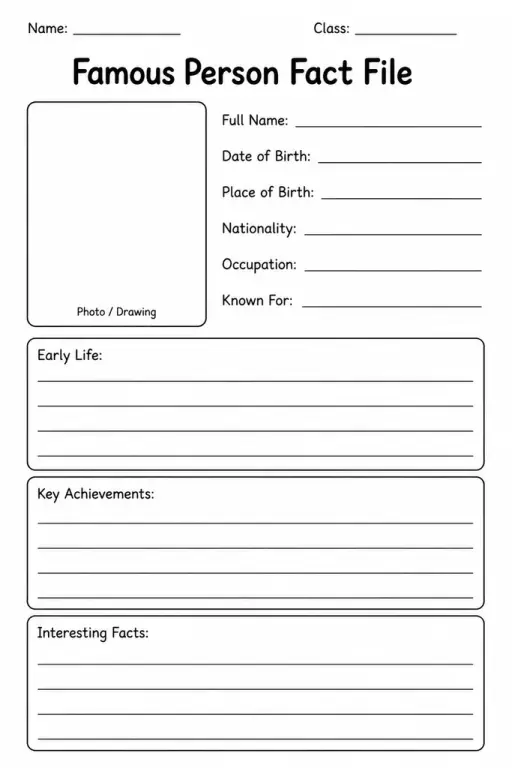
Famous Person Fact File
Social Studies Templates
Ages 4–11
——
KiwiBee uses optional Google Analytics, Google Ads, and Meta Pixel cookies to understand adult visitors, measure completed sign-ups, and improve campaigns. Essential cookies always stay on. OpenAI’s ChatGPT Ads Pixel also measures page views and completed enquiries after advertising consent, and may use hashed contact details for matching. Privacy policy

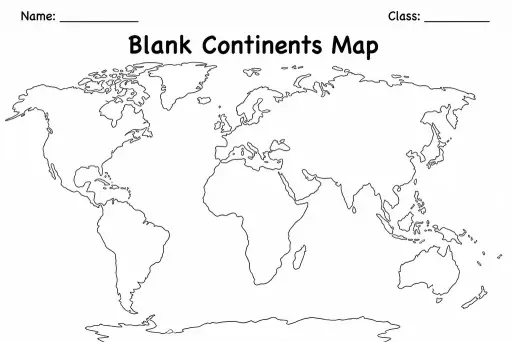
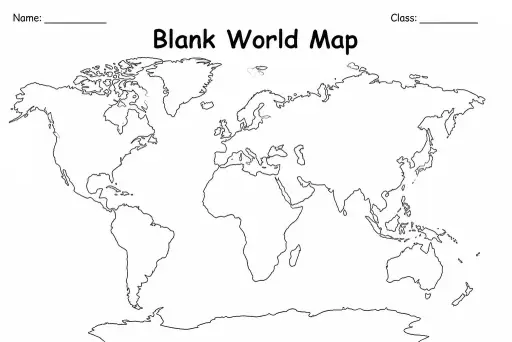
The Continents and Oceans (Blank) template is a clean outline world map with the seven continents and five oceans clearly shaped but unlabelled, giving students a ready surface for identification and labelling practice. Suited to grades 2 through 6, it removes the clutter of country borders and city names so learners can concentrate on the largest-scale geographical divisions of the Earth. A second grader can simply write the continent names with teacher guidance; a sixth grader can add ocean currents, trade routes, or climate zones as an extension task. The blank format makes it endlessly reusable across different units — one week it is a labelling exercise, the next a mapping quiz, and the week after a coloured reference poster.
It shows only the outer coastlines of each continent and the open ocean areas, with no internal country borders. This keeps the focus on macro-level geography.
A typical blank world map includes country outlines. This template intentionally omits them so students practise the foundational level of geographical knowledge — continents and oceans — before moving to nations and capitals.
This template is designed for five oceans: Pacific, Atlantic, Indian, Arctic, and Southern. Teachers who follow a four-ocean curriculum can simply leave the Southern Ocean box blank or combine it with Antarctic notes.
Yes. It is commonly used as a low-stakes quiz or exit ticket. Print on plain paper for written responses or laminate for a reusable self-checking centre activity.
See what other teachers think and share a helpful note.
Generate a fresh worksheet for any grade, topic and language. Free.
 Home
Home All solutions
 Pricing
 About us
 KiwiBee for Non-profits
 Events & webinars
 For big organisations
 For schools
 For centers
 For team leaders
 For teachers
 AI and resources
 Resources
 Printable worksheets
 Lesson Packs
 Interactive simulations
 Teacher tools
 AI studio
 Ideas and research