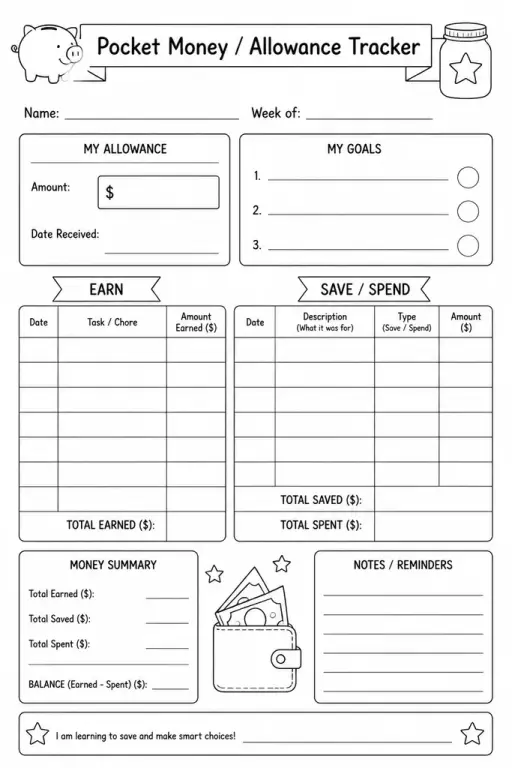
Pocket Money / Allowance Tracker
Parent & Home Printables
Ages 4–11
——
KiwiBee uses optional Google Analytics, Google Ads, and Meta Pixel cookies to understand adult visitors, measure completed sign-ups, and improve campaigns. Essential cookies always stay on. OpenAI’s ChatGPT Ads Pixel also measures page views and completed enquiries after advertising consent, and may use hashed contact details for matching. Privacy policy

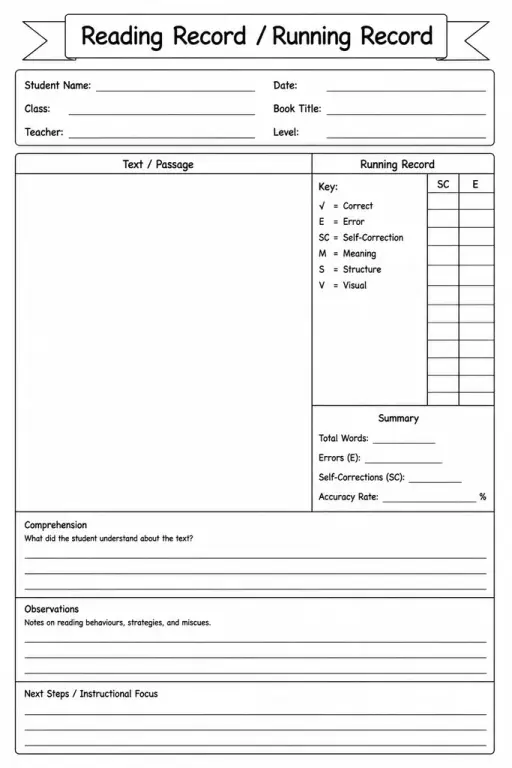
A class reading log is a blank shared record sheet that captures what the whole class—or individual students—has read over a set period. Unlike a personal reading diary, this template gives the teacher a bird's-eye view of reading activity across the group: book titles, authors, genres, dates started and finished, and a brief rating or response column that confirms genuine engagement rather than just page-turning. Teachers use it during independent reading blocks, home-reading programs, or whole-class novel studies. The format suits any grade level and can track picture books in a first-grade classroom just as effectively as chapter books or informational texts in upper elementary. Over a semester, a completed log becomes a portfolio artifact showing reading breadth, genre variety, and reading stamina across the class.
From about Grade 2 upward, students can manage their own log entries with brief teacher check-ins. In kindergarten and Grade 1, teachers or parents typically record the details after reading sessions.
Yes. Many teachers use a single log to capture both, with a simple 'H' or 'S' indicator in the source column to distinguish home reading from school reading. This gives a complete picture of a student's reading life.
Keep it brief—a five-star rating, a thumbs-up/thumbs-down, or a single sentence is enough for routine entries. The goal is a habit of reflection, not a full written review after every book.
Yes. A class reading log is a simple volume and engagement record, not an assessment instrument. It tracks what was read and a surface-level reaction, while formal assessments measure comprehension, fluency, and skill in depth.
See what other teachers think and share a helpful note.
Generate a fresh worksheet for any grade, topic and language. Free.
 Home
Home All solutions
 Pricing
 About us
 KiwiBee for Non-profits
 Events & webinars
 For big organisations
 For schools
 For centers
 For team leaders
 For teachers
 AI and resources
 Resources
 Printable worksheets
 Lesson Packs
 Interactive simulations
 Teacher tools
 AI studio
 Ideas and research