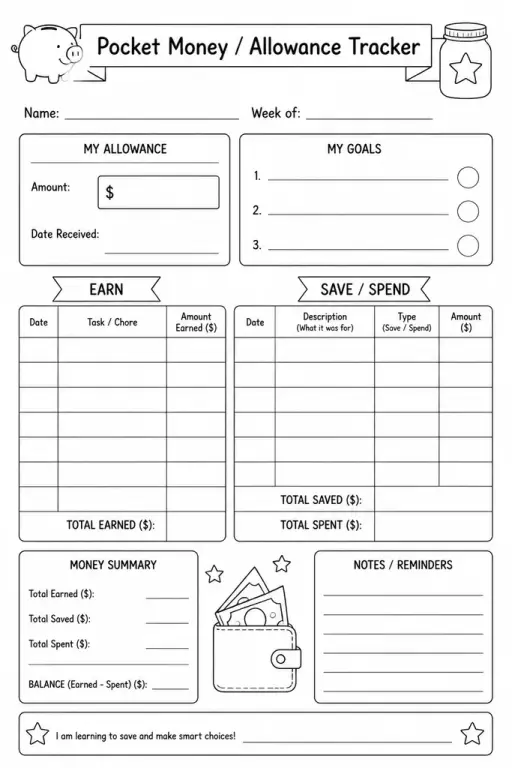
Pocket Money / Allowance Tracker
Parent & Home Printables
Ages 4–11
——
KiwiBee uses optional Google Analytics, Google Ads, and Meta Pixel cookies to understand adult visitors, measure completed sign-ups, and improve campaigns. Essential cookies always stay on. OpenAI’s ChatGPT Ads Pixel also measures page views and completed enquiries after advertising consent, and may use hashed contact details for matching. Privacy policy

The Choice Board / Learning Menu is a blank 3×3 grid template that teachers fill with nine different activity options, then hand to students who choose which tasks to complete. Unlike a fixed assignment, a choice board puts decision-making in the student's hands, boosting motivation and allowing for natural differentiation across readiness levels and learning styles. Teachers typically populate each cell with a different modality — write, draw, build, discuss, research — so every learner finds at least one entry point they are excited about. The blank grid works for any subject and any grade: vocabulary review, science inquiry extensions, reading response, math practice, or end-of-unit projects. Students can be asked to complete any three, all nine, or a teacher-selected row or column.
That is entirely up to you. Common structures are any three in a row (like tic-tac-toe), any five forming a cross, or any three of the student's choice. The blank template supports all formats.
Place simpler tasks toward the center cell and more complex ones toward the corners, or color-code cells by difficulty level before printing.
Yes. Print one board per student for independent work, or project it on the whiteboard and have table groups collectively choose which cells to tackle.
The template is a blank PDF you can annotate digitally — type activity descriptions into each cell using any PDF viewer, then print the completed board.
See what other teachers think and share a helpful note.
Generate a fresh worksheet for any grade, topic and language. Free.
 Home
Home All solutions
 Pricing
 About us
 KiwiBee for Non-profits
 Events & webinars
 For big organisations
 For schools
 For centers
 For team leaders
 For teachers
 AI and resources
 Resources
 Printable worksheets
 Lesson Packs
 Interactive simulations
 Teacher tools
 AI studio
 Ideas and research