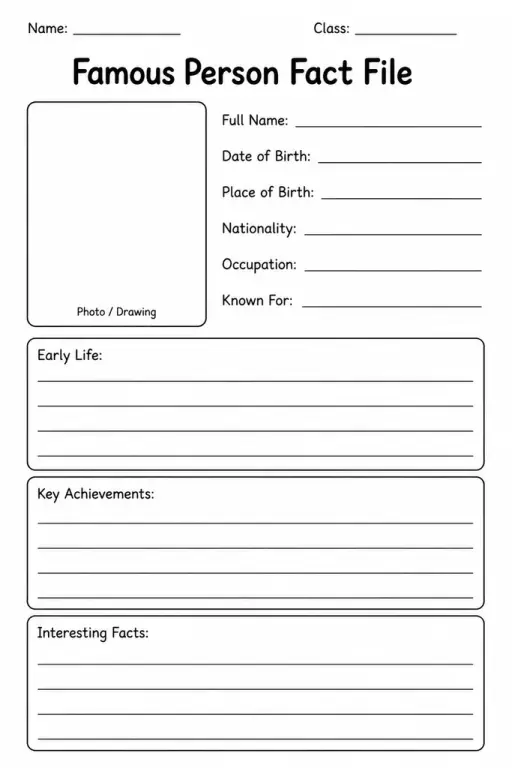
Famous Person Fact File
Social Studies Templates
Ages 4–11
——
KiwiBee uses optional Google Analytics, Google Ads, and Meta Pixel cookies to understand adult visitors, measure completed sign-ups, and improve campaigns. Essential cookies always stay on. OpenAI’s ChatGPT Ads Pixel also measures page views and completed enquiries after advertising consent, and may use hashed contact details for matching. Privacy policy

The Cause and Consequence (History) template is a blank event-to-consequences graphic organiser built for history students in grades 4–8. At its centre sits an empty event box; branching arrows lead outward to short-term and long-term consequence boxes, while a separate causes column feeds into the event from the left. This structure helps students move beyond memorising dates to actually thinking historically—identifying why something happened and what changed as a result. Teachers deploy it during units on wars, revolutions, migrations, inventions, or any turning point where causation matters. It is equally useful as a guided note-taking frame during a lesson or as an independent analysis task after reading a source. The blank format means it works for any period, civilisation, or event without adaptation.
For grade 4, pre-fill the central event box and supply a word bank of causes and consequences for students to sort into the correct columns—this reduces cognitive load while maintaining the analytical structure.
The blank consequence boxes are intentionally open so teachers can instruct students to colour-code by significance, add a 1–5 rating, or write a brief justification sentence below each box.
Yes. Print as a PDF and open in any annotation app—students can type or handwrite directly into the boxes on screen.
It is ideal for source work. Students cite the specific source evidence (e.g. 'Source B states…') inside each cause or consequence box, reinforcing the habit of evidencing historical claims.
See what other teachers think and share a helpful note.
Generate a fresh worksheet for any grade, topic and language. Free.
 Home
Home All solutions
 Pricing
 About us
 KiwiBee for Non-profits
 Events & webinars
 For big organisations
 For schools
 For centers
 For team leaders
 For teachers
 AI and resources
 Resources
 Printable worksheets
 Lesson Packs
 Interactive simulations
 Teacher tools
 AI studio
 Ideas and research