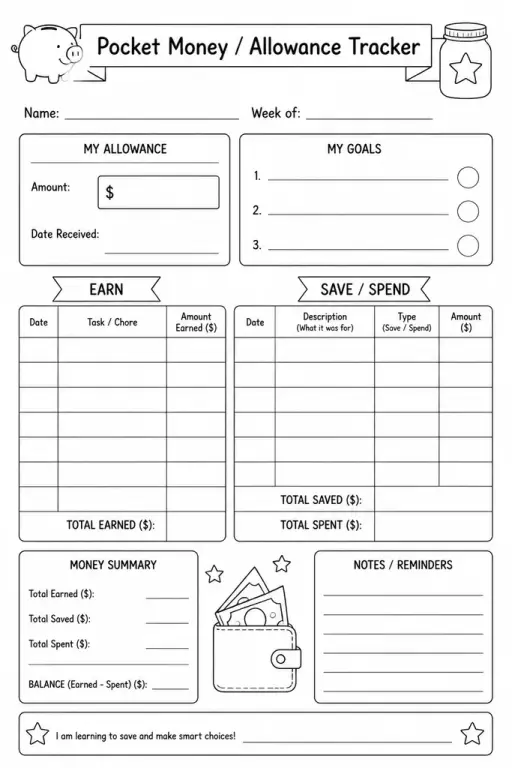
Pocket Money / Allowance Tracker
Parent & Home Printables
Ages 4–11
——
KiwiBee uses optional Google Analytics, Google Ads, and Meta Pixel cookies to understand adult visitors, measure completed sign-ups, and improve campaigns. Essential cookies always stay on. OpenAI’s ChatGPT Ads Pixel also measures page views and completed enquiries after advertising consent, and may use hashed contact details for matching. Privacy policy

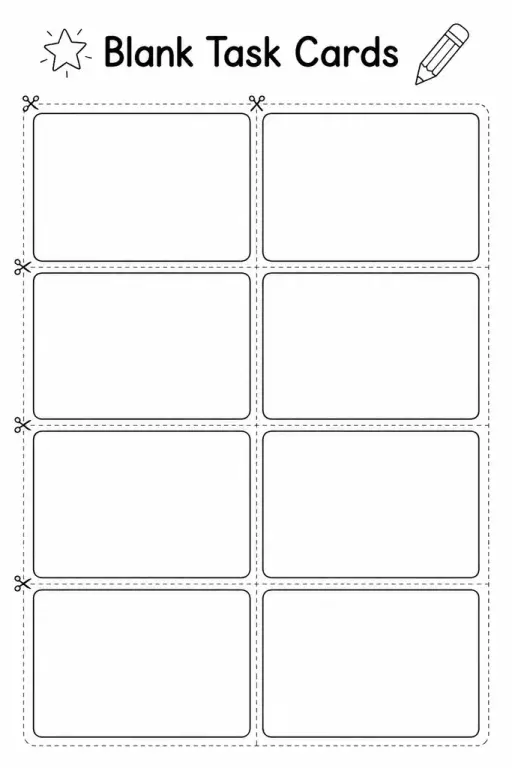
A set of blank printable cards sized for easy handling, each ready to have a short movement or mindfulness activity written directly onto it. Teachers fill them in with whatever works best for their class — jumping jacks, a breathing exercise, a stretch sequence, a silly dance, or a quick riddle — then shuffle the deck and draw one whenever the room needs a reset. Brain breaks improve focus and reduce restlessness by giving the body and mind a short, purposeful pause between cognitively demanding tasks. These blank cards are deliberately simple: no clip art, no prescribed activities, just clean card-sized rectangles that print eight to a sheet. Cut apart and laminated, they last a full school year and can be added to or swapped out any time.
The template fits eight cards per A4 or letter sheet. Print as many sheets as you need — most teachers build a deck of 20–30 cards to keep variety high.
Animal walks (bear crawl, frog hop), freeze-dance, finger stretches, and ten slow breaths all work brilliantly with Kindergarten through Grade 2 students who need big, simple movements.
Yes, and it is highly recommended. Students who invent and illustrate their own cards are more engaged when that card is drawn, and it builds a sense of class community around the routine.
Two to four minutes is the research-supported sweet spot — long enough to shift blood flow and reset attention, short enough to transition back to learning without losing momentum.
See what other teachers think and share a helpful note.
Generate a fresh worksheet for any grade, topic and language. Free.
 Home
Home All solutions
 Pricing
 About us
 KiwiBee for Non-profits
 Events & webinars
 For big organisations
 For schools
 For centers
 For team leaders
 For teachers
 AI and resources
 Resources
 Printable worksheets
 Lesson Packs
 Interactive simulations
 Teacher tools
 AI studio
 Ideas and research