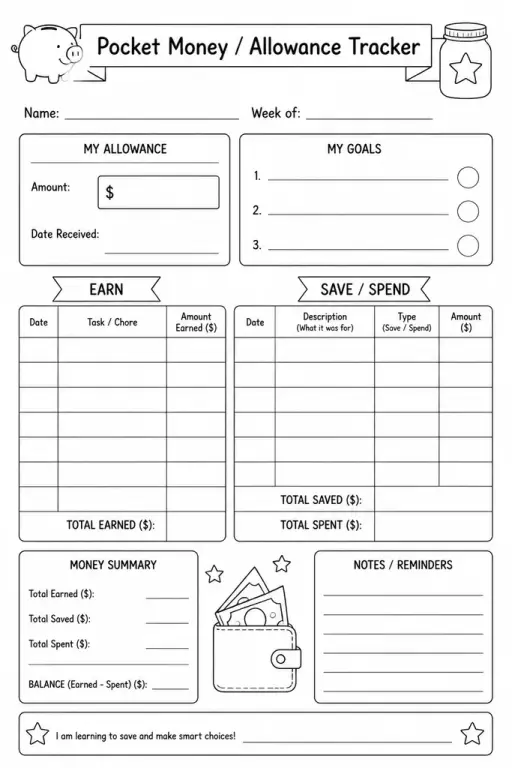
Pocket Money / Allowance Tracker
Parent & Home Printables
Ages 4–11
——
KiwiBee uses optional Google Analytics, Google Ads, and Meta Pixel cookies to understand adult visitors, measure completed sign-ups, and improve campaigns. Essential cookies always stay on. OpenAI’s ChatGPT Ads Pixel also measures page views and completed enquiries after advertising consent, and may use hashed contact details for matching. Privacy policy

A Backward-Design (UbD) Template is a three-stage planning frame drawn from Wiggins and McTighe's Understanding by Design framework. Instead of starting with activities, the teacher begins by defining the desired results — the enduring understandings and essential questions students should take away — then identifies acceptable evidence of learning, and only then plans the learning experiences that will lead students there. The blank template structures this reverse-engineering process with clearly labelled stages so every planning decision is tied back to the ultimate goal. Curriculum coordinators use it for unit design; individual teachers use it for lesson sequences; instructional coaches use it in professional learning workshops. Because the frame is subject-neutral and grade-independent, it works equally well for a Year 1 science unit, a high-school literature study, or a cross-curricular inquiry project. The disciplined structure it imposes consistently reduces the 'coverage trap' of activity-focused planning.
A basic understanding helps, but the labelled stages and prompt questions on the template guide even first-time users through the backward-design thinking process.
Yes, though the framework adds the most value for multi-lesson units. For a single lesson you can treat Stage 1 as the lesson objective and Stage 2 as an exit task.
It is particularly well suited to cross-curricular design because the enduring understandings section invites big ideas that naturally span subject boundaries.
Map the mandated content standards into Stage 1 alongside your enduring understandings. The process helps you identify which standards require deep understanding and which only need coverage.
See what other teachers think and share a helpful note.
Generate a fresh worksheet for any grade, topic and language. Free.
 Home
Home All solutions
 Pricing
 About us
 KiwiBee for Non-profits
 Events & webinars
 For big organisations
 For schools
 For centers
 For team leaders
 For teachers
 AI and resources
 Resources
 Printable worksheets
 Lesson Packs
 Interactive simulations
 Teacher tools
 AI studio
 Ideas and research