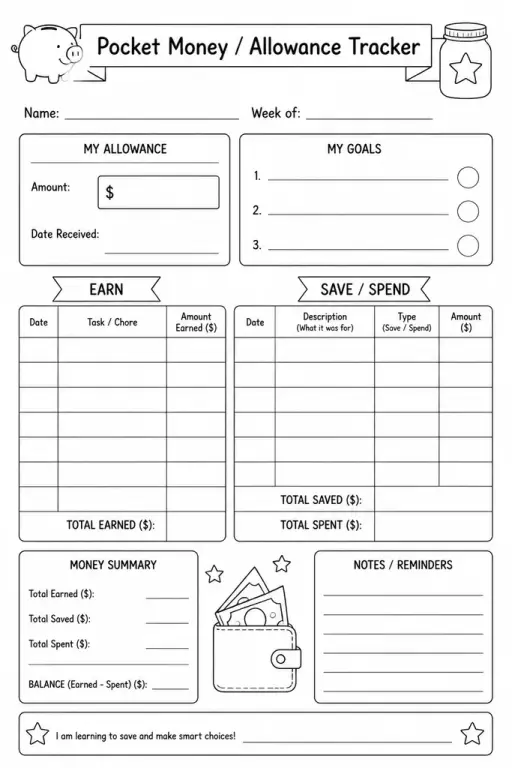
Pocket Money / Allowance Tracker
Parent & Home Printables
Ages 4–11
——
KiwiBee uses optional Google Analytics, Google Ads, and Meta Pixel cookies to understand adult visitors, measure completed sign-ups, and improve campaigns. Essential cookies always stay on. OpenAI’s ChatGPT Ads Pixel also measures page views and completed enquiries after advertising consent, and may use hashed contact details for matching. Privacy policy

The Assessment Tracker (RAG) is a blank red-amber-green progress grid that turns a class-worth of assessment data into an instant colour-coded overview. Each cell in the grid represents one pupil against one objective or assessment point; the teacher shades or writes R, A, or G to indicate whether the learner is below, approaching, or meeting the expected standard. The RAG system is language-neutral and works at a glance, making it a favourite for department meetings, pupil progress reviews, and SLT data conversations. Because the template is entirely blank, it is equally at home tracking end-of-unit quiz results in Year 2, GCSE mock grades across a tutor group, or termly assessment milestones for a Reception class. No software or spreadsheet skill is required — just a grid, three colours, and a pen.
The definitions are yours to set, but a common convention is: Red = below expected standard and at risk of falling further behind; Amber = approaching expected standard with some gaps; Green = meeting or exceeding expected standard.
Yes. Print one tracker per class and line them up to see patterns across year groups. The blank format means it scales from a five-pupil intervention group to a 200-pupil year cohort.
The template itself contains no personal data until you fill it in. Once completed with pupil names, apply your school's data-handling policy — store securely, do not leave unattended, and anonymise before sharing beyond your team.
A mastery checklist typically uses tick or date to record skill attainment. The RAG tracker adds a third, provisional state (Amber) that captures emerging understanding — useful for ongoing assessment rather than binary mastery judgements.
See what other teachers think and share a helpful note.
Generate a fresh worksheet for any grade, topic and language. Free.
 Home
Home All solutions
 Pricing
 About us
 KiwiBee for Non-profits
 Events & webinars
 For big organisations
 For schools
 For centers
 For team leaders
 For teachers
 AI and resources
 Resources
 Printable worksheets
 Lesson Packs
 Interactive simulations
 Teacher tools
 AI studio
 Ideas and research