Do Team Work Activities Actually Work?
Evidence-based strategies to make group work truly collaborative and hold every student accountable.
 By KiwiBee· KiwiBee
Last updated May 26, 2026
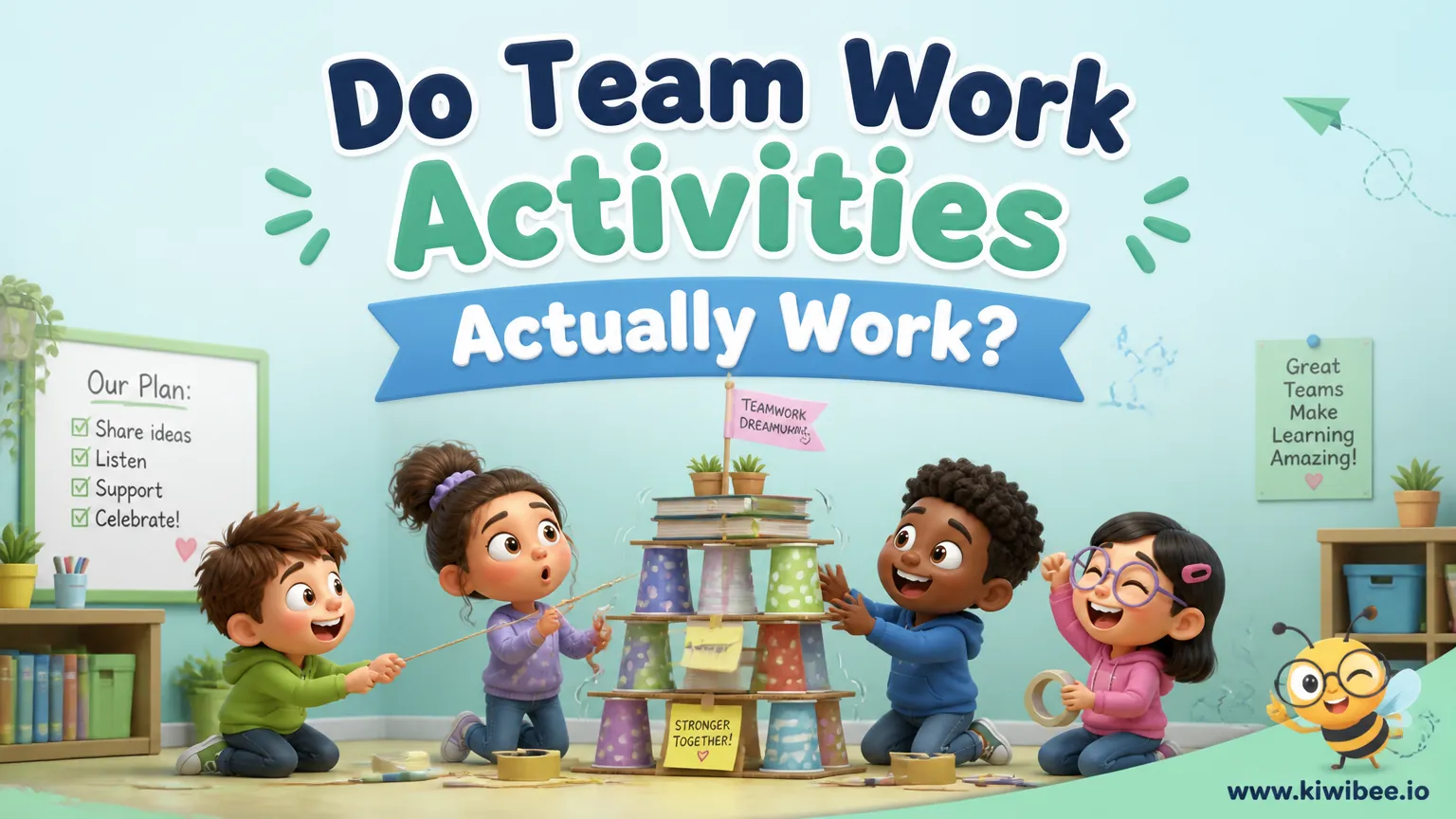
The honest question I should have asked sooner: does group work actually produce group work?
I have been assigning group work for over a decade. For most of those years I assumed it was working — kids in groups, work happening, projects produced. Then one term I sat down and analysed who actually contributed to each group project. The results were uncomfortable. Most of what I was calling 'group work' was four individual contributions stapled together, with one or two students doing the heavy lifting and the rest free-riding. Here is what I changed, and what I now believe about team work in classrooms.
What 'teamwork' often actually is
Watch any unfacilitated group project. Within five minutes the group has self-organised into roles: one or two leaders who actually do the work, one or two coordinators who delegate (but do not contribute), and one or two passengers who collect the credit. The work product looks like a group product, but its components are mostly individual contributions glued together at the end. The actual collaborative effort — the meeting-of-minds where ideas build on each other — is rare.
This is not the kids' fault. It is the default outcome when you put humans into a group with no design pressure forcing real collaboration. Unless I deliberately structure the activity to require interdependence, the group will atomise.
Three structural changes that fixed it for me
Change 1: jigsaw the inputs. Each member of the group is given a different piece of the puzzle — different sources, different texts, different parts of the problem. None of them can solve the task alone. They are forced to teach each other, then synthesise. The group cannot atomise because the work physically cannot be done alone.
Change 2: role rotation within the task. Each group has a facilitator, a recorder, a checker, and a presenter — and these roles rotate every five minutes. The leader cannot just lead; she has to also be the recorder for a stretch, the checker for a stretch. The kids who would free-ride get caught the moment it is their turn to be checker.
Change 3: individual accountability inside the group grade. Every group project has both a group grade (the final product) and individual grades (each member's contribution). I track contribution through observation, peer evaluations, and — increasingly — through the digital trail of who edited what in the shared document. The free-rider strategy stops working once it has individual consequences.
Tracking who is actually contributing
This is the part most teachers skip because it is hard to do well. My current approach: at the end of each group session, every student fills in a short reflection — what I contributed, what my group did well, what we struggled with. I cross-reference reflections against each other (the kid who claims he did everything while three teammates say he did nothing is visible immediately) and against my own observation log.
The technology layer made this practical. ClassSpark lets me award points to individual students for collaboration behaviours observed during the group work — Leadership, Helping Others, On Task — without disrupting the activity. Insights dashboards show me which kids are consistently scoring high on collaboration and which are consistently slipping, which is the data I use for group composition the next time. And the class shop gives me a low-stakes reward for the kid who has been doing the unglamorous coordination work that the group grade alone would never recognise.
What I tell parents at conferences
When a parent asks me whether group work is just individual work in disguise, I now answer honestly: it depends entirely on how the group work is designed. Badly-designed group work is individual work; well-designed group work teaches collaboration skills that no individual task can. The difference is in the structural design choices, not in whether the activity is labelled 'group work' on the lesson plan.
Does teamwork work?
Yes — but only if I am willing to engineer the conditions where actual collaboration is required, individual contributions are visible, and free-riding has costs. Without those three, what I am running is parallel individual work labelled as a team activity. With those three, group work develops skills that the same kids working alone would never develop.
The teacher's design effort is the entire variable. The platform helps with tracking and reward, but the design has to come from me.
Where this fits in KiwiBee
If you want team work that's measurable, KiwiBee adds ClassSpark for team-level points and goals, Insights dashboards for collaboration trends, and a class shop with team rewards. Try it free at app.kiwibee.io.
Explore the platform
Continue with KiwiBee
Choose the KiwiBee workspace or resource library that fits what you need next.
Related posts
Pair Work for English Classes: Primary Level Activities
Practical pair work activities for primary English classes using word mats, dice games, spinners, and Snakes and Ladders to build speaking and vocabulary skills.
Classroom management strategies that actually work in 2026
Forget the Pinterest boards. These classroom management strategies come from real teachers who tested, failed, iterated, and finally found what works in modern classrooms.
Top Warm-Up Activities for the Classroom
Explore video, image, question, and brainstorming warm-ups that activate prior knowledge and set the tone for engaged learning.
 For big organisations
 For schools
 For centers
 For team leaders
 For teachers
 AI and resources
 Printable worksheets
 Teacher tools
 AI studio
 Ideas and research