Top Warm-Up Activities for the Classroom
Four proven warm-up strategies to hook students in the first five minutes of any lesson.
 By KiwiBee· KiwiBee
Last updated May 26, 2026
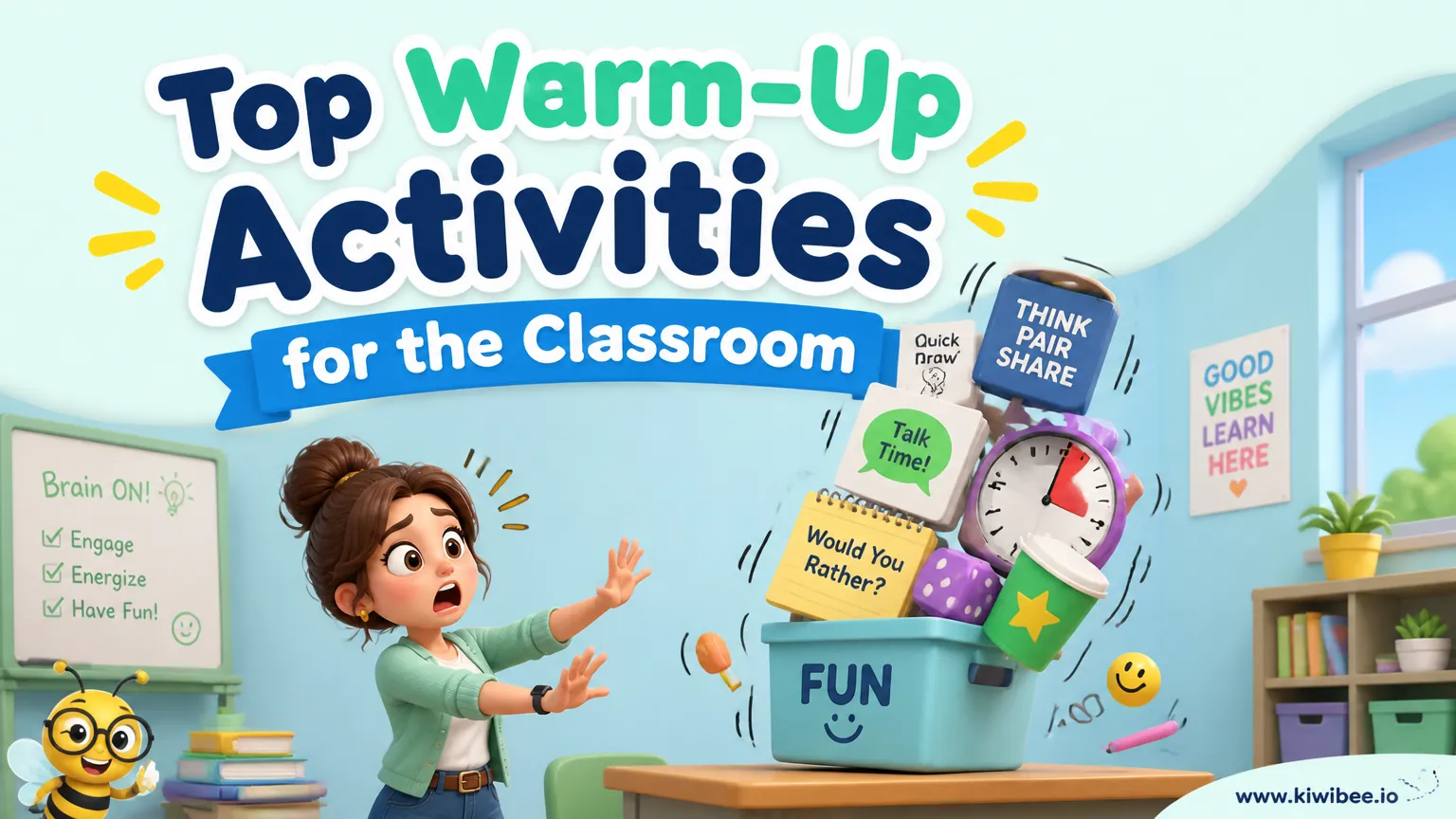
Four warm-ups that take 30 seconds to set up and actually work
I have tried every warm-up format I have ever seen in a teaching book. After cycling through every elaborate framework, I have come back to four formats that I use, in rotation, across almost every lesson. They are deliberately simple — the warm-up is not the lesson, and any minute I spend setting it up is a minute I lose from teaching.
1. Video
Open the lesson with a 60-second video clip related to the topic. Could be a news headline, a short documentary clip, a movie scene, or a YouTube short. The kids watch, then I ask one open question: 'What did you notice?' Energy in the room shifts immediately because the lesson started with motion and sound rather than my voice.
Variation: play the clip with the sound off and have students predict what is being said. Especially powerful for language classes.
2. Image
Project one image — a photograph, a painting, a graph, a meme, a cartoon. Ask the kids: what do you see? what does this make you think? how does this connect to the topic we are starting? The simplicity is the point. Any decent image will pull a quiet class into talking within 90 seconds.
For language teaching, image warm-ups double as vocabulary primers. For history, they prime the period. For science, they raise the question we are about to answer.
3. Question
One good open question, projected on the board before students enter the room. 'What is the difference between a leader and a manager?' 'If you could only save one ecosystem, which?' 'What is something everyone knows that you think is wrong?' The students do not need to know the answer — they need to be curious. A good warm-up question is the curiosity-shaped hole the lesson will fill.
4. Brainstorming
Give the class a topic or a problem. 'Two minutes — write down every reason a city might run out of water.' 'Two minutes — every example of figurative language you can think of.' No judgement, no editing, just generate. Then I collect the best three on the board and we go.
Mixing the four
My rule: never the same format two days in a row. Monday could be a question, Tuesday an image, Wednesday a video, Thursday brainstorming, Friday back to a question. The variety alone keeps the routine from feeling like a routine.
Where this got easier: I now stage all my warm-ups inside KiwiBee's lesson planner, which suggests warm-up formats based on the unit. The image library, video links, and brainstorming prompts attach to the lesson card itself. I do not have to remember which warm-up I used last week — the planner does. Participation points for warm-up wins feed back into ClassSpark, which means the warm-up doubles as an attendance-and-engagement signal for the start of class.
The one thing that matters more than the format
Whichever warm-up I use, the rule is the same: keep it under five minutes. The warm-up is not the lesson. If it runs long, it eats the part of class where the actual learning happens. I set a visible timer every single time.
Where this fits in KiwiBee
If you want warm-ups that take 30 seconds to set up, KiwiBee adds Wordwall-style games tied to today's lesson, ClassSpark points for warm-up wins, and a free worksheet generator for printable warm-ups. Try it free at app.kiwibee.io.
Explore the platform
Continue with KiwiBee
Choose the KiwiBee workspace or resource library that fits what you need next.
Related posts
Warm-Up Activities: A Kaleidoscope of Options
Go beyond the basics with image-based prompts, critical thinking questions, brainstorming games, Wordwall activities, and Total Physical Response warm-ups.
Top Brain Break Activities for the Classroom
Discover three of the most effective brain break activities teachers use to reset student energy, improve focus, and make learning fun throughout the school day.
The first 10 minutes of class: calm vs chaos
The first 10 minutes set the tone. Here's how to make them calm, structured, and productive — every single day.
 For big organisations
 For schools
 For centers
 For team leaders
 For teachers
 AI and resources
 Printable worksheets
 Teacher tools
 AI studio
 Ideas and research