
Fraction Pie Cutter
- Math
Comments
Related to this simulation
Picked by meaning from games, worksheets, simulations, teacher tools and videos.
About this simulation
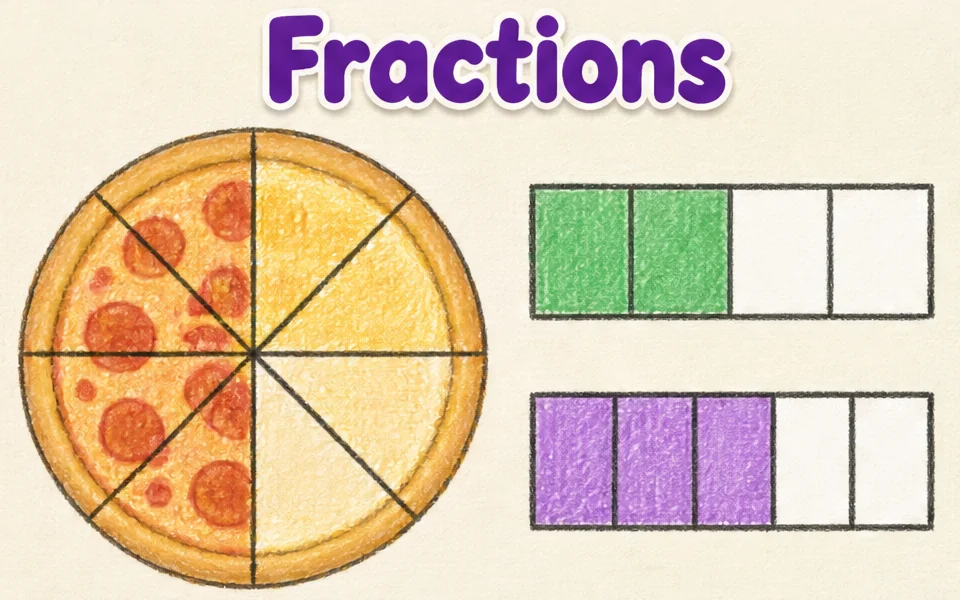
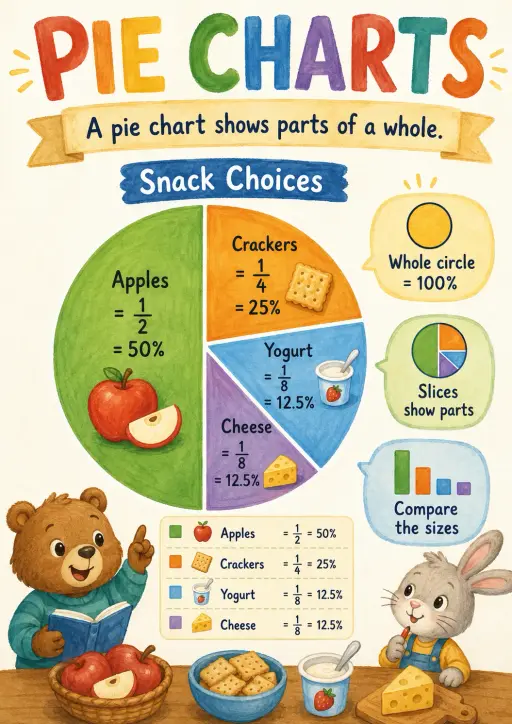
Fraction Pie Cutter shows Pie A and Pie B, each divided into equal slices from 1 to 12. Students click a number tile to choose how many slices, then click slices to shade them. Readouts give each fraction with its decimal and percent, say which is bigger, and tell whether the two are equivalent. A Make B equal A button finds a matching fraction, and a toggle hides or shows percents on the pies. It helps children see why 1/2 and 4/8 are the same amount and makes comparing fractions concrete.
What students can explore
- Click the 4 tile on Pie A, shade two slices, then click 8 on Pie B and shade four slices to compare.
- Read the Compare and Equivalent readouts to see whether your two fractions are equal.
- Press Make B equal A and notice how many slices Pie B uses to match.
- Shade one slice on each pie with different slice counts and decide which fraction is larger.
- Turn Percent on pies off, predict the percent, then turn it on to check.
Learning objectives
- 1Represent a fraction as shaded equal slices of a whole.
- 2Compare two fractions with unlike denominators using the pies.
- 3Identify equivalent fractions such as 1/2, 2/4 and 4/8.
- 4Convert a fraction to a decimal and a percent.
Questions teachers ask
Is it free?
Yes, it costs nothing and needs no account. Open it in any current browser on a whiteboard, tablet, Chromebook or phone and it just works.
Why are 1/2 and 2/4 equal?
Cutting each half into two smaller slices gives the same amount of pie in more pieces. Multiplying top and bottom by the same number never changes the amount, only the slice size.
How do I compare fractions with it?
Cut Pie A and Pie B into different slice counts, shade each fraction, and read the Compare readout. Students should predict the answer first and then use the shading to explain it.
What is the maximum number of slices?
Each pie can be cut into anywhere from 1 to 12 equal slices, so halves, thirds, quarters, sixths, eighths, tenths and twelfths are all available.
Embed this simulation
Drop it into your LMS, blog, or class site — free.
<iframe src="https://kiwibee.io/en/simulations/fraction-pie-cutter-3d-simulation/embed" title="Fraction Pie Cutter | KiwiBee" loading="lazy" allowfullscreen style="width:100%;height:min(70vh,620px);min-height:420px;border:0;border-radius:16px"></iframe>Curriculum standards
Cambridge
- 4Nf.01Understand that the more parts a whole is divided into, the smaller the parts becomeCambridge Primary Mathematics (0096) — Stage 4 › Number › Fractions, decimals, percentages, ratio and proportion
- 4Nf.04Recognise that two proper fractions can have an equivalent valueCambridge Primary Mathematics (0096) — Stage 4 › Number › Fractions, decimals, percentages, ratio and proportion
Learning objectives © UCLES (Cambridge University Press & Assessment), quoted with attribution.
Bring interactive science into your classroom
KiwiBee's free teacher workspace brings lesson planning, worksheets, classroom tools, and gradebook together in one place.
Start free and create your first classWatch KiwiBee on YouTube
Short KiwiBee videos for teachers and schools. Subscribe, or follow KiwiBee wherever you are.
 Home
 All solutions
 Pricing
 About us
 KiwiBee for Non-profits
 Events & webinars
 For big organisations
 For schools
 For centers
 For team leaders
 For teachers
 Resources
 Printable worksheets
 Interactive simulations
 Teacher tools
 Ideas and research


