Leading Student AI Ethics Roundtables
A ready-to-run classroom protocol for structured, evidence-aware discussion about AI use, risk, and responsibility
 By KiwiBee· KiwiBee
Last updated July 11, 2026
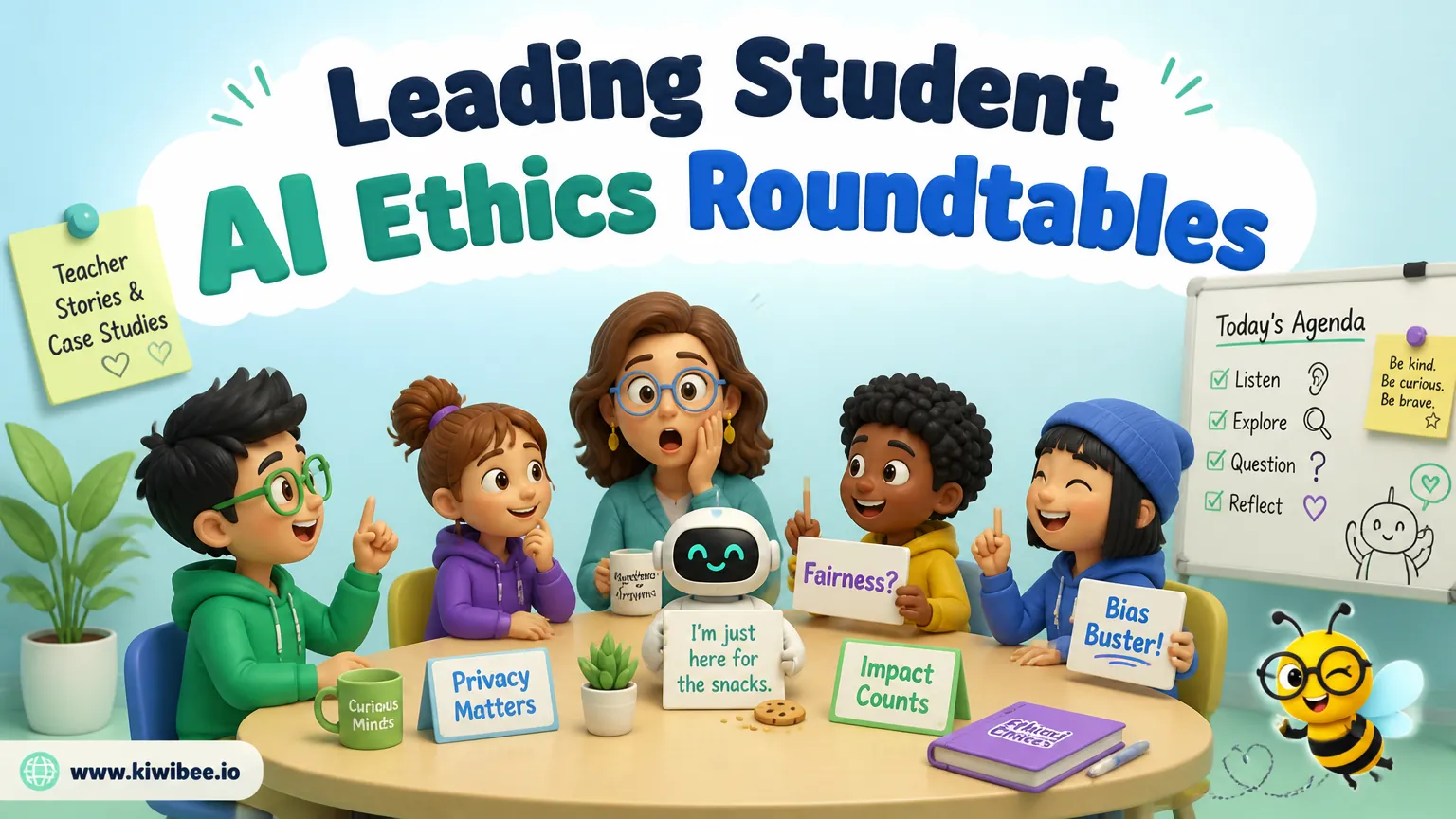
Student discussions about AI can become shallow very quickly if the task is simply to decide whether a tool is “good” or “bad.” A stronger approach is to slow the conversation down and give students a structure for examining who is affected, what evidence is available, where uncertainty remains, and who is accountable for the consequences.
A roundtable format works well because it asks students to listen, test assumptions, and consider trade-offs without pushing them toward a predetermined conclusion. That approach aligns with current guidance that emphasizes human-centred AI use, data privacy, ethical validation, and careful pedagogical design.
This protocol is designed for teachers who want a practical lesson or advisory routine. It includes neutral scenario cards, stakeholder mapping, evidence questions, privacy and bias prompts, speaking roles, and an exit reflection that helps students name what they still need to learn.
What the roundtable is for
A student AI ethics roundtable is not a debate in which one side must win. Its purpose is to help students reason carefully about an AI-related decision, practice responsible discussion, and recognise that ethical questions often involve incomplete information.
A useful roundtable keeps the focus on people, systems, and consequences. Students should examine affected groups, the quality of evidence, uncertainty, accountability, privacy, bias, access, and realistic alternatives. This mirrors the broad areas highlighted in UNESCO’s student AI competency framework, which spans human-centred thinking, ethics, applications, and design across stages of understanding, applying, and creating.
If your school already has guidance on approved tools, data protection, coursework, or safeguarding, use the roundtable to help students interpret those expectations in concrete situations. Do not treat the discussion as a replacement for school policy.
- Goal: deepen reasoning, not force consensus
- Focus: people affected, evidence, uncertainty, and consequences
- Boundary: school policy and local requirements still apply
Preparation before the lesson
Choose one to three scenarios that are relevant to your students’ age and context. Keep them neutral. The card should describe the situation clearly without signalling the “right” answer.
Plan for age-appropriate discussion. UNESCO’s guidance stresses human-centred use and pedagogical design, so simplify the language for younger students and increase complexity for older students by adding conflicting priorities or uncertain evidence.
If the discussion touches coursework, make time to explain your school’s expectations explicitly. Ofqual’s 2026 coursework resources encourage consistent school-wide messages, open discussion of grey areas, and clear consequences for undisclosed AI-generated coursework.
- Print one scenario card per group
- Prepare a stakeholder map template
- Prepare an evidence-and-uncertainty prompt sheet
- Decide speaking roles in advance
- Set aside time for exit reflection
Neutral scenario cards you can use
Each card should present a real-world style dilemma without steering students toward approval or rejection. Students then evaluate the situation using the protocol below.
You can adapt the wording to suit subject lessons, tutor time, digital literacy, or staff-student forums.
- Coursework support: A student uses a generative AI tool to help plan an essay, rewrite sentences, and suggest examples. The final submission is turned in as the student’s own work. What questions should the school ask before deciding whether this use was fair,
- Attendance support: A school considers using an AI system to flag students who may be at risk of low attendance so staff can intervene earlier. What benefits, risks, and safeguards should be considered?
- Translation and access: A class uses AI translation and summarising tools to support multilingual learners and students who need reading support. Where could this improve access, and where could it create new problems?
- Feedback drafting: A teacher uses an AI tool to draft feedback comments before reviewing and editing them. What responsibilities remain with the teacher, and what data protection questions should be asked?
- Image or media generation: Students use an AI tool to create campaign posters for a school project. How should the class think about originality, representation, accuracy, and disclosure?
Step 1: Start with norms and roles
Open by explaining that the task is to investigate the issue, not rush to a verdict. Students should expect disagreement, revision of ideas, and some uncertainty at the end.
Assign clear speaking roles so the conversation does not depend only on confident volunteers. Roles help make participation more even and make the discussion feel purposeful rather than performative.
- Facilitator: reads prompts, keeps the group on task, and invites quieter voices in
- Stakeholder mapper: records who is affected and how
- Evidence checker: asks what is known, what is assumed, and what is missing
- Privacy and bias monitor: listens for data protection, fairness, and access concerns
- Summariser: prepares the group’s final position and remaining questions
Step 2: Map the stakeholders before judging the tool
Before students discuss whether the AI use is acceptable, ask them to identify everyone affected. This prevents the conversation from narrowing too quickly to the immediate user of the tool.
Students should note both direct and indirect effects. A system may help one group while creating risk or extra workload for another.
- Who is using the AI system?
- Who is affected by its outputs or decisions?
- Who may benefit?
- Who may be overlooked or disadvantaged?
- Who is responsible if something goes wrong?
- Who should be told that AI is being used?
Step 3: Test the evidence and name the uncertainty
Once stakeholders are visible, move to evidence. Students should distinguish between a claim, an example, and evidence strong enough to support a decision. They also need practice admitting when they do not know enough yet.
This matters because AI discussions often become overconfident. A careful roundtable helps students ask what information would actually be needed before recommending adoption, restriction, or closer monitoring.
- What facts do we actually have in this scenario?
- What are we assuming?
- What evidence would we want before making a school decision?
- How might the system be tested or checked?
- What could be hard to measure?
- What uncertainty remains even after discussion?
Step 4: Use privacy, bias, access, and accountability prompts
This stage turns the conversation from general opinion into ethical analysis. UNESCO’s guidance highlights data privacy protection and ethical validation, and current UK education materials also emphasise safe use and staff and student understanding of how personal data are processed.
Students do not need legal conclusions. They do need practice spotting where privacy, fairness, or responsibility questions should be raised.
- Privacy: What personal data might be entered, collected, stored, or inferred? Do users understand how their data are processed?
- Bias and fairness: Could some groups be misrepresented, disadvantaged, or judged inaccurately? Who would notice if that happened?
- Access: Would this tool help some students more than others? Could it widen gaps in access, confidence, or support?
- Accountability: Who remains responsible for the final decision, feedback, grade, or action?
- Transparency: Should students, families, or staff be told when AI is used? What should be disclosed?
- Alternatives: Is AI the best option here, or could a non-AI approach address the same need more safely or fairly?
Step 5: Discuss coursework and grey areas explicitly
If a scenario involves homework, drafting, feedback, or assessed work, address the grey areas directly instead of avoiding them. Ofqual’s March 2026 resources encourage schools to use consistent messages, make room for explicit discussion of uncertainty, and be clear about consequences where AI-generated coursework is undisclosed.
A good roundtable question is not simply “Is this cheating?” but “What kind of help is this, what must be disclosed, and how would students know the boundary?” That helps students connect ethical reasoning to real school expectations.
- What kind of assistance is the AI providing?
- At what point does support become authorship or substitution?
- What would need to be acknowledged or disclosed?
- How could the school explain this boundary clearly and consistently?
- What consequence would be fair if the boundary were ignored?
Finish with a short written reflection
End with an individual exit reflection rather than a public vote. A written reflection captures thinking more accurately, reduces pressure to conform, and helps students recognise that responsible judgement may include unresolved questions.
A simple prompt set works well: What is your current view? Who is most affected? What is one privacy, fairness, or accountability concern that matters here? What evidence is still missing? What alternative, safeguard, or policy would you suggest before this use goes ahead? Teachers can then review responses to identify misconceptions, policy confusion, or themes for future lessons.
Sources and further reading
Explore the platform
Continue with KiwiBee
Choose the KiwiBee workspace or resource library that fits what you need next.
Related posts
ChatGPT for students: a teacher's classroom guide
A teacher's classroom strategy guide for ChatGPT — AI literacy as a curriculum thread, prompt-design as a 21st-century skill, citation conventions, and assignment design that actually works in an AI-saturated world.
Our Board Was Skeptical of AI. Then We Saw the Teacher Wellbeing Data.
When staff presented an AI platform proposal, our board's first instinct was caution. Six months later, we're asking why we didn't adopt sooner.
After 25 Years in Education, AI Showed Me What I'd Been Missing
I thought I was an expert observer. Then AI analysis of the same lessons I watched showed patterns my experienced eyes had completely missed.
 For big organisations
 For schools
 For centers
 For team leaders
 For teachers
 AI and resources
 Printable worksheets
 Teacher tools
 AI studio
 Ideas and research