Our Board Was Skeptical of AI. Then We Saw the Teacher Wellbeing Data.
A school board chair explains how AI adoption became a teacher retention strategy.
 By KiwiBee· KiwiBee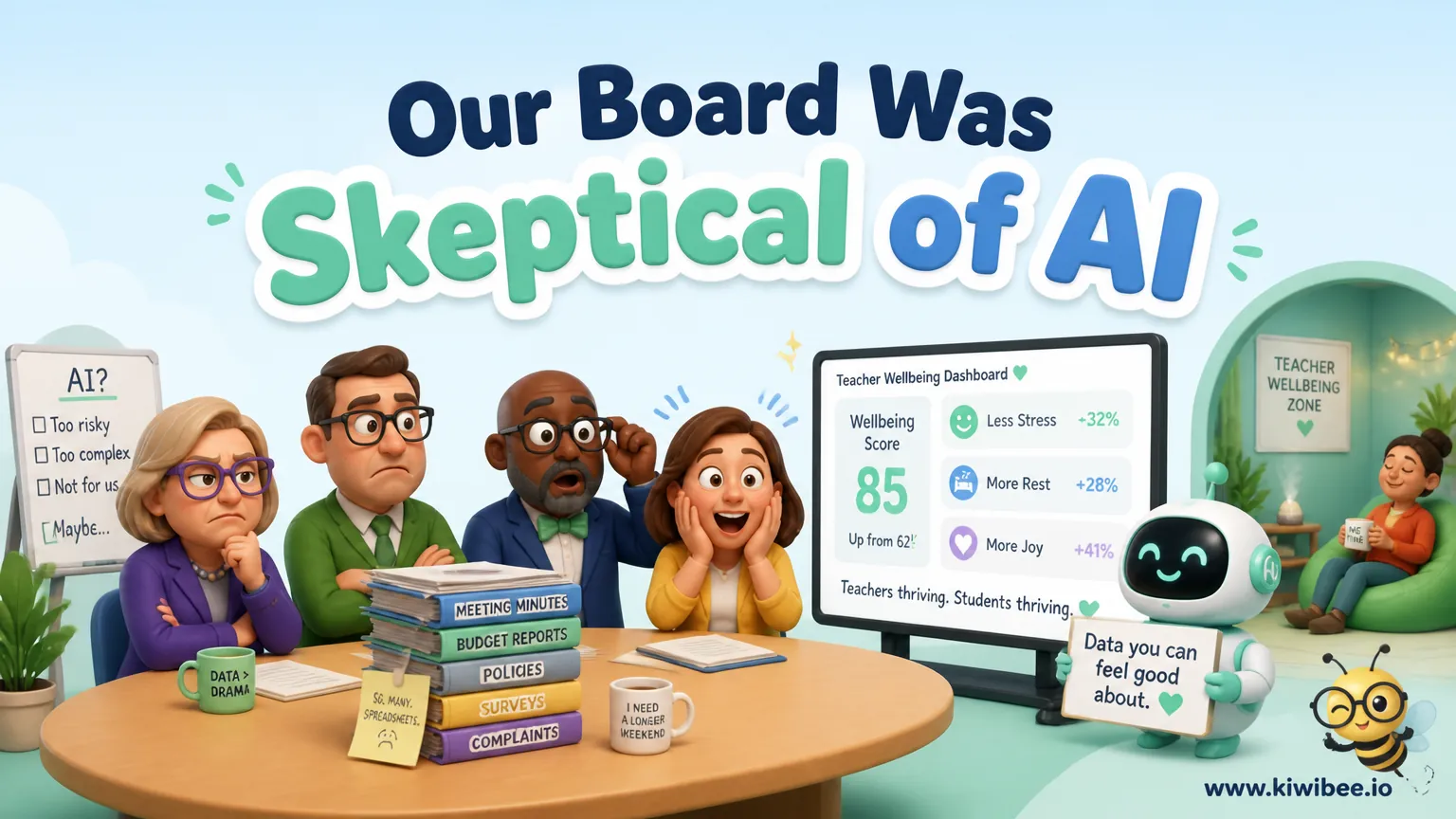
The Board's Initial Hesitation
When our head of digital learning presented KiwiBee's AI platform to the board, I'll be honest about our reaction. Several members worried about data privacy implications. Others questioned whether AI would 'replace' teachers. Our finance committee wanted to know the ROI in concrete terms. As chair, I saw heads nodding in skepticism around the table.
But we also saw other data that demanded attention: teacher turnover had reached 23% annually. Exit interviews consistently cited workload and work-life balance. We were spending significant budget on recruitment and training, only to lose teachers within three years. Something had to change, and traditional workload reduction strategies weren't working.
The Pilot Decision
We approved a one-year pilot with clear success metrics: teacher reported workload, hours worked beyond contract, wellbeing survey scores, and retention indicators.The head agreed to present quarterly data. If results weren't compelling, we'd sunset the investment. If they were, we'd expand. It felt like a reasonable, cautious approach for a governance body to take.
The first quarterly report surprised us. Teachers using the AI tools reported 7.3 fewer hours of admin work per week. SEVEN. That's nearly a full additional school day recovered. Wellbeing survey scores had improved measurably. More importantly, the qualitative feedback was striking — teachers described feeling 'supported' rather than 'monitored' by technology for the first time.
What We've Learned
As of this writing, we're nine months into implementation. Teacher turnover intentions (surveyed anonymously) have dropped from 34% to 12%. Early-career teachers are specifically citing AI planning support as a reason they feel able to sustain the profession. Our recruitment conversations have shifted — candidates ask about our technology support as a selling point.
The board's role isn't to be early technology adopters. It's to steward resources wisely for educational outcomes. But we've learned that teacher wellbeing IS a resource worth investing in. When teachers have time to actually teach, to recover, to have lives outside school — students benefit. AI didn't replace anything. It gave our teachers back the capacity to do what they love. From a governance perspective, that's exactly the kind of investment we should be making.
Explore the platform
Continue with KiwiBee
Choose the KiwiBee workspace or resource library that fits what you need next.
Related posts
After 25 Years in Education, AI Showed Me What I'd Been Missing
I thought I was an expert observer. Then AI analysis of the same lessons I watched showed patterns my experienced eyes had completely missed.
We Replaced 17 Spreadsheets with One AI Dashboard. Here's What Happened.
Our behavior management system was a nightmare of inconsistent spreadsheets, forgotten referrals, and missed patterns. One AI platform changed everything.
Leading Student AI Ethics Roundtables
Facilitate meaningful AI ethics conversations with scenario cards, collaborative norms, and artifact-based reflection tasks.
 For big organisations
 For schools
 For centers
 For team leaders
 For teachers
 AI and resources
 Printable worksheets
 Teacher tools
 AI studio
 Ideas and research