Mastering Talk for Writing: A Step-by-Step Guide to Building Young Writers
How oral rehearsal, story maps, and creative invention transform reluctant writers into confident storytellers.
 By KiwiBee· KiwiBee
Last updated May 26, 2026
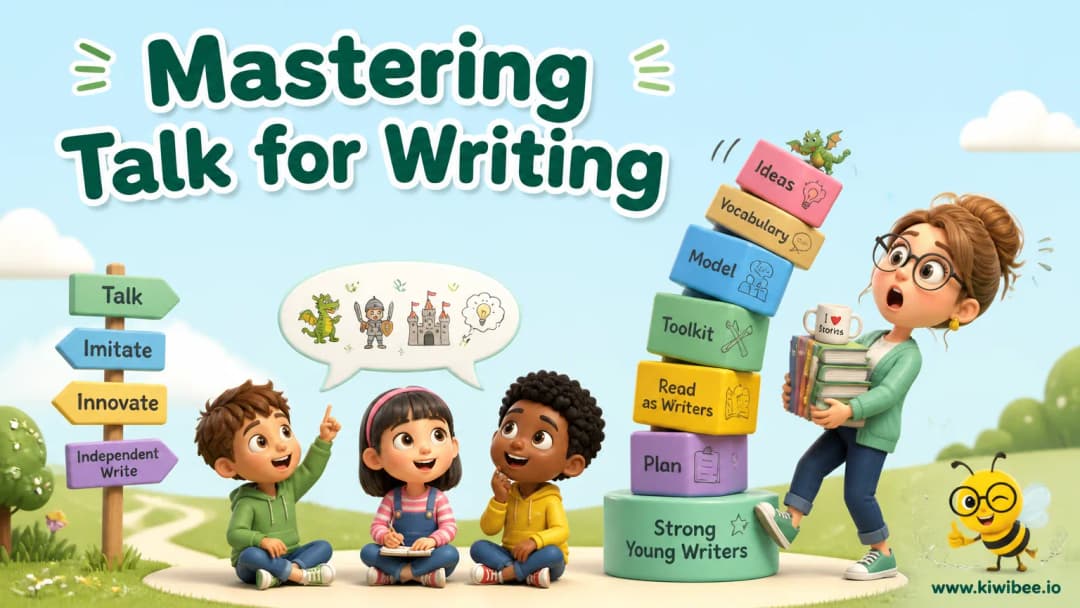
Talk for Writing changed how my kids learned to write. Here's the version I actually use.
Talk for Writing is the Pie Corbett framework for teaching primary children to write by first teaching them to tell stories aloud. I spent a year resisting it as 'too structured'. Then I tried it for one term and writing standards in my class jumped more than they had in any single year. Here is the four-step version I actually use, what each step is for, and where the framework finally clicked.
Step 1: Storytelling — talk it before you write it
The premise that takes a moment to accept: children cannot write a sentence they cannot first say. Before any writing happens, students orally narrate the story. Beginning, middle, end. Out loud, with gestures, with the language patterns they will need for the written version baked in.
What this does: builds confidence through speaking aloud, develops the child's narrative voice and fluency, and surfaces every weakness in the story before they have committed it to paper. The kid who could not write a coherent paragraph can usually tell a coherent story given the right scaffold. Talk for Writing is mostly about transferring that oral coherence onto the page.
My routine: every story starts with three days of pure oral work. No pencils. No paper. Just retell, with actions, in pairs and in the whole-class circle. The kids who hate writing love this part, which is the entire point.
Step 2: Story Maps — make the structure visible
Once the story lives in their voices, we make it visual. A story map is a hand-drawn sequence of pictures showing every key moment of the story in order. Beginning. Middle. End. Characters, settings, plot points — all visible on one page.
This is where the framework's invisible work happens. The kids who could tell the story but cannot remember the structure when they try to write it now have a visual scaffold. They can write the part of the story that matches the picture in front of them, then move to the next picture. Long writing tasks become a sequence of short writing tasks, each anchored to a visual.
Step 3: Invent something inside the story
Once they have retold the original story and mapped it, I push them to inhabit it creatively. Invent a new character, a new setting, a new problem within the framework of the original story. This is where imaginative problem-solving develops — not in a vacuum, but in a structure the kids already own.
Example I use in my class: we retell the Three Little Pigs. Then I ask: invent a new house material the third pig could have used. What would the wolf have done? What new ending becomes possible? Suddenly the kids who 'cannot think of anything to write' are writing wildly inventive material because the scaffold is doing the structural work.
Step 4: Change the story to a similar one
The final step is transfer. Take the underlying structure of the story and apply it to a different surface. The Three Little Pigs becomes the Three Little Robots. Goldilocks becomes a different intruder story. Same beats, new content. The skill being practised is the transferable narrative architecture, not the specific story.
This is the step where the framework pays off in standardised assessments. The kids have internalised the structure deeply enough that when they encounter a brand-new prompt under exam conditions, they have a structural scaffold ready to apply. That structural transfer is the actual outcome of the year.
What changed when I wired it into my planner
For two years I ran Talk for Writing manually — story map on paper, retell in a circle, invent on a worksheet I drafted Sunday night. The framework works, but the prep is heavy.
This year I templated the whole four-step cycle inside KiwiBee's curriculum planner, so each unit of writing automatically generates the oral-retell scaffold, the story map worksheet, the invention prompts, and the transfer-task prompt. The story-map worksheet comes from the AI worksheet generator, and the comprehension and retell checks land in auto-graded homework so I can see who has internalised the structure and who needs another pass. Same Pie Corbett framework. The prep is finally proportional to the impact.
Where this fits in KiwiBee
If you want Talk for Writing wired into the curriculum, KiwiBee adds a unit-aware curriculum planner, a free worksheet generator for retell tasks, and auto-graded comprehension homework. Try it free at app.kiwibee.io.
Explore the platform
Continue with KiwiBee
Choose the KiwiBee workspace or resource library that fits what you need next.
 For big organisations
 For schools
 For centers
 For team leaders
 For teachers
 AI and resources
 Printable worksheets
 Interactive simulations
 Teacher tools
 AI studio
 Ideas and research