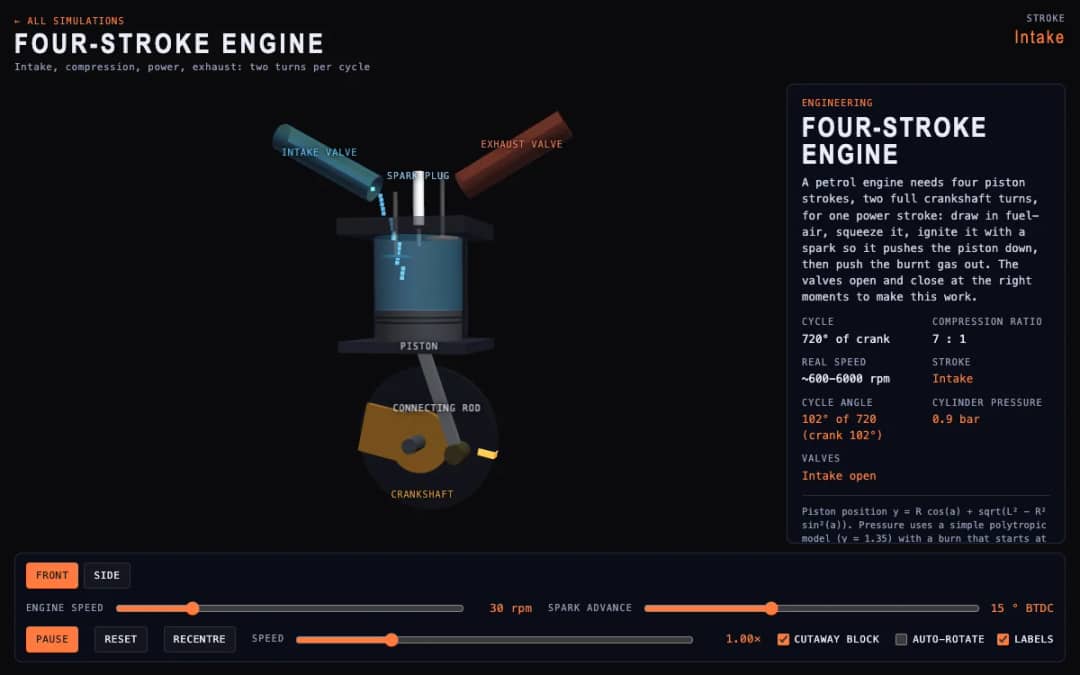
A cutaway engine cylinder shows the piston, valves and spark through the four strokes of the cycle. Students change engine speed and spark advance and watch the stroke, cycle angle, cylinder pressure and valve states update.
—
KiwiBee uses optional Google Analytics, Google Ads, and Meta Pixel cookies to understand adult visitors, measure completed sign-ups, and improve campaigns. Essential cookies always stay on. OpenAI’s ChatGPT Ads Pixel also measures page views and completed enquiries after advertising consent, and may use hashed contact details for matching. Privacy policy
Cryptography & Key Exchange demystifies the mathematics protecting modern internet security. Three illuminated stations represent Alice (left), Eve the Eavesdropper monitoring the public channel (center), and Bob (right). In Diffie–Hellman mode, Alice mixes her secret integer a with the public generator g and prime modulus p to send A = gᵃ mod p across the bridge, while Bob sends B = gᵇ mod p. Even though Eve intercepts g, p, A, and B on her modular arithmetic clock ring, she faces the hard Discrete Logarithm Problem, whereas Alice computes Bᵃ mod p and Bob computes Aᵇ mod p to unlock the exact same glowing shared secret S = gᵃᵇ mod p. Switching to RSA mode shows asymmetric encryption C = Mᵉ mod n and decryption M = Cᵈ mod n.
They never send their private numbers a or b. Instead, they send the mixed modular results A = gᵃ mod p and B = gᵇ mod p. Because raising to a power modulo p wraps around the clock ring repeatedly, Eve cannot easily undo A to find a, yet Alice and Bob can each apply their own secret power to the other's public number to reach gᵃᵇ mod p.
Computing gᵃ mod p is fast even for 2048-bit numbers, but given g, p, and the remainder A = gᵃ mod p, finding the exponent a requires searching through an astronomical number of possibilities when p is a large prime.
Small primes like p = 23 let you verify every calculation by hand (for example, 5⁶ mod 23 = 15625 mod 23 = 8). Real TLS connections use the exact same equation with primes hundreds of digits long so Eve cannot brute-force them.
Diffie–Hellman lets two parties jointly create a shared secret key. RSA is an asymmetric padlock: Bob publishes a public lock (e, n) that anyone like Alice can snap shut on a message (C = Mᵉ mod n), while only Bob holds the private key d needed to open it (M = Cᵈ mod n).
Drop it into your LMS, blog, or class site — free.
<iframe src="https://kiwibee.io/en/simulations/public-key-cryptography-diffie-hellman-3d-simulation/embed" title="Cryptography & Key Exchange | KiwiBee" loading="lazy" allowfullscreen style="width:100%;height:min(70vh,620px);min-height:420px;border:0;border-radius:16px"></iframe>Continue exploring
A cutaway engine cylinder shows the piston, valves and spark through the four strokes of the cycle. Students change engine speed and spark advance and watch the stroke, cycle angle, cylinder pressure and valve states update.
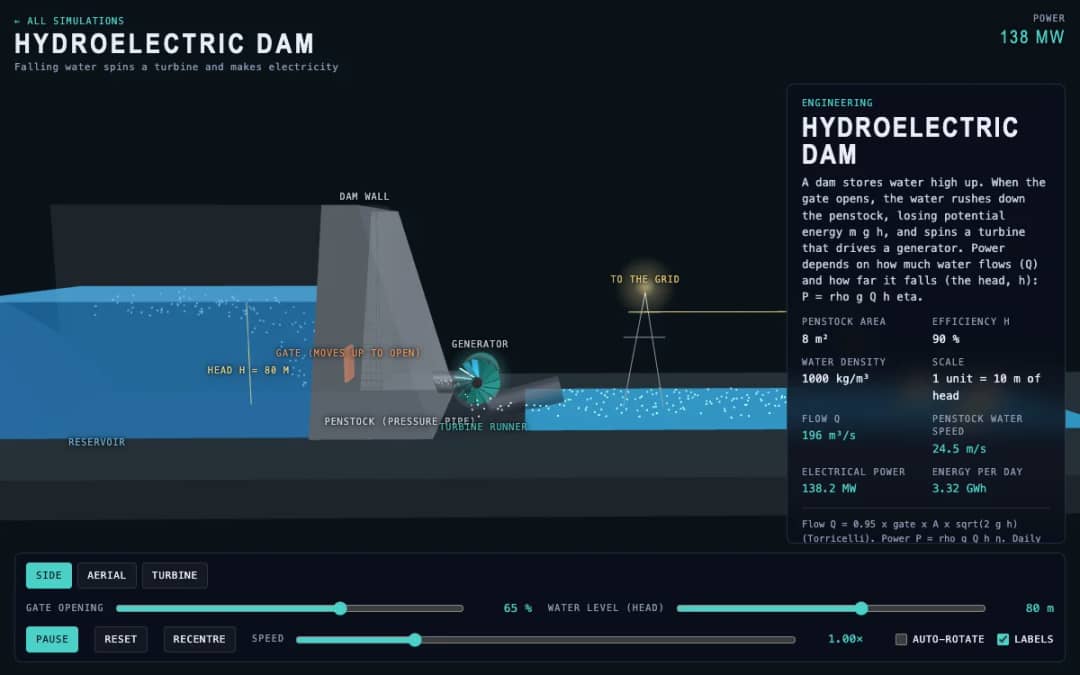
A dam, penstock and turbine are shown in 3D. Students change the gate opening and the water level, called the head, and read the water flow, penstock water speed, electrical power and energy per day.
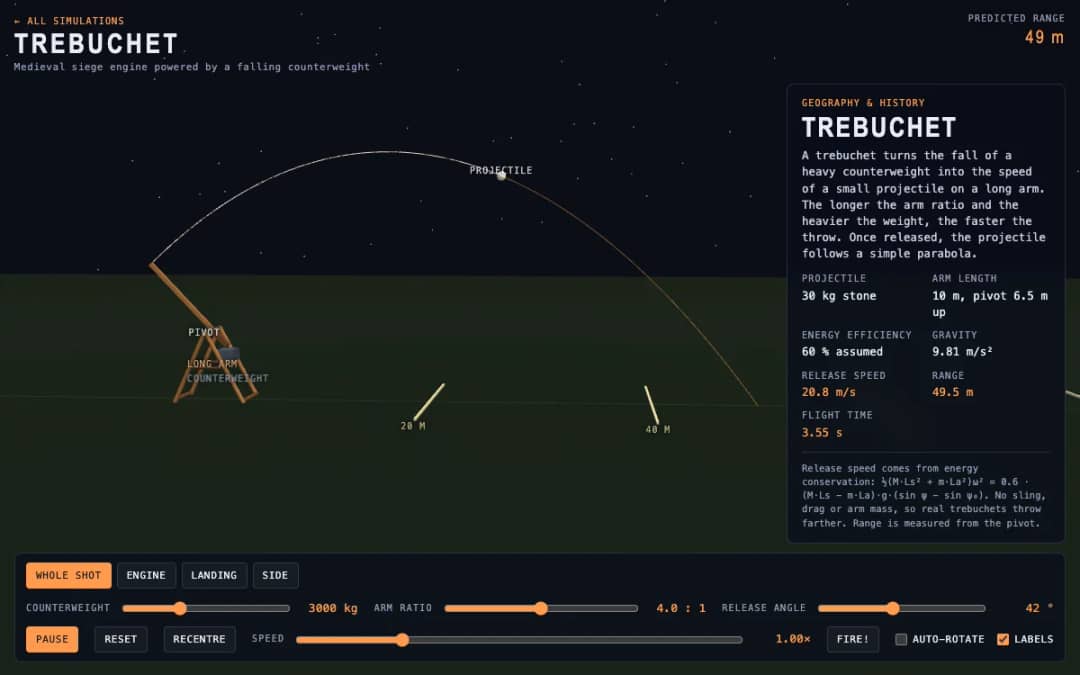
A medieval trebuchet swings its arm in 3D and throws a stone. Students change the counterweight mass, arm ratio and release angle, press Fire, and read the release speed, range and flight time.
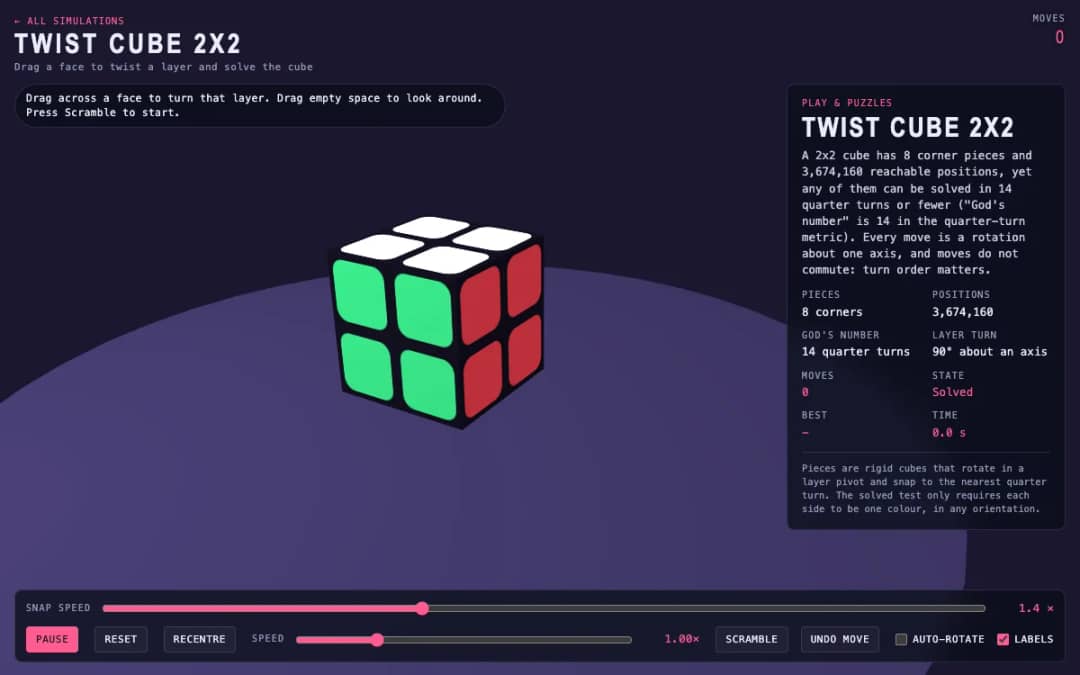
A 3D pocket cube with colored faces sits on screen. Students drag across a face to turn a layer, press Scramble to mix it, and try to solve it while the move counter and timer run.
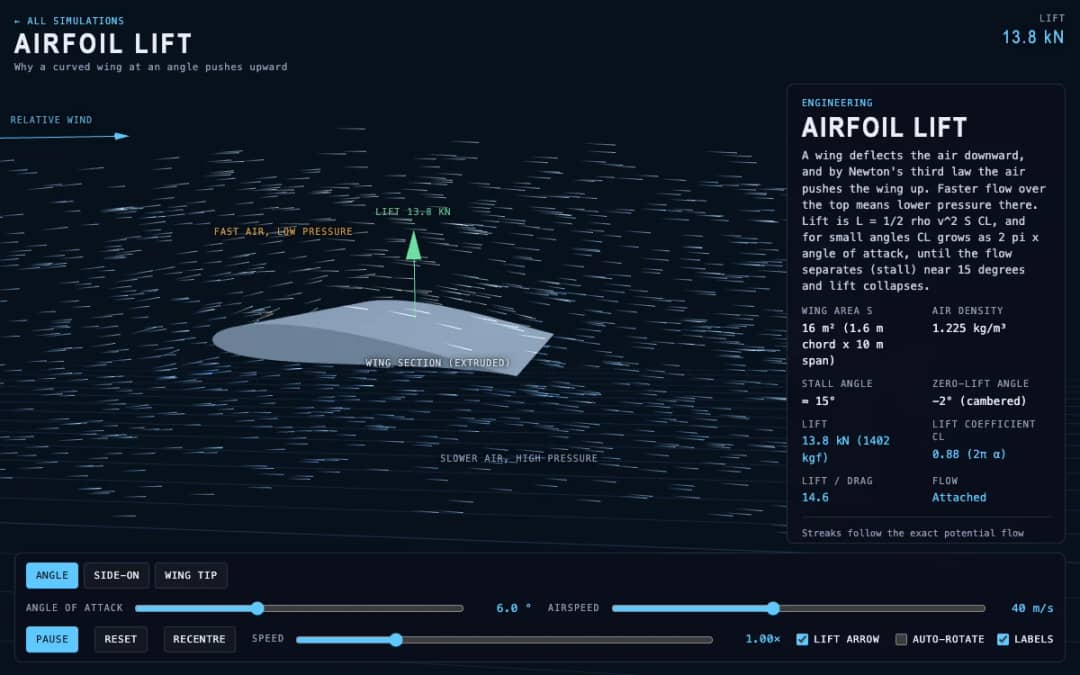
Streaks of air flow around a curved wing in 3D while students change the angle of attack and airspeed. Readouts show lift, the lift coefficient, lift to drag ratio and whether the flow is normal or stalled.
KiwiBee's free teacher workspace brings lesson planning, worksheets, classroom tools, and gradebook together in one place.
Start free and create your first class Home
 All solutions
 Pricing
 About us
 KiwiBee for Non-profits
 Events & webinars
 For big organisations
 For schools
 For centers
 For team leaders
 For teachers
 AI and resources
 Resources
 Printable worksheets
 Lesson Packs
 Interactive simulations
 Teacher tools
 AI studio
 Ideas and research