
3D Geometric Nets & Folding
- Math
Comments
Related to this simulation
Picked by meaning from games, worksheets, simulations, teacher tools and videos.
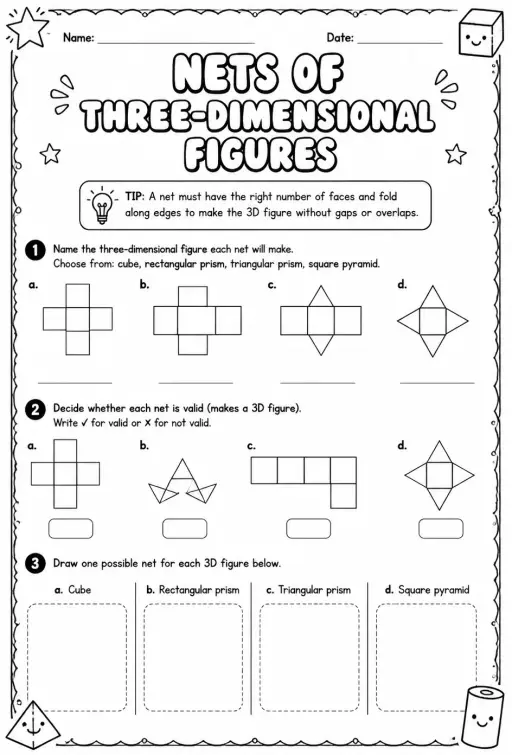
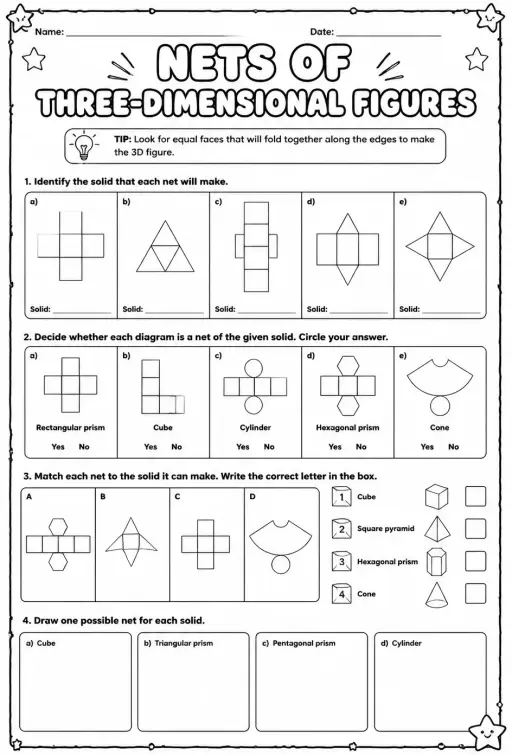
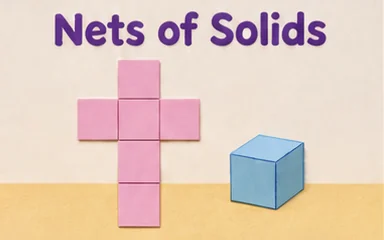
About this simulation
3D Geometric Nets & Folding helps students build spatial reasoning by smoothly hinging 2D polygon nets into closed 3D solids. Students can drag the glowing gold fold handle directly in the 3D viewport (or slide the Fold progress control from 0% to 100%) to watch a Cube, Rectangular Prism, Triangular Prism, Square Pyramid, or Cylinder assemble edge-to-edge. Clicking any face highlights that polygon and displays its individual area formula, demonstrating why total surface area equals the sum of all faces in the flat net. Live readouts update total surface area, 3D volume, and Euler's polyhedron characteristic (V - E + F = 2) as base width and height change.
What students can explore
- Drag the gold Fold Handle from 0% (flat 2D net on the grid) up to 100% (closed 3D solid) and watch which edges meet to form corners.
- Click each colored face of the Rectangular Prism or Square Pyramid while unfolded to compare the base area against the lateral face areas.
- Switch Solid type to Cylinder and fold it to see how a flat rectangle of width 2πr wraps smoothly around two circular end caps.
- Compare the Faces / Edges / Vertices readout across the Cube, Rectangular Prism, Triangular Prism, and Square Pyramid to verify Euler's rule V - E + F = 2.
Learning objectives
- 1Visualize and predict how a 2D net of polygons folds along shared hinge edges into a closed 3D solid.
- 2Calculate the total surface area of prisms, pyramids, and cylinders by summing the areas of their constituent 2D net faces.
- 3Contrast how changing base width w and height h scales 2D surface area (u²) versus 3D enclosed volume (u³).
- 4Verify Euler's polyhedron formula (V - E + F = 2) for convex polyhedra.
Questions teachers ask
What is a geometric net of a 3D solid?
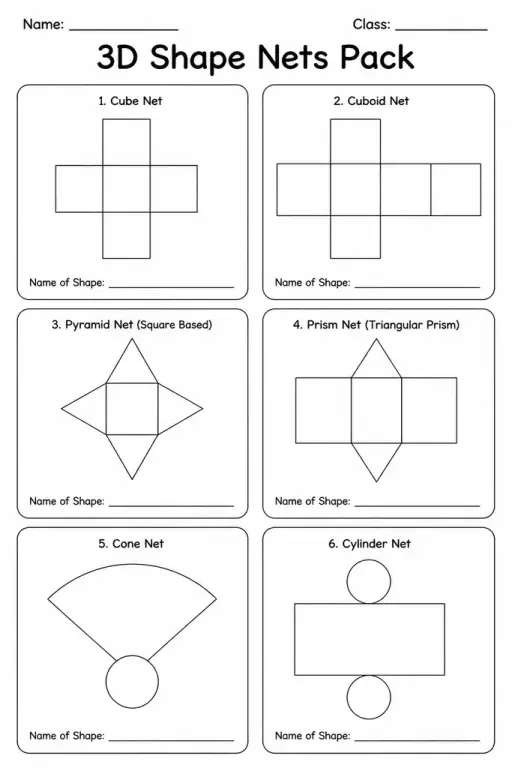
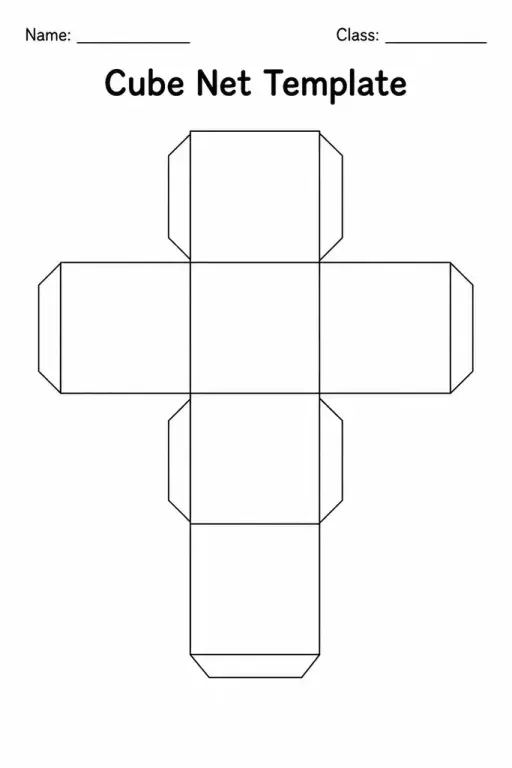
A geometric net is a two-dimensional pattern of flat polygons joined edge-to-edge that can be folded along its seams without overlapping to form the complete surface of a three-dimensional solid.
How does unfolding a solid into a net help calculate surface area?
Unfolding a 3D shape lays every face flat on a single 2D grid. Instead of memorizing separate surface area formulas for every solid, you can simply find the area of each familiar rectangle, triangle, or circle in the net and add them together.
Why does the lateral wall of a cylinder unfold into a rectangle?
When you slice a cylinder vertically and unroll its curved side flat, the height h stays the same and the top and bottom edges unroll to match the exact circumference (2πr) of the circular end caps, forming a 2πr by h rectangle.
What is Euler's polyhedron formula?
For any convex polyhedron (a 3D solid with flat polygon faces), the number of Vertices (V) minus the number of Edges (E) plus the number of Faces (F) always equals 2: V - E + F = 2.
Embed this simulation
Drop it into your LMS, blog, or class site — free.
<iframe src="https://kiwibee.io/en/simulations/geometric-nets-surface-area-3d-3d-simulation/embed" title="3D Geometric Nets & Folding | KiwiBee" loading="lazy" allowfullscreen style="width:100%;height:min(70vh,620px);min-height:420px;border:0;border-radius:16px"></iframe>Curriculum standards
Cambridge
- 6Gg.06Identify and sketch different nets for cubes, cuboids, prisms and pyramidsCambridge Primary Mathematics (0096) — Stage 6 › Geometry and Measure › Geometrical reasoning, shapes and measurements
- 6Gg.07Understand the relationship between area of 2D shapes and surface area of 3D shapesCambridge Primary Mathematics (0096) — Stage 6 › Geometry and Measure › Geometrical reasoning, shapes and measurements
Learning objectives © UCLES (Cambridge University Press & Assessment), quoted with attribution.
Bring interactive science into your classroom
KiwiBee's free teacher workspace brings lesson planning, worksheets, classroom tools, and gradebook together in one place.
Start free and create your first classWatch KiwiBee on YouTube
Short KiwiBee videos for teachers and schools. Subscribe, or follow KiwiBee wherever you are.
 Home
 All solutions
 Pricing
 About us
 KiwiBee for Non-profits
 Events & webinars
 For big organisations
 For schools
 For centers
 For team leaders
 For teachers
 Resources
 Printable worksheets
 Interactive simulations
 Teacher tools
 Ideas and research


