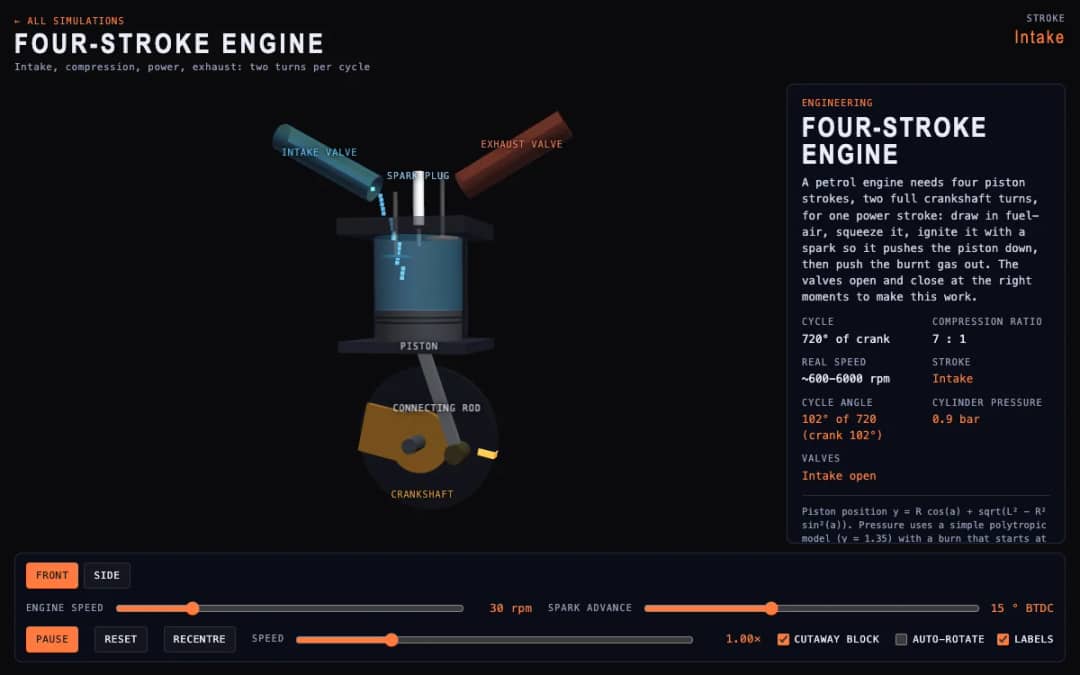
A cutaway engine cylinder shows the piston, valves and spark through the four strokes of the cycle. Students change engine speed and spark advance and watch the stroke, cycle angle, cylinder pressure and valve states update.
—
KiwiBee uses optional Google Analytics, Google Ads, and Meta Pixel cookies to understand adult visitors, measure completed sign-ups, and improve campaigns. Essential cookies always stay on. OpenAI’s ChatGPT Ads Pixel also measures page views and completed enquiries after advertising consent, and may use hashed contact details for matching. Privacy policy
Fiber Optics & Light Guide shows how hair-thin strands of glass carry global internet traffic at the speed of light. A translucent 3D optical fiber displays its high-index inner Core (n₁), lower-index outer Cladding (n₂), entrance Acceptance Cone, and exit Photodetector. As students drag the red laser emitter or adjust the launch angle, a continuous laser ray and a stream of glowing photon pulses refract into the core face and strike the core–cladding wall at incidence angle θᵢ. As long as θᵢ stays above the critical angle θc = arcsin(n₂/n₁), 100% of the light reflects internally down the waveguide; dragging the middle bend ring too sharply drops the local incidence angle below θc and reveals cladding leakage rays.
The inner glass core has a higher refractive index (n₁) than the surrounding cladding glass (n₂). When light inside the core hits the boundary at a shallow grazing angle (meaning a large angle θᵢ measured from the normal, greater than θc), Snell's law has no refracted solution and 100% of the light reflects back into the core.
A bare glass fiber touching dust, moisture, scratches, or another fiber would leak light at every contact point. Surrounding the core with a clean, protective glass cladding of index n₂ guarantees a pristine reflection interface along the entire cable.
Numerical Aperture NA = √(n₁² − n₂²) measures the light-gathering ability of the fiber. It equals sin(θ_max), where θ_max is the half-angle of the green acceptance cone at the entrance face within which entering light will successfully undergo total internal reflection.
At a sharp bend, the outer wall of the core curves toward the oncoming ray, reducing the angle θᵢ between the ray and the wall normal. Once θᵢ falls below the critical angle θc, light refracts out into the cladding and the signal weakens.
Drop it into your LMS, blog, or class site — free.
<iframe src="https://kiwibee.io/en/simulations/fiber-optic-total-internal-reflection-3d-simulation/embed" title="Fiber Optics & Light Guide | KiwiBee" loading="lazy" allowfullscreen style="width:100%;height:min(70vh,620px);min-height:420px;border:0;border-radius:16px"></iframe>Continue exploring
A cutaway engine cylinder shows the piston, valves and spark through the four strokes of the cycle. Students change engine speed and spark advance and watch the stroke, cycle angle, cylinder pressure and valve states update.
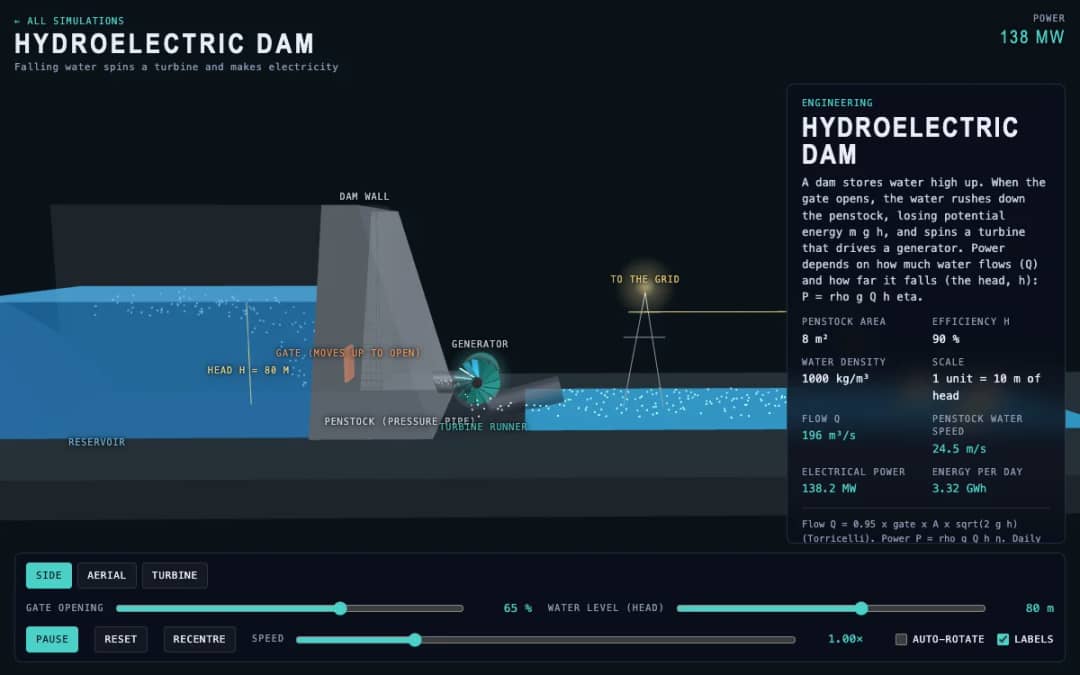
A dam, penstock and turbine are shown in 3D. Students change the gate opening and the water level, called the head, and read the water flow, penstock water speed, electrical power and energy per day.
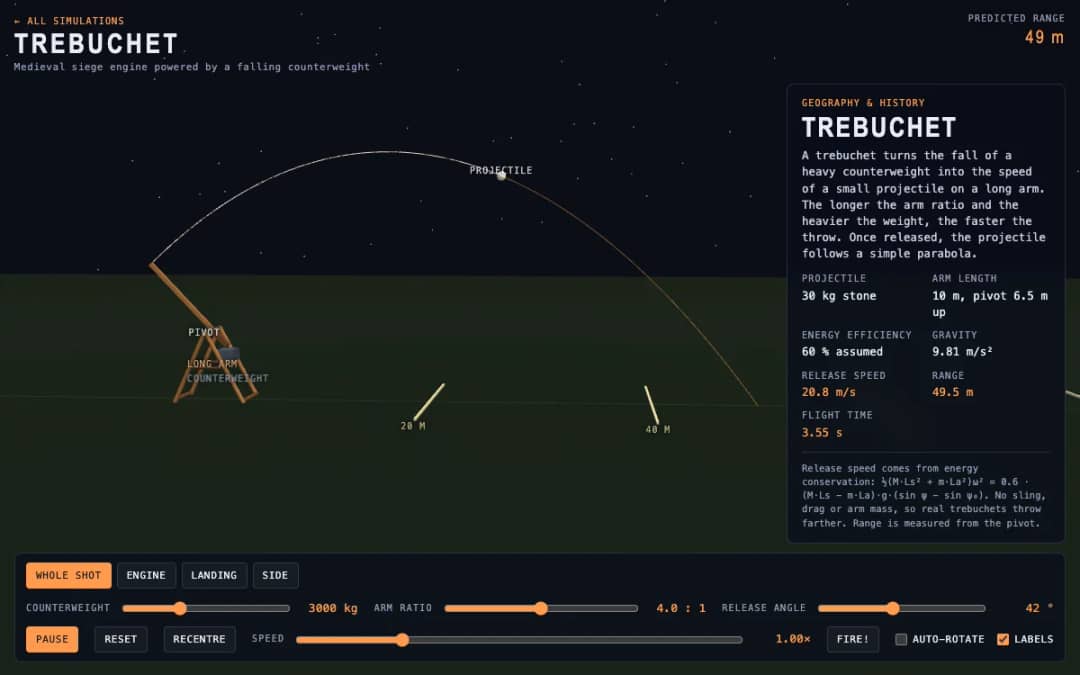
A medieval trebuchet swings its arm in 3D and throws a stone. Students change the counterweight mass, arm ratio and release angle, press Fire, and read the release speed, range and flight time.
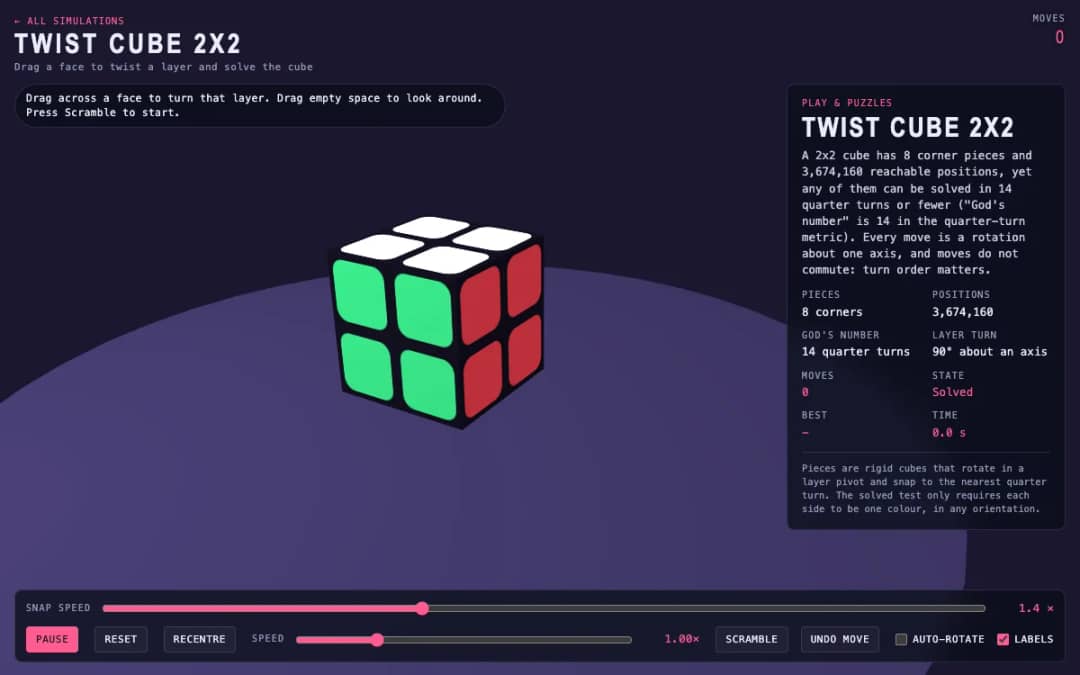
A 3D pocket cube with colored faces sits on screen. Students drag across a face to turn a layer, press Scramble to mix it, and try to solve it while the move counter and timer run.
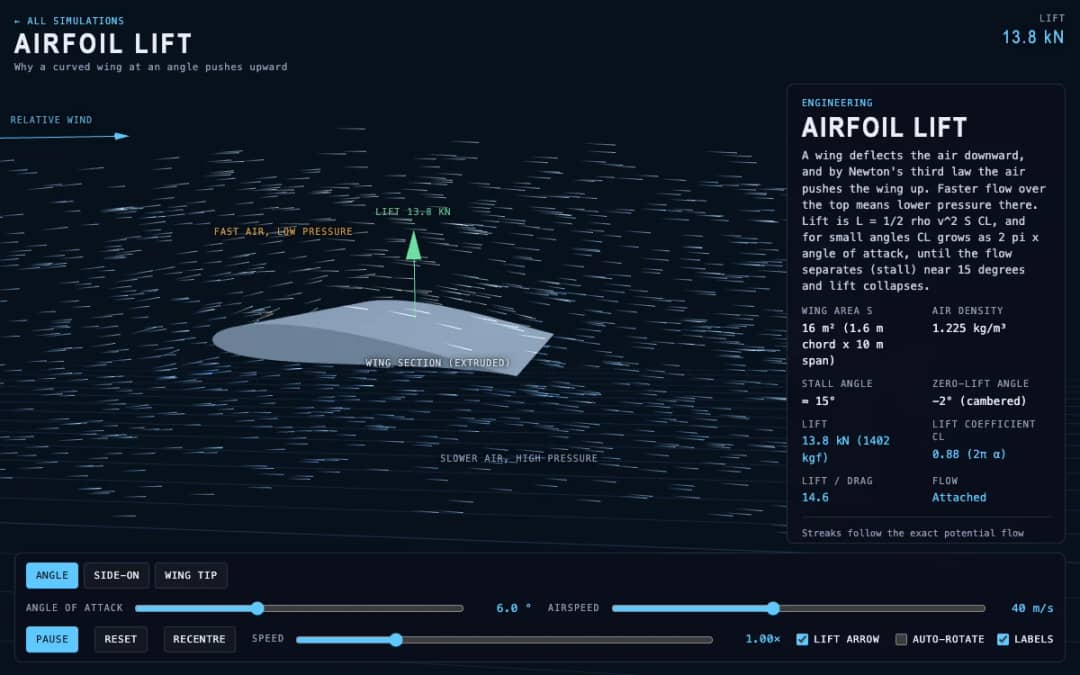
Streaks of air flow around a curved wing in 3D while students change the angle of attack and airspeed. Readouts show lift, the lift coefficient, lift to drag ratio and whether the flow is normal or stalled.
KiwiBee's free teacher workspace brings lesson planning, worksheets, classroom tools, and gradebook together in one place.
Start free and create your first class Home
 All solutions
 Pricing
 About us
 KiwiBee for Non-profits
 Events & webinars
 For big organisations
 For schools
 For centers
 For team leaders
 For teachers
 AI and resources
 Resources
 Printable worksheets
 Lesson Packs
 Interactive simulations
 Teacher tools
 AI studio
 Ideas and research