
Breathing & the Diaphragm
- Biology
Comments
Related to this simulation
Picked by meaning from games, worksheets, simulations, teacher tools and videos.
About this simulation
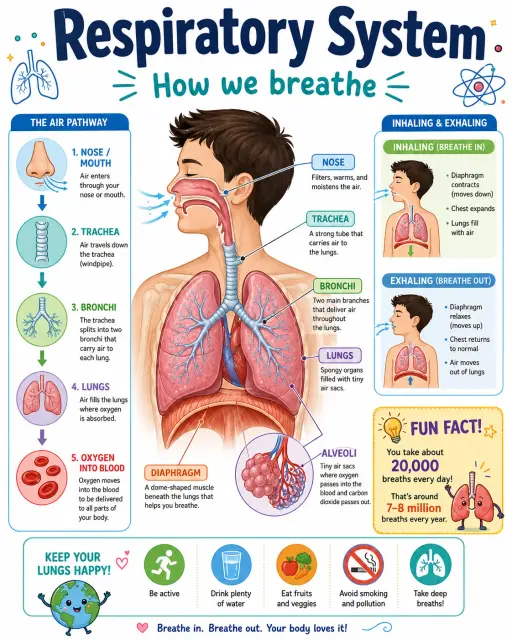
Breathing and the Diaphragm lets students control the breathing muscle directly. Dragging the red handle down flattens the diaphragm, enlarges the chest, lowers the pressure inside the lungs and draws air in. Moving it up does the reverse. Readouts show lung volume from 1.2 to 4.8 liters, pressure, airflow, breaths per minute and a Boyle check. Students can switch on auto breathing and set its rate, take a deep breath, or block the airway to see pressure change with no airflow. It connects the diaphragm to Boyle's law and the mechanics of breathing.
What students can explore
- Drag the red diaphragm handle down slowly and watch Lung volume and Pressure in lungs.
- Move the handle back up and see the Airflow readout change direction.
- Turn on Auto breathing and use the Auto rate slider to compare 6 and 40 breaths per minute.
- Switch on Block airway and move the diaphragm to see pressure change with no air moving.
- Press Deep breath and compare its peak volume with a normal breath.
Learning objectives
- 1Explain how the diaphragm changes chest volume to move air in and out.
- 2Apply Boyle's law to relate lung volume and pressure.
- 3Describe why air flows from higher to lower pressure.
- 4Compare a resting breathing rate with a faster one.
Questions teachers ask
Is it free?
Yes, completely free with no login. Any modern browser will run it, so it works on school tablets, whiteboards and personal phones.
Why does air flow in when the diaphragm moves down?
The diaphragm flattens and enlarges the chest, so volume goes up and pressure inside the lungs drops below the air outside. Air then flows in until the pressures are equal.
What is Boyle's law?
At constant temperature, pressure times volume stays constant. When the volume of the lungs rises, the pressure inside falls, and when the volume falls, the pressure rises.
What does Block airway do?
It closes the airway so no air can enter or leave. Moving the diaphragm then changes the pressure but not the amount of air, which shows how volume and pressure are linked.
Embed this simulation
Drop it into your LMS, blog, or class site — free.
<iframe src="https://kiwibee.io/en/simulations/breathing-lungs-diaphragm-3d-simulation/embed" title="Breathing & the Diaphragm | KiwiBee" loading="lazy" allowfullscreen style="width:100%;height:min(70vh,620px);min-height:420px;border:0;border-radius:16px"></iframe>Curriculum standards
Cambridge
- 8Bs.03Describe how the structure of the human respiratory system is related to its function of gas exchange (in terms of lung structure and the action of the diaphragm and intercostal muscles) and understand the difference between breathing and respiration.Cambridge Lower Secondary Science (0893) — Stage 8 › Biology › Structure and function
Learning objectives © UCLES (Cambridge University Press & Assessment), quoted with attribution.
Bring interactive science into your classroom
KiwiBee's free teacher workspace brings lesson planning, worksheets, classroom tools, and gradebook together in one place.
Start free and create your first classWatch KiwiBee on YouTube
Short KiwiBee videos for teachers and schools. Subscribe, or follow KiwiBee wherever you are.
 Home
 All solutions
 Pricing
 About us
 KiwiBee for Non-profits
 Events & webinars
 For big organisations
 For schools
 For centers
 For team leaders
 For teachers
 Resources
 Printable worksheets
 Interactive simulations
 Teacher tools
 Ideas and research


