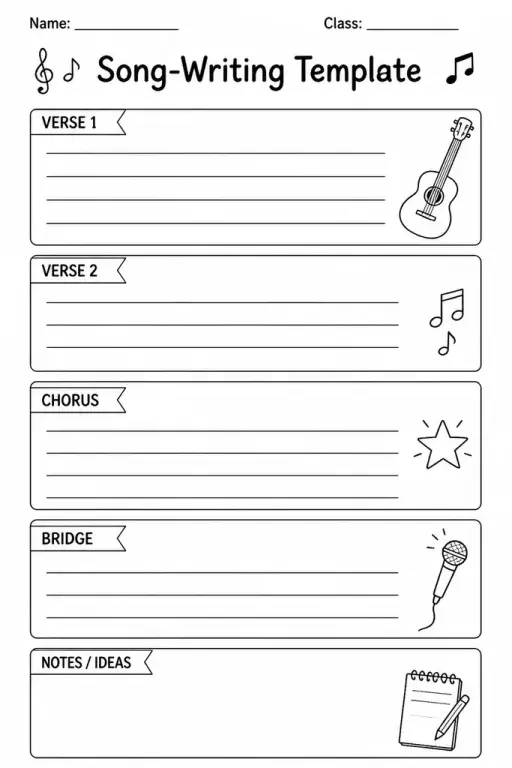
Song-Writing Template
Music Templates
Ages 4–11
——
KiwiBee uses optional Google Analytics, Google Ads, and Meta Pixel cookies to understand adult visitors, measure completed sign-ups, and improve campaigns. Essential cookies always stay on. OpenAI’s ChatGPT Ads Pixel also measures page views and completed enquiries after advertising consent, and may use hashed contact details for matching. Privacy policy

This blank repeating-pattern template provides a ready-made strip or grid of equal-sized cells for students to design and extend their own patterns. Depending on the version, the layout is a single horizontal strip (ideal for border and frieze patterns), a square grid (for all-over repeat patterns), or a combination of both on one sheet. Students in grades K–6 use it to explore pattern in art, mathematics, and textile design without having to rule their own grids. Teachers introduce it alongside lessons on symmetry, tessellation, and decorative arts. Young students fill cells with coloured shapes using crayons; older students design more complex motifs with fine-liner and ruler. Because the cells are pre-sized, students can focus entirely on the pattern logic—colour sequence, shape alternation, rotational repeat—rather than on construction. Reprint as many copies as needed for differentiated practice.
The strip layout has a single row of cells running horizontally—best for linear border and frieze patterns. The grid layout has multiple rows and columns—best for all-over surface repeat patterns like fabric or wallpaper.
Yes. The larger-cell versions of the strip layout work well for K–1 students who are still developing fine motor control. Provide chunky crayons and model the pattern rule before they begin.
Absolutely. Stamps, dot stickers, and cut-paper shapes all work well in the cells and can actually help younger students keep the repeat more consistent than freehand drawing.
Repeating patterns are a core element of early maths (K–2) and connect to multiplication, fractions, and spatial reasoning in grades 3–6. The visual format makes the abstract rule concrete and visible.

See what other teachers think and share a helpful note.
Generate a fresh worksheet for any grade, topic and language. Free.
 Home
Home All solutions
 Pricing
 About us
 KiwiBee for Non-profits
 Events & webinars
 For big organisations
 For schools
 For centers
 For team leaders
 For teachers
 AI and resources
 Resources
 Printable worksheets
 Lesson Packs
 Interactive simulations
 Teacher tools
 AI studio
 Ideas and research