
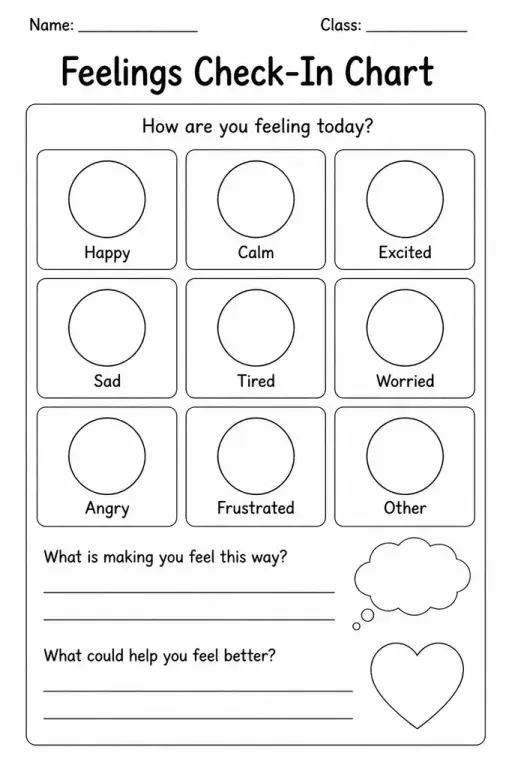
Zones Check-In Template
SEL & Wellbeing Templates
Ages 4–11
——
KiwiBee uses optional Google Analytics, Google Ads, and Meta Pixel cookies to understand adult visitors, measure completed sign-ups, and improve campaigns. Essential cookies always stay on. OpenAI’s ChatGPT Ads Pixel also measures page views and completed enquiries after advertising consent, and may use hashed contact details for matching. Privacy policy

The Conflict-Resolution Template provides a structured blank frame that walks students in grades 2–7 through three essential steps: describing the problem, naming the feelings involved, and proposing a solution. Rather than asking students to talk through a conflict cold, this printable gives them a quiet, private space to organise their thoughts first—reducing the heat of the moment and making the subsequent conversation more productive. Teachers, school counsellors, and parents use this template as a first-response tool when a disagreement arises, as a role-play scaffold during SEL lessons, or as part of a classroom peace-corner toolkit. Because each section is blank, students fill it in from their own perspective, which builds empathy and personal accountability at the same time.
Yes—giving each student their own copy ensures both perspectives are captured independently before a joint conversation. Compare the two sheets together to find common ground.
Yes. For grade 2, pre-fill sentence starters such as 'The problem was…', 'I felt…', and 'A fair solution could be…' before printing to scaffold the writing.
No. The template is a first-step thinking tool, not a substitute for professional support. Use it to organise thoughts before a restorative conversation with a trusted adult.
Allow them to draw the situation, use bullet points, or dictate while you scribe. The goal is structured thinking, not perfect writing—any form of expression counts.

See what other teachers think and share a helpful note.
Generate a fresh worksheet for any grade, topic and language. Free.
 Home
Home All solutions
 Pricing
 About us
 KiwiBee for Non-profits
 Events & webinars
 For big organisations
 For schools
 For centers
 For team leaders
 For teachers
 AI and resources
 Resources
 Printable worksheets
 Lesson Packs
 Interactive simulations
 Teacher tools
 AI studio
 Ideas and research