Top Worksheet Choice for Primary English: Word Search
Why word searches are the most popular worksheet in primary English and how to make them even more effective.
 By KiwiBee· KiwiBee
Last updated May 26, 2026
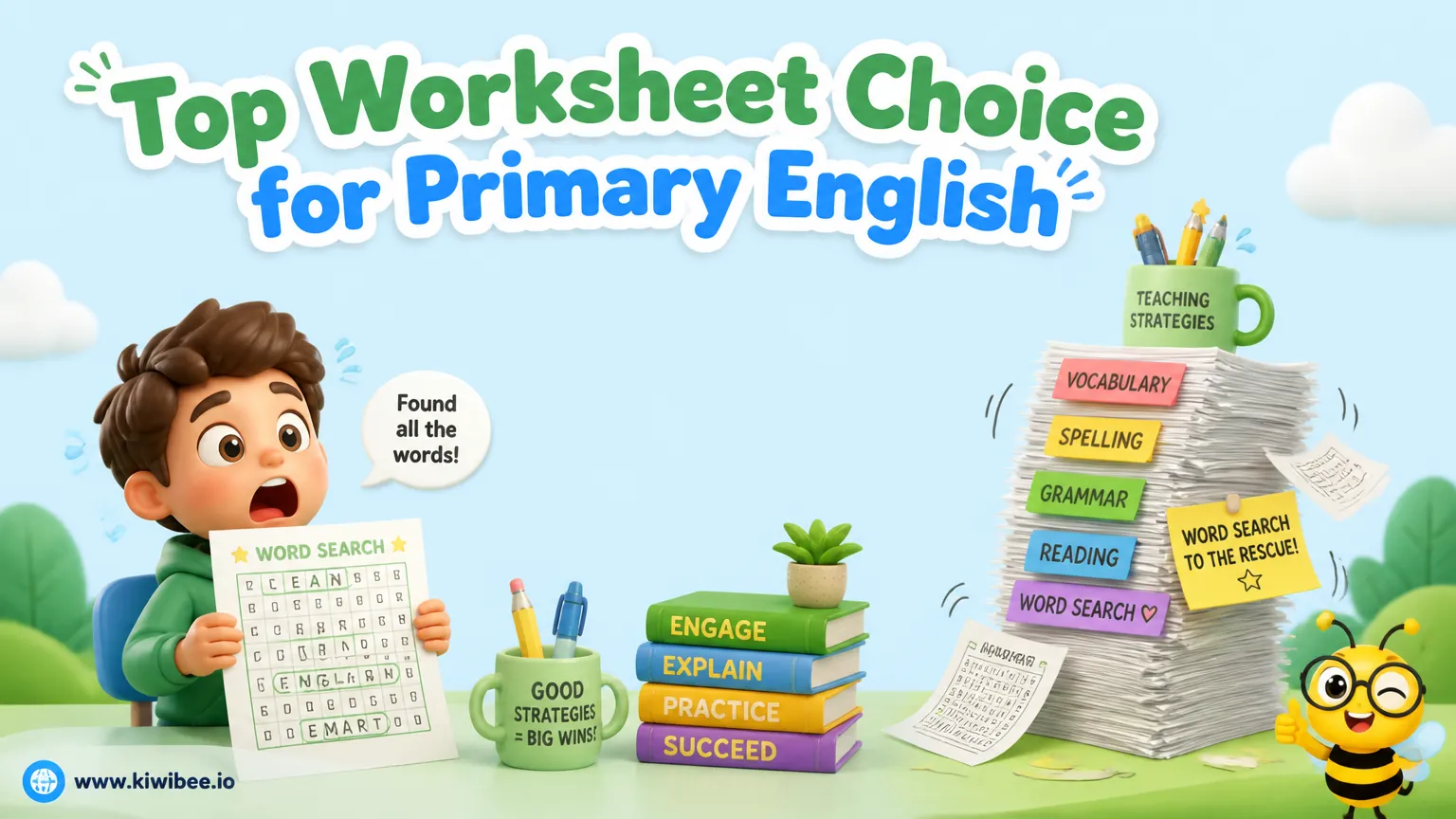
After testing every worksheet type in my classroom, the winner is embarrassing
I have run a quiet experiment in my primary English classes for years now. Every worksheet I hand out, I watch the kids' faces. I track which ones they finish enthusiastically, which ones they grind through, and which ones they quietly slide into the recycling bin. The consistent winner — across every age group, every ability level, every term — is also the most basic format on Earth. It is the word search. Yes, really. Here is why I have made peace with it.
Why word searches win
They feel like a game, not work. The single biggest reason. The instant a kid sees a grid of letters and a list of words, the frame in their brain switches from 'do my homework' to 'play a game.' I can dress up the same vocabulary in a hundred elaborate formats; the word search is the one that walks past their defences.
They are visually engaging. The grid is satisfying to scan, highlighting found words feels good, and the moment of recognition when a word appears in the chaos is genuinely rewarding to a child's brain. It is a tiny dopamine hit, designed in.
They give every kid a sense of accomplishment. Even the kid who struggles with conventional comprehension can find some of the words. The struggling kid leaves the lesson with a completed worksheet and an experience of competence, which is the single most important thing for that kid.
They adapt to any theme. Animals, colours, holidays, jobs, historical figures, food, weather, irregular verbs — anything you can list as words, you can build a word search around. Versatility is what keeps the format from getting old over a term.
They are accessible at every reading level. Beginners with five short words. Advanced students with twenty multi-syllabic words and diagonals enabled. Same format, different difficulty, same engagement.
What word searches actually teach
Beyond the engagement, the cognitive benefits are real. Vocabulary development happens through repeated visual exposure. Spelling reinforcement comes from matching letters carefully. Visual scanning and attention to detail develop with every grid. Pattern recognition is the core mental skill being practised — and that skill underpins reading itself. And problem-solving and spatial reasoning are bonus side effects.
The argument that word searches are 'just for fun' misunderstands what is happening cognitively. The kid is practising real reading skills disguised as a puzzle.
How to make a word search that actually works
Choose a relevant theme. The theme should align with whatever I am teaching this week, or with the kids' current obsession. A word search of dinosaur names during a dinosaur unit is on-topic. A word search of generic 'classroom items' is filler.
Use age-appropriate vocabulary. Mix easier and harder words so kids of different abilities all find some. If every word is too hard, the lower-ability kid gives up. If every word is too easy, the strong kid loses interest in 90 seconds.
Use a clear, easy-to-read font with adequate letter spacing. Word searches printed in cramped Times New Roman fail. Sans-serif, generously spaced, big enough for primary eyes. This is a design detail teachers undervalue.
Always provide the word list. The 'find the words without a list' version is a different cognitive task — much harder, much less universally accessible. Stick to the word list version for most uses.
For advanced students, add a layer: the unused letters spell a hidden message; or answering a question based on the words found. Stretch tasks for kids who finish first.
Why I stopped making them by hand
For years I built every word search manually in a generator website, typed in the words, exported a PDF, printed. The whole loop took ten minutes per worksheet. That adds up.
Now I generate them inside KiwiBee's AI worksheet generator — type the vocabulary list, get a printable word search and a digital interactive version simultaneously. The interactive version becomes auto-graded homework so the kids can do the word search on a device and I get the data without grading anything. For more advanced or themed worksheets — phonics-pattern word searches at specific levels — the phonics & writing worksheet builder handles the scaffolding.
Word searches still win. The format has just stopped costing me time.
Where this fits in KiwiBee
If you want word searches without the manual cell-by-cell work, KiwiBee adds a free AI worksheet generator (word search included), a phonics & writing worksheet builder, and auto-graded homework versions of those worksheets. Try it free at app.kiwibee.io.
Explore the platform
Continue with KiwiBee
Choose the KiwiBee workspace or resource library that fits what you need next.
Related posts
Top Free Worksheet Sites for English Teachers
Discover four of the best free worksheet platforms for English teachers, from Canva's customizable templates to ISL Collective's massive library of ready-made materials.
Top Paid Worksheet Websites for English Teachers
Explore four top paid worksheet platforms for English teachers, including Teachers Pay Teachers, Twinkl, Education.com, and BusyTeacher. Compare pricing, quality, and best use cases.
Pair Work for English Classes: Primary Level Activities
Practical pair work activities for primary English classes using word mats, dice games, spinners, and Snakes and Ladders to build speaking and vocabulary skills.
 For big organisations
 For schools
 For centers
 For team leaders
 For teachers
 AI and resources
 Printable worksheets
 Teacher tools
 AI studio
 Ideas and research