Top Rewards for Kindergarten and Primary Students
Five affordable, motivating reward ideas that keep young learners excited about positive behavior.
 By KiwiBee· KiwiBee
Last updated May 26, 2026
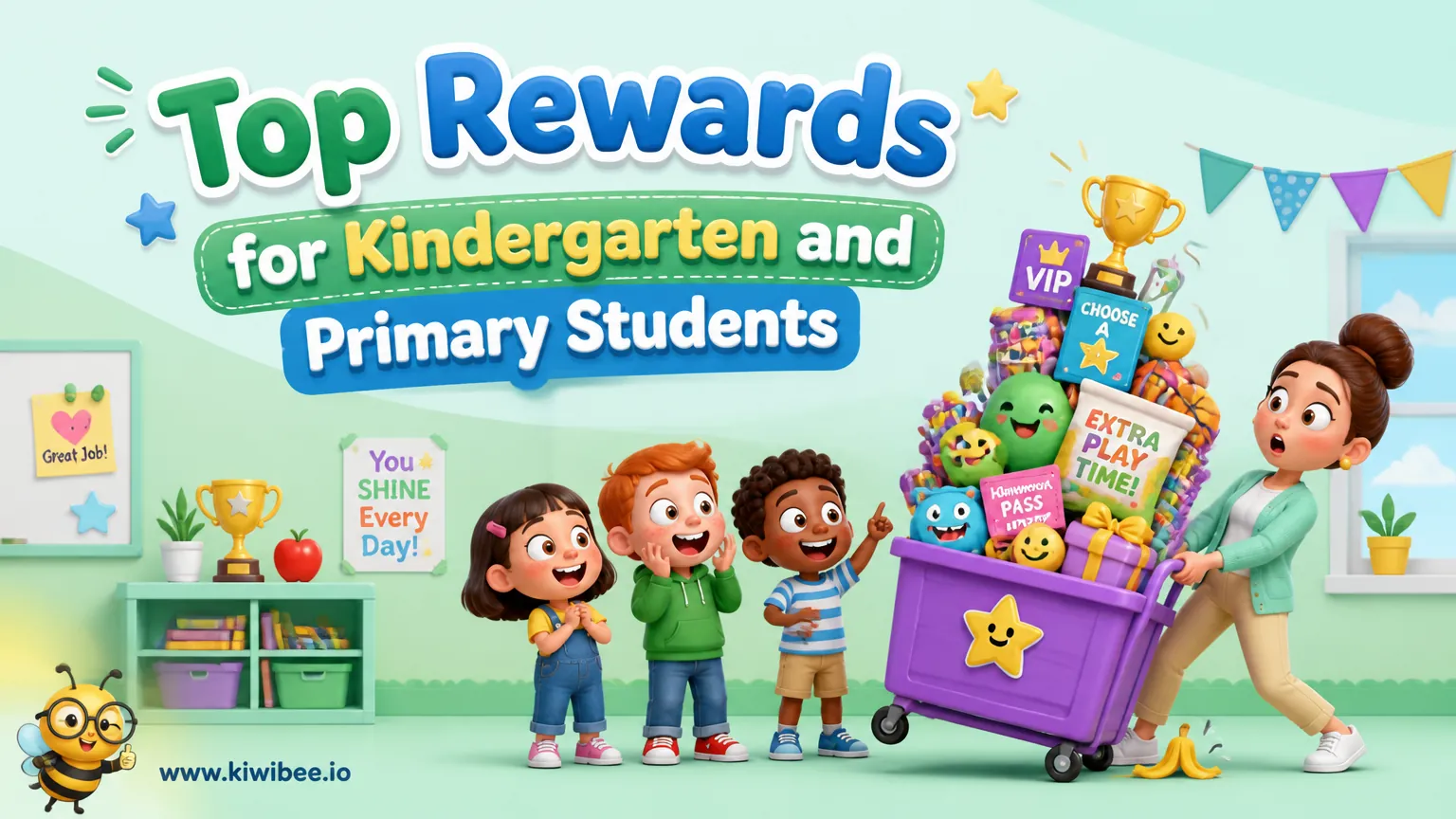
Four rewards my K and primary students would steal for
Reward systems live or die on what is actually in the prize bucket. I have tried elaborate point ladders and earned-privilege systems and they all fell over because the kids did not care enough about what was at the end. Then I simplified everything down to four reward types my students genuinely want, and the system started working the way the books said it would. Here are the four, and why each one works.
1. Stickers
Inexpensive, beautiful, practical. The thing about stickers is that the modern ones are gorgeous — holographic, scratch-and-sniff, glittery, themed around whatever the kids are currently obsessed with. They stick to anything (notebooks, water bottles, foreheads — yes, foreheads). They take up no storage. They can be earned individually or in sheets for collective wins.
I keep an 'album' system: every kid has a sticker page in the back of their notebook. They paste each earned sticker onto the page. By end of term the page is full and the kid carries around a visual record of their good week. The album is the reward as much as the individual sticker.
2. Cards
Kids love collecting cards. The cards that work in my classroom are whatever the kids are currently obsessed with — at the moment that is Pokemon cards, Brain Rot characters, anime trading cards, and K-pop photocards. Yours will be different next year. Track the obsession, buy a bulk pack, distribute strategically.
Why cards work better than stickers for older kids: rarity. Some cards are common, some are rare. Trading happens. A whole social economy springs up around the cards I distribute, which is hilarious to watch and also teaches negotiation, fairness, and trade.
The rules I enforce: no real money trades, no bullying for cards, no forcing trades. Anything beyond those rules I let play out.
3. Plastic diamonds (gems)
This idea I stole from another teacher and it has become my favourite reward token. Plastic gems — decorative stones from a craft store. Cheap, durable, and weirdly satisfying to hold. Some gems are bigger or more colourful than others, which creates an automatic rarity tier without me having to manage it.
The kids treat them like dragon hoard. They collect them, compare them, trade them with friends. Some keep theirs in a glass jar on their desk. The visceral tangibility of holding earned currency works on kids in a way that virtual points never quite match.
4. Certificates
The formal reward. A printable, personalised certificate awarded for something specific — 'Outstanding Persistence in October', 'Math Star of the Week'. Easy to make once I have a template. Kids genuinely treasure them, and the moment when they show the certificate to their parent at pickup is the kind of thing that makes parents become evangelists for your classroom culture.
I keep a quarterly award ceremony where every kid gets at least one certificate for something they did well. The point: certificates work as long as they are not handed out so casually that they become meaningless. Reserve them for moments that actually deserve recognition.
How I tie all four into one system
Before I moved my class onto a digital platform, the four reward types lived on separate tracks — stickers for behaviour points, cards for participation streaks, gems for special wins, certificates for end-of-term recognition. The tracking was a mess.
Now everything funnels into ClassSpark points inside KiwiBee. Students earn points for the behaviours I am tracking, and they spend points in the class shop, which is configured with the four reward tiers — small reward (stickers), medium reward (cards), large reward (gems), special reward (certificates earned by collective class goals). The shop tracks what each student has earned and redeemed. The gamified avatar layer gives them a second progression track on top of the physical rewards. The physical rewards still exist in the prize bucket. The administration of the system finally does not.
Where this fits in KiwiBee
If you want a reward system that scales beyond stickers, KiwiBee adds ClassSpark behaviour points, a class shop with redeemable items, and a gamified avatar layer that grows with progress. Try it free at app.kiwibee.io.
Explore the platform
Continue with KiwiBee
Choose the KiwiBee workspace or resource library that fits what you need next.
Related posts
Effective Reward Systems for Kids: ClassDojo and Collectibles
Compare ClassDojo's digital point system with collectible-based rewards like stickers, cards, and gems. Learn the pros, cons, and best practices for each approach.
Top Gadgets to Use in the Classroom for Kindergarten and Primary Teachers
From laser pointers to self-inking stamps, discover five affordable gadgets that help kindergarten and primary teachers manage attention, deliver lessons, and give instant feedback.
A Teacher's Must-Haves for the Kindergarten and Primary Classroom
Six cheap, low-tech items I refuse to teach kindergarten and primary without — from self-inking stamps to a wheeled suitcase and a trusty bell.
 For big organisations
 For schools
 For centers
 For team leaders
 For teachers
 AI and resources
 Printable worksheets
 Teacher tools
 AI studio
 Ideas and research