Student Mental Health Warning Signs: A Practical Guide for Teachers
How to observe, talk, document, and refer without diagnosing or handling risk alone
 By KiwiBee· KiwiBee
Last updated July 11, 2026
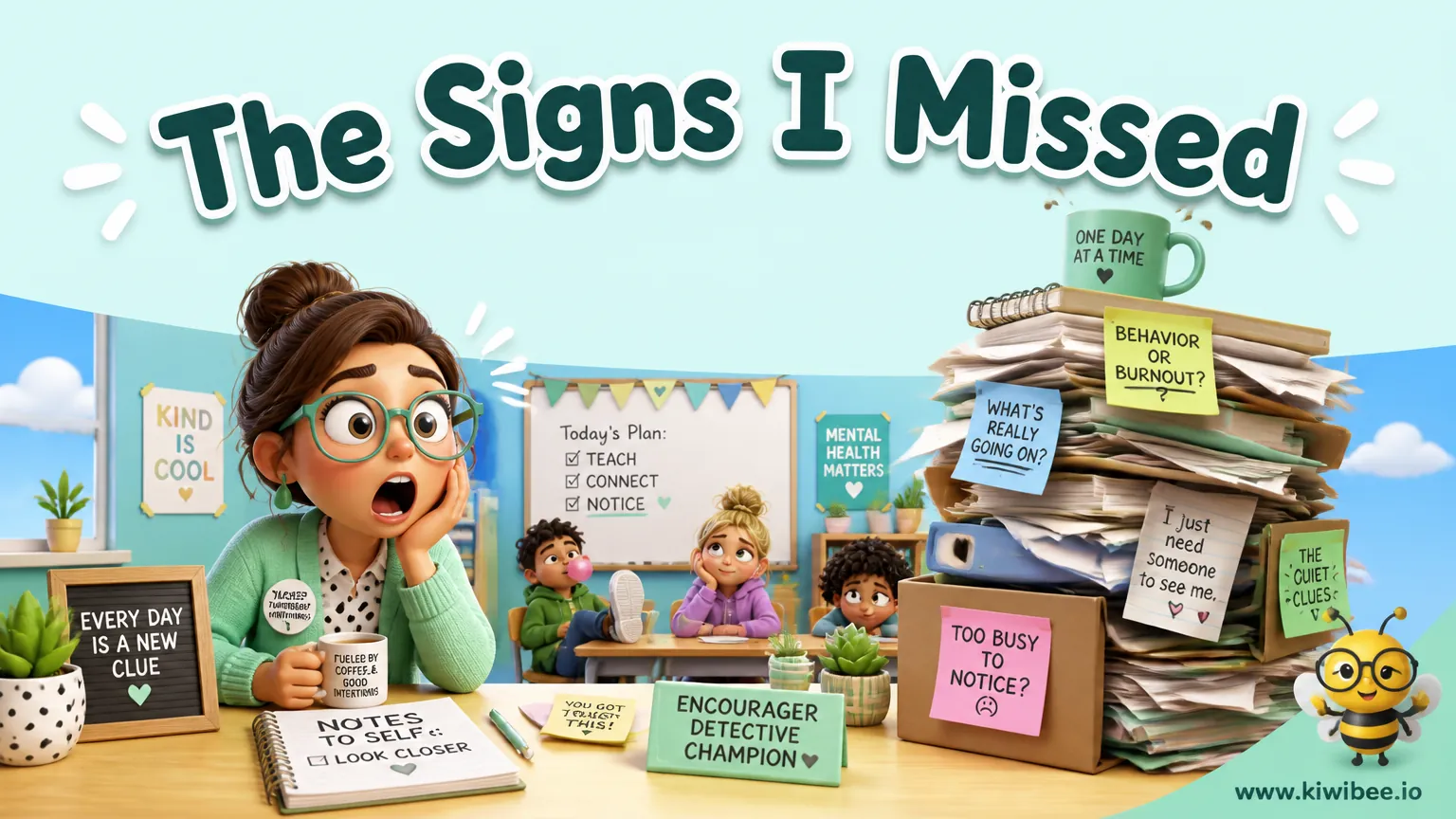
Teachers are often among the first adults to notice when a student seems different. That role matters, but it has limits. A classroom teacher is not there to diagnose, investigate alone, or provide treatment.
This guide focuses on practical school-based steps: what to observe, how to start a brief supportive conversation, when to document and refer, and when to use urgent safeguarding or emergency procedures without delay.
Current public-health guidance emphasizes that adolescent mental health is shaped by many interacting factors. The safest response is usually a team response involving school staff, families, and health services rather than one teacher trying to interpret everything alone.
Start with observation, not diagnosis
A useful first step is to notice changes from a student’s usual pattern. One isolated behavior may not mean much. A marked change across mood, behavior, work, attendance, peer interaction, or daily functioning deserves attention.
In class, this can look like a student who suddenly withdraws, stops speaking to peers, seems unusually agitated, appears overwhelmed by fear, or shows severe mood changes. It can also show up in work habits: sharp changes in concentration, missed tasks, a visible drop in functioning, or writing and discussion that repeatedly express hopelessness or severe emotional pain.
Observation should stay concrete. Record what was seen or heard rather than guessing the cause. For example, “left work blank three times this week and asked to leave class twice” is more useful than “seems depressed.”
- Look for marked withdrawal from classmates or normal activities.
- Notice intense worries or fear that disrupt everyday school activity.
- Pay attention to harmful out-of-control behavior or drastic personality change.
- Treat substance use concerns or signs of serious self-harm as referral issues, not classroom discipline issues alone.
- Watch for patterns across several days or settings when possible, not just a single difficult lesson.
Use ordinary classroom routines to notice change
Supportive routines can help teachers notice concerns early without turning the classroom into a screening tool. Simple habits such as greeting students at the door, scanning the room during independent work, and noticing shifts in seating, participation, or peer contact can reveal meaningful changes over time.
Student work can also provide context. Teachers do not need to interpret creative themes as proof of risk, but repeated expressions of hopelessness, severe pain, or self-harm should not be ignored. Content that seems alarming should prompt a private check-in and, if needed, referral through school procedures.
These routines are most helpful when they are consistent. The goal is not to search for hidden meanings in every behavior, but to know students well enough to spot when something has changed.
- Notice who usually talks, collaborates, or sits with others and whether that pattern changes sharply.
- Take note when a student’s energy, sleepiness, agitation, or emotional intensity seems very different from their normal baseline.
- Re-read concerning written or creative work for what it communicates, not only for grammar or analysis.
- If several small changes cluster together, move from private concern to documentation and consultation.
Have a brief, private, supportive conversation
If there is concern but no immediate sign of danger, a short private conversation can help. Keep the tone calm, specific, and non-judgmental. The purpose is to show care, listen, and decide whether the concern should be referred through school channels.
It helps to mention the observable change rather than making a label. For example: “I’ve noticed you seem quieter than usual and you’ve had trouble getting started in class this week. I wanted to check in.” That approach is clearer and safer than naming a condition or pressing for an explanation.
The teacher’s role in this moment is limited but important: listen, avoid promises of secrecy, and explain that if safety is a concern, school procedures require sharing the concern with the right people.
- Choose a private setting that follows school policy and appropriate professional boundaries.
- Lead with what was observed: a change in mood, withdrawal, distress, alarming written content, or disrupted daily functioning.
- Use open questions such as “How have things been lately?” or “Is there something making school hard right now?”
- Do not argue, diagnose, or demand a detailed disclosure.
- Do not promise to keep serious safety concerns secret.
Document and refer through the school team
When concerning behaviors are observed, SAMHSA advises consultation with the school counselor, nurse, administrator, and parents. In practice, that means following the school’s approved referral pathway rather than carrying the concern alone.
Good documentation is factual, dated, and limited to what matters for student support. Include what was observed, what the student said if relevant, what classroom impact was noticed, and which staff member was informed. Keep records according to school policy, approved systems, and local privacy requirements.
Teachers do not need proof before referring. A pattern of concerning changes is enough to consult. Referral is especially important when behaviors are marked, escalating, or affecting daily functioning.
- Write down dates, times, and direct observations.
- Record exact phrases when a student says something concerning, especially about hopelessness, severe pain, or self-harm.
- Note any immediate steps taken, such as informing the designated safeguarding lead, counselor, nurse, or administrator.
- Follow school policy for contacting families or passing concerns to those who do.
- Continue ordinary classroom support after referral, while respecting confidentiality and role boundaries.
Know the warning signs that need urgent action
Some signs require immediate action rather than a wait-and-see approach. SAMHSA identifies suicide warning signs such as new or increasing hopelessness, severe emotional pain, withdrawal, sleep changes, agitation, and statements or plans about suicide. Serious self-harm attempts or plans also require urgent response.
In these situations, a teacher should not investigate alone, assess risk independently, or send the student away with a promise to talk later. The correct step is to activate the school’s urgent safeguarding or emergency procedure immediately.
If there is immediate risk of harm, use local emergency services and the school’s emergency process without delay. Stay within school procedures for supervision, handover, and documentation.
- Treat statements or plans about suicide as urgent.
- Act immediately on serious self-harm attempts or plans.
- Escalate severe agitation, overwhelming fear, or harmful out-of-control behavior when safety may be affected.
- Use the designated emergency or safeguarding pathway rather than trying to manage the crisis alone.
Build a classroom and school environment that supports students
Individual teacher actions matter most when they sit inside a wider school response. UNICEF, WHO, and UNESCO recommend whole-school approaches that create supportive environments and connect students, families, teachers, and services.
For classroom teachers, that usually means predictable routines, respectful relationships, inclusive participation, and clear referral pathways when concerns arise. It also means understanding that support is shared work: schools, families, communities, and health services each have a role.
A strong system makes it easier for staff to raise concerns early. Teachers should know whom to contact, what to document, and what the urgent process is before a crisis happens.
- Make check-ins and respectful greetings part of normal classroom practice.
- Use consistent routines that reduce unnecessary stress and make changes easier to notice.
- Know the names or roles of the counselor, nurse, administrator, and safeguarding lead in your setting.
- Encourage a culture where raising a concern is expected, even when the teacher is uncertain.
- Review school procedures regularly so urgent action does not depend on memory in a crisis.
The teacher’s role is to notice, respond, and refer
A careful teacher can make a real difference by noticing changes early, checking in briefly and respectfully, documenting concerns, and involving the right people at the right time.
The key boundary is just as important as the key opportunity. Teachers observe, listen, document, and refer. They do not diagnose or provide treatment, and they should not handle immediate risk alone. When warning signs suggest urgent danger, follow the school’s safeguarding or emergency procedure and use local emergency services without delay.
Sources and further reading
Explore the platform
Continue with KiwiBee
Choose the KiwiBee workspace or resource library that fits what you need next.
Related posts
Why I Stopped Dreading Lesson Observations (A Principal's Confession)
After 20 years in education, I thought I knew what teacher observations had to be. Clipboard, checklist, anxiety. Then we discovered a better way.

After 25 Years in Education, AI Showed Me What I'd Been Missing
I thought I was an expert observer. Then AI analysis of the same lessons I watched showed patterns my experienced eyes had completely missed.

I Left Finance for Teaching at 35. Here's What Nobody Warned Me About.
After 12 years in investment banking, I thought teaching would be easier. I was wrong about almost everything — but not in the ways I expected.
 For big organisations
 For schools
 For centers
 For team leaders
 For teachers
 AI and resources
 Printable worksheets
 Teacher tools
 AI studio
 Ideas and research