Rethinking Homework Policy in Primary and Middle Years
A practical framework for deciding what to assign, what to drop, and how to protect learning time
 By KiwiBee· KiwiBee
Last updated July 11, 2026
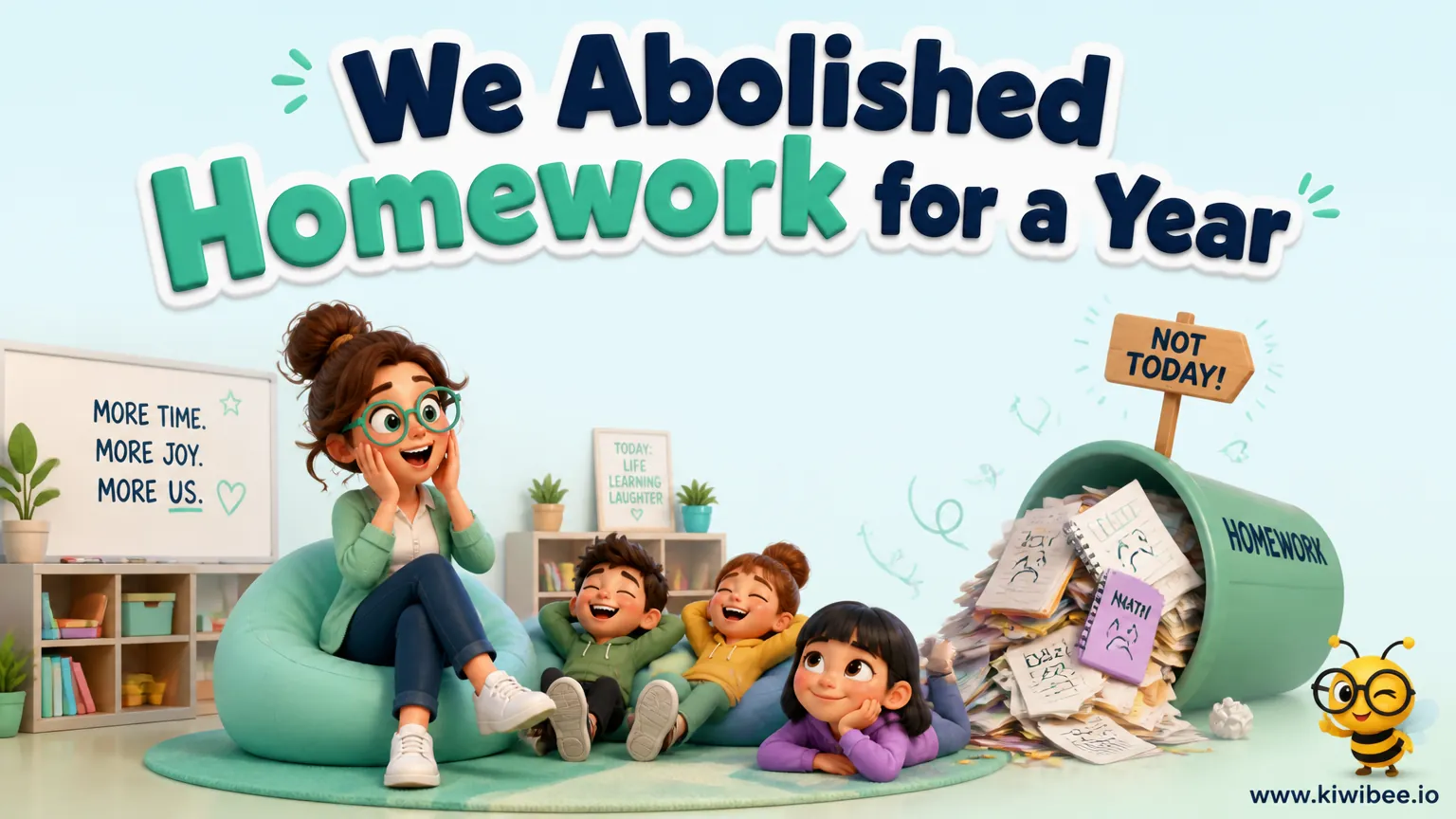
Homework policy often becomes a proxy argument about standards, family life, and teacher expectations. One side sees homework as necessary discipline. Another sees it as stress, conflict, or low-value repetition. Both concerns can be real at the same time.
A more useful question is not whether homework is always good or always bad. It is whether a specific type of homework serves a clear learning purpose for a specific age group and subject.
For school leaders and teachers, that shifts the work from defending tradition to making design decisions. Which tasks genuinely need independent practice? Which tasks can be taught better in class? Which assignments create more compliance work than learning?
Start with purpose, not habit
The weakest homework is assigned because it is expected, not because it solves a learning problem. Nightly tasks can easily become routine worksheets, reading logs, or unfinished classwork sent home without a clear reason.
A stronger policy begins by sorting homework into purposes. Some tasks build fluency through repeated practice. Some extend reading volume. Some prepare students for a discussion or project. Some merely prove that something was assigned.
When schools examine homework this way, they often find that one policy does not fit every age group or subject. Younger students may gain little from required nightly assignments, while older students may still benefit from targeted independent practice in selected areas.
- Ask teachers to label each recurring homework task by purpose: fluency practice, reading, preparation, retrieval, project work, or completion.
- Remove any task that cannot answer a simple question: what will students learn from doing this at home rather than in class?
- Separate ‘practice’ from ‘proof of compliance’ when reviewing existing assignments.
- Check whether homework is compensating for weak lesson design, rushed pacing, or limited class practice.
- Decide whether the same learning goal could be met through better use of class time instead of take-home work.
Treat age and subject as decision factors
Homework decisions should vary by developmental stage. Younger students usually need predictable routines, time to read, play, talk, and sleep, and support that does not depend heavily on adult availability at home. Required nightly homework can crowd out those needs without adding much learning value.
Older students are different. They may be more ready for independent practice, especially where fluency matters. Mathematics is a common example. When students need repeated practice to strengthen accuracy and automaticity, some carefully chosen work outside class may help.
Reading deserves separate treatment. Assigned chapters and reading logs do not always create better readers. In many classrooms, students read more willingly and attentively when they can choose their own books and read without turning every session into a monitored task.
- Use one policy for younger primary years only if it protects time for reading, rest, and family routines.
- Consider limited, purposeful independent practice in upper primary or middle years where skill fluency is essential.
- Avoid assuming that every subject needs homework simply because mathematics may benefit from extra practice.
- Treat self-selected reading differently from written reading tasks; the goal may be volume and enjoyment, not paperwork.
- Adjust expectations for students who rely on transport, caregiving duties, shared devices, or inconsistent adult help at home.
Expect the transition period to be messy
A school that reduces or removes mandatory homework should expect uncertainty at first. Families may worry that less homework means lower expectations. Students who are used to being told exactly what to do each evening may not know how to use the extra time well. Teachers may feel exposed if they previously relied on homework to finish practice or cover content.
That does not mean the policy is failing. It means routines are changing. Schools need to explain the purpose of the change and show what will replace the old system. If independent learning remains important, it should be visible in classroom practice, longer-term projects, reading habits, and optional extension pathways.
The key is not to promise a smooth rollout. The key is to prepare for the friction points.
- Explain the policy to families in plain language before implementation, including what is changing and what is not.
- State clearly whether homework is optional, required, or differentiated by year level and subject.
- Give families examples of useful home activities that support learning without becoming formal assignments.
- Prepare a short script for teachers to answer common concerns about standards, readiness, and assessment.
- Review the first month closely for confusion about expectations rather than treating complaints as evidence that the policy should be reversed immediately.
If homework is reduced, class time has to improve
Removing homework does not remove the need for practice, feedback, and strong instruction. It shifts more responsibility onto the school day. Teachers may need tighter lesson sequences, clearer modelling, more guided practice, and better checks for understanding.
This can be a productive pressure. If class time must carry more of the learning load, low-value activities become harder to justify. Teachers may become more selective about what they teach, what they assess, and how they use independent work periods.
Feedback also changes. Instead of spending time checking whether homework was completed, teachers can focus more on work produced in class, conferences, drafts, and visible evidence of student thinking.
- Audit where practice currently happens: teacher model, guided work, independent work, or homework.
- Build extra in-class practice into units before removing a routine homework task.
- Use exit tickets, short conferences, or live marking to catch misunderstandings that homework once revealed belatedly.
- Reduce tasks that generate large amounts of superficial marking and replace them with fewer pieces of work that allow meaningful feedback.
- Check whether students have enough protected reading and problem-solving time during the school day.
Use a differentiated policy instead of a slogan
Many schools do not need an all-or-nothing homework rule. A differentiated policy is often more practical than declaring homework abolished or fully restored.
For example, a school might choose no required homework in younger primary years, limited mathematics practice in older year levels, self-selected reading expectations, and project work with longer completion windows. The common thread is that each task has a reason and a timescale that matches the kind of learning involved.
Longer deadlines matter. Work that invites planning, revision, and family conversation is different from work that creates a nightly deadline and recurring conflict. Not every take-home task should feel urgent.
- Write separate homework expectations for lower primary, upper primary, and middle years if your school spans multiple stages.
- Limit required homework categories rather than allowing every subject to add its own routine tasks.
- Use longer windows for projects so students can plan, revisit, and seek help without a nightly compliance cycle.
- Keep optional extension available for students who want more challenge, but do not let optional work quietly become expected work.
- Review the total homework load across subjects to prevent overlap and deadline clustering.
Judge impact with caution
Schools should be careful about claiming that a homework change caused better academic results, lower stress, or stronger engagement unless they can show how those conclusions were reached. Many factors can influence outcomes across a year.
That said, schools can still evaluate a policy responsibly. The aim is not to produce sweeping proof from a local change. The aim is to learn whether the policy is working well enough for students, families, and staff.
Useful evaluation asks a small set of practical questions. Are students completing more meaningful practice in class? Are particular subjects showing gaps that need a different approach? Are families clearer or more confused? Are teachers spending less time policing completion and more time teaching?
- Compare year-level expectations before and after any policy change so staff know what evidence to watch.
- Track subject-specific concerns separately; one area may need adjustment even if the overall policy is working.
- Use family and teacher feedback to identify stress points, but avoid turning perception alone into proof of impact.
- Look at classroom evidence such as quality of in-class work, participation, and feedback cycles, not just whether homework rates changed.
- Schedule a formal review point so the policy can be refined rather than defended as permanent from day one.
A hypothetical review process for school leaders
A school leadership team considering change could use a staged review rather than jumping straight to a bold announcement. This example is hypothetical, but it shows how to turn a values debate into a workable process.
First, gather current homework expectations by year level and subject. Second, sort each task by purpose and estimated time. Third, identify where tasks depend heavily on parent supervision or create routine marking with little feedback value. Fourth, decide where independent practice is still necessary and where class redesign would do more for learning.
After that, draft a simple policy, communicate it clearly, and set a review date. The most important feature is not the exact rule. It is the discipline of aligning homework with curriculum goals instead of leaving it to habit.
- Collect actual examples of current homework rather than relying on general descriptions.
- Ask teachers to bring one task they believe is essential and explain why it must happen at home.
- Identify tasks that create family conflict or inequity because they require materials, internet access, or adult teaching.
- Pilot changes in a limited set of year levels if the school needs a lower-risk starting point.
- Publish a short parent guide with examples of what supportive home learning can look like without formal assignments.
The best homework policy is specific
Homework works poorly when it is treated as a symbol of rigour rather than a tool for learning. Schools do better when they ask what kind of learning is needed, for whom, and under what conditions.
That often leads to a more precise policy: less routine homework for younger students, more deliberate use of class time, selective independent practice where it truly matters, and fewer assignments that exist only because they always have. The goal is not to win the homework argument. The goal is to assign work worth doing.
Explore the platform
Continue with KiwiBee
Choose the KiwiBee workspace or resource library that fits what you need next.
Related posts
What Parents Actually Want from Homework (We Surveyed 500 Families)
We expected parents to demand more rigorous homework. What we found was a community desperate for something entirely different.

We Replaced 6 Apps With One Platform — Here's Our Honest First Year
Google Classroom, ClassSpark, spreadsheet gradebooks, separate scheduling software, an exam platform, and email newsletters. Last year, we ran all of it. This year, we don't.
I Used to Spend Sundays Making Worksheets — AI Changed That Forever
The AI doesn't just create generic worksheets. It looks at each student's gradebook data and generates homework targeting their specific weak spots. Differentiation that would take me hours happens in seconds.
 For big organisations
 For schools
 For centers
 For team leaders
 For teachers
 AI and resources
 Printable worksheets
 Teacher tools
 AI studio
 Ideas and research