What Parents Need From Homework Communication
A practical editorial for schools that want homework to support learning without creating unnecessary family friction.
 By KiwiBee· KiwiBee
Last updated July 11, 2026
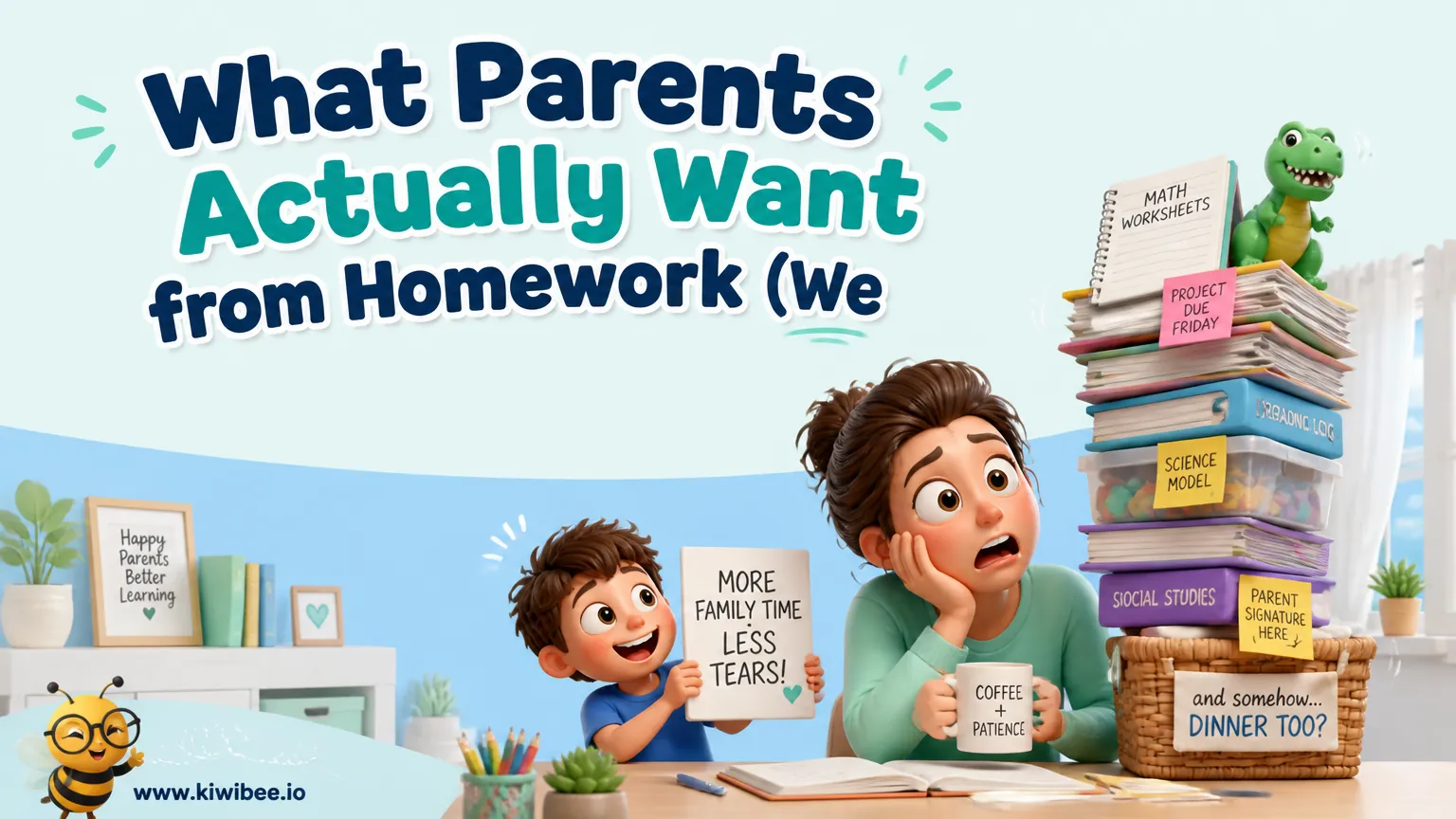
Homework complaints are often framed as a debate about how much work students should do. In practice, many concerns start somewhere else: families do not always understand the purpose of the work, how it connects to class learning, or what kind of help is actually useful at home.
That shifts the leadership question. Instead of asking only whether homework is harder, lighter, longer, or shorter, schools may need to ask whether it is visible and understandable to the adults supporting students after school.
A cautious reading of parent-feedback themes suggests a clear lesson: families often want better insight into learning, less confusion about expectations, and fewer home routines built around preventable conflict. Those needs can be addressed without asking parents to become substitute teachers.
Move the conversation from volume to clarity
When homework creates tension, schools can be tempted to solve the problem by adjusting the amount. Sometimes that is necessary. But reducing or increasing volume will not fix assignments that families cannot interpret.
A worksheet, task list, or online post may tell students what to do without telling families what the learning goal is. That gap matters. Many adults are willing to support effort, routines, and encouragement, but they cannot do that well if the purpose of the task is hidden.
For classroom teachers, the practical shift is simple: explain the concept behind the assignment, not only the instructions. A family does not need a full lesson plan. It usually needs a short statement of what the student is practising and what success looks like.
- Add one plain-language sentence to homework directions: 'This task helps students practise...'.
- State whether the goal is fluency, comprehension, discussion, revision, or preparation for a later lesson.
- Tell families what kind of support is helpful, such as listening, asking questions, checking completion, or helping a child organise time.
- Avoid assuming that an assignment list on its own gives enough context for home support.
Help families support learning without teaching the lesson
A common source of frustration is the belief that helping with homework requires subject expertise. That is often unrealistic. Families vary in confidence, time, language background, and familiarity with current curriculum approaches.
Schools can lower that barrier by defining a support role that does not depend on parents knowing the content in detail. In many cases, the most useful home support is not explanation but conversation, routine, and observation.
For example, if a class is learning a mathematical idea, families may not need to reteach the method used in class. They may only need to know the core idea being developed so they can notice it in everyday life or ask a useful question at dinner.
- Describe the learning goal in parent-friendly language rather than specialist classroom terms alone.
- Include one or two prompts families can use, such as 'Can you show me how you started?' or 'What part felt easiest or hardest?'.
- Make clear when parents should not correct method or provide answers if that would interfere with the teacher seeing student understanding.
- Offer examples of support that fit ordinary routines, such as talking during a car ride, reading instructions together, or helping a child plan when to begin.
Use conversation starters instead of more paperwork
Not all homework needs to produce a stack of completed pages. In some cases, a short conversation can reinforce learning more effectively and with less stress.
Conversation-based tasks can help families feel included because they reveal what students are studying and give adults an easy entry point. They are also often more manageable for households with limited evening time.
This does not mean every assignment should become informal. It means schools should consider when the purpose of homework is better served by discussion, retrieval, explanation, or reflection than by repetitive written tasks.
- Send one brief discussion prompt each week linked to current learning, such as a question, scenario, or explain-your-thinking task.
- Keep prompts specific enough that families know where to start and short enough to use in five minutes.
- Label discussion tasks clearly so families understand that the goal is talking and thinking, not producing polished written work.
- Use hypothetical examples when introducing this format, such as: 'At home, a student might explain how a character changed during the story'.
Give advance notice for assignments that affect home routines
Families can usually manage demanding work better when they can see it coming. Last-minute projects, unclear deadlines, and hidden material requirements create avoidable pressure.
Advance notice is not only a convenience issue. It is an equity issue. Some households need more time to arrange transport, materials, shared devices, or a quiet work period.
A predictable homework rhythm can reduce conflict because students and families spend less energy on surprise and more on planning.
- Announce larger assignments early and repeat the date in the same place each time so families know where to check.
- Break projects into interim steps with suggested completion points rather than revealing only the final deadline.
- Flag any materials, reading, or online access students will need before the night the work is due.
- If your school uses digital platforms, check whether families can realistically access notifications and instructions.
Look for signs that homework is creating unproductive conflict
Some level of challenge is normal in learning. Persistent evening conflict is different. When homework repeatedly turns parents into monitors, negotiators, or reluctant enforcers, the school should examine whether the task design is contributing to the problem.
This does not mean all resistance signals a flawed assignment. Students may avoid effort for many reasons. But when the same patterns appear across many homes, schools should review clarity, timing, workload, and developmental fit.
Leaders can support teachers here by treating homework concerns as a design problem to investigate, not a loyalty test between rigor and convenience.
- Ask whether the assignment can be completed with the knowledge and materials students already have.
- Check whether the expected duration matches students' age and the task's actual complexity.
- Notice repeated parent questions that signal confusion, such as 'What are they supposed to do here?' or 'How should I help?'.
- Review whether students are being asked to learn brand-new content independently at home rather than practise taught content.
Create a simple homework communication routine teachers can sustain
The best homework communication system is one that teachers can maintain consistently. A perfect template used once is less helpful than a modest routine used every week.
Schools do not need elaborate reports to improve visibility. A brief weekly summary, a standard homework note structure, or a shared team template can be enough if it clearly names learning goals and expectations.
Leaders should be careful not to solve a communication problem by adding excessive teacher workload. If a new process is too heavy, it will become uneven, and families will again receive mixed signals.
- Use a repeatable format: what we are learning, why it matters, what students are doing, and how families can help.
- Limit home-facing summaries to the most important points so they are readable on busy evenings.
- Coordinate across a year level or department so families do not receive conflicting styles and expectations from different classes.
- Pilot any new communication routine with a small team first and revise it for clarity and workload before wider rollout.
A hypothetical workflow schools can adapt
A practical homework communication model might look like this. On Friday, a teacher sends a short summary of the coming week's focus. It names the main concept, one reason it matters, any larger deadline on the horizon, and one optional question families can ask at home.
On Monday, students receive the assignment with a plain-language purpose statement. The task directions tell families whether support should look like listening, checking completion, or helping the student plan time. If the work depends on prior teaching, that is stated clearly.
During the week, the teacher notes any recurring confusion from students or families and adjusts the next summary accordingly. Over time, the communication becomes shorter because the routine is familiar. The point is not to produce more messages. It is to make each message more usable.
- Start with one class or one year level before scaling the routine school-wide.
- Use family questions as feedback on assignment design, not only on family engagement.
- Keep optional supports clearly optional so homework does not become more demanding for households with less time.
- Review after a few weeks whether the routine improved understanding without creating extra administrative burden.
Homework works best when the support role is clear
The most useful insight in parent feedback is often not a demand for more or less homework, but a request for clearer connection to learning. Families want to know what students are working on, what the assignment is for, and how to help without taking over.
For teachers, that means making learning goals visible. For school leaders, it means building homework policies around clarity, predictability, and realistic home support. When those pieces are in place, homework is more likely to reinforce learning and less likely to become an avoidable source of stress.
Explore the platform
Continue with KiwiBee
Choose the KiwiBee workspace or resource library that fits what you need next.
Related posts
We Abolished Homework for a Year. Here's What Actually Happened.
When our school eliminated homework for one academic year, we expected backlash. What we found challenged assumptions on all sides.

Why I Ditched Letter Grades — And What My Parents Actually Want to Know
Parents used to ask 'What grade did my child get?' Now they ask 'Which skills should we practice at home?' That shift tells you everything about why skills-based assessment works.

Parent Engagement Jumped 340% When We Stopped Sending Letter Grades
Parents ignored our termly reports. Then we switched to real-time skill dashboards with specific practice suggestions. Suddenly they were logging in weekly and asking the right questions at parents' evening.
 For big organisations
 For schools
 For centers
 For team leaders
 For teachers
 AI and resources
 Printable worksheets
 Teacher tools
 AI studio
 Ideas and research