Replacing Letter Grades With Skill-Based Feedback
A practical way to make reporting more useful for teachers, families, and students
 By KiwiBee· KiwiBee
Last updated July 11, 2026
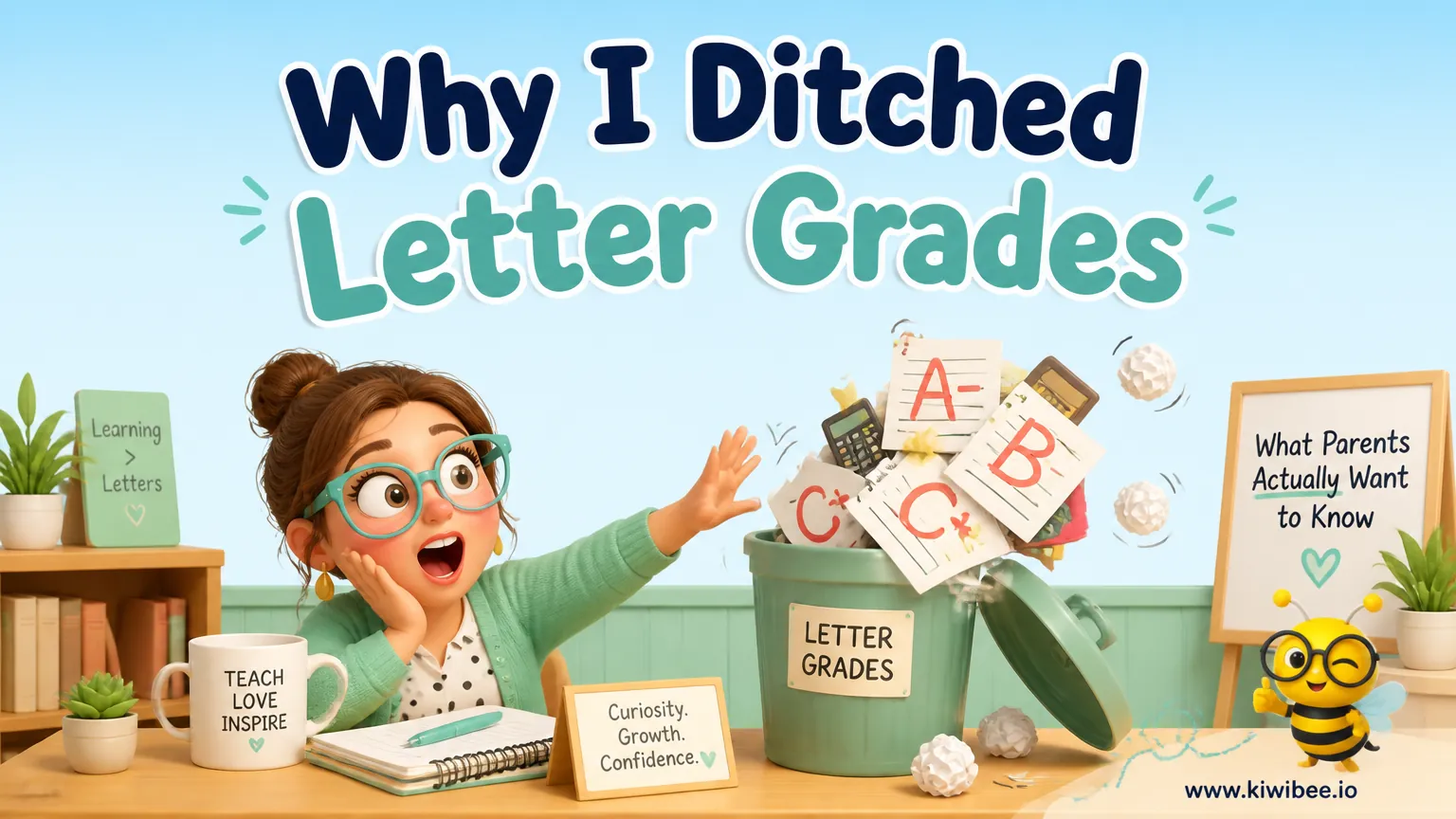
A single letter grade can summarize performance, but it often does a poor job of explaining what a student actually understands. Two students may earn the same overall mark while needing very different kinds of support.
For teachers and school leaders, the practical question is not whether grades should disappear in every context. It is whether reporting systems give enough detail to guide instruction, intervention, and conversations with families.
A skill-based approach can help. Instead of reducing a unit to one average, it breaks learning into specific skills or concepts and shows where each student is secure, developing, or struggling.
Why a single grade can be misleading
An overall grade tends to compress uneven performance into one symbol. In mathematics, for example, a student may be confident with multiplication and division but not yet secure with fractions or word problems. Another student may perform at a similar middling level across every topic. If both receive the same overall grade, the report hides the difference.
That matters because these students do not need the same response. One may need targeted help with a narrow concept. The other may need broader review, slower pacing, or more frequent checks for understanding.
When reporting blurs those distinctions, it can also weaken communication with families. A parent who sees a B or C may understand whether performance is broadly strong or shaky, but not what to do next. Specific feedback makes the next step easier to see.
- Treat overall grades as summaries, not diagnoses of learning needs.
- Separate reporting on unit performance from reporting on individual skills.
- Review recent assessments to identify where one grade is masking very different patterns of understanding.
What skill-based feedback looks like in practice
Skill-based feedback breaks a subject into clear learning targets and records progress on each one. In a primary mathematics class, those targets might include recalling multiplication facts, comparing fractions, solving multi-step word problems, or explaining reasoning.
Teachers can then record a level for each skill using a simple scale such as secure, developing, and needs support, or a numbered proficiency scale if that matches school policy. The exact labels matter less than their consistency and clarity.
What changes is not only the report format but the teaching workflow. Instead of asking, "Who got low marks on the test?" the teacher asks, "Which students need more work on this specific skill, and which students are ready to move on?"
- Define skills in plain language that both staff and families can understand.
- Use a small number of reporting levels so judgments stay manageable and consistent.
- Align each classroom task or assessment item to one or more specific skills before teaching the unit.
How this supports better instructional decisions
The main advantage of skill-level reporting is that it makes grouping and reteaching more precise. If several students are struggling with the same concept, the teacher can run a short intervention group without reteaching the entire unit to everyone.
At the same time, students who are already secure can work on extension tasks, application problems, or peer discussion rather than repeating content they have already mastered. This can make classroom time more efficient without requiring a complete redesign of the curriculum.
Skill patterns can also reveal when a problem lies in the design of instruction rather than in individual effort. If many students miss the same skill, that may signal a need to revisit examples, explanations, or task design.
- Group students by current skill need rather than by overall average whenever possible.
- Use skill-level data to decide whether to reteach a whole class, a small group, or only a few students.
- Look for class-wide weak spots as a prompt to review instruction, not just student performance.
How to make family reporting more useful
Families often want more than a verdict. They want to know what a child is doing well, what is still difficult, and how to help without guessing. Skill-based reporting can support that kind of conversation if it stays simple and specific.
A family-facing report does not need every score from every task. It needs a clear picture of strengths, current areas for support, and a small number of practical next steps. For example, telling a family that a child is secure with multiplication but still developing fraction comparison is more useful than saying the child is "average in maths."
This approach can also reduce misunderstandings. Instead of debating why a grade shifted from one reporting period to another, the conversation can focus on what the student is currently learning and what practice would help most.
- Show families a short list of strengths before discussing areas of difficulty.
- Name the exact skill needing support instead of giving a broad subject label.
- Offer one or two home practice ideas tied to the skill, not a generic instruction to "do more practice."
A hypothetical classroom example
Consider a hypothetical Year 4 mathematics class finishing a unit with four assessed skills: multiplication facts, division strategies, fraction comparison, and solving word problems. Two students receive the same overall result if their scores are averaged.
Student A is strong on multiplication and division but weak on fractions and word problems. Student B is moderately secure across all four skills but has not yet mastered any of them. An overall grade makes them look similar. A skill profile does not.
With skill-level information, the teacher might place Student A in a short, focused small group on fractions and language in problem solving, while Student B receives broader review across several concepts. The teacher can then explain that difference clearly to families.
- Use hypothetical profiles in staff training to show how the same overall grade can hide different learning needs.
- Test whether a report format would help a teacher choose an intervention within a minute or two.
- Check whether families could read the report and identify one sensible next step without additional explanation.
Implementation choices school leaders should settle early
A move toward skill-based reporting can stall if schools do not agree on basic design decisions. Staff need shared expectations about which skills are reported, how proficiency is defined, and how often judgments are updated.
Leaders also need to decide how the system will coexist with any required overall grades. In some settings, schools must still produce a final grade for reports or transcripts. If so, the skill-based layer should be treated as the richer explanation underneath the summary, not as a competing system teachers must maintain twice over.
Moderation matters as well. If one teacher interprets "secure" very differently from another, families will receive inconsistent messages and staff confidence will drop.
- Create shared definitions for each reporting level using student work examples where possible.
- Limit required reporting categories to those teachers can assess reliably during normal instruction.
- Decide in advance how skill-level judgments connect to any mandated report grades.
- Build short moderation routines into team meetings so staff can compare interpretations of the same skill.
Questions to ask before adopting a digital tool
Many schools use digital gradebooks or dashboards to track skill progress. These can be helpful if they reduce workload, make patterns visible, and produce family-friendly reports. They can also create new problems if the setup is too complex or if the visual design encourages false precision.
The important issue is not whether a platform looks impressive. It is whether the tool supports sound assessment practice. A color-coded view, for example, may help teachers spot patterns quickly, but only if the underlying judgments are based on clear criteria and current evidence.
Schools should also check what families will see. A parent report that is too technical may confuse rather than clarify. A simple dashboard can be useful, but it should not replace teacher explanation when nuance is needed.
- Verify that any tool can organize evidence by skill rather than only by assignment average.
- Check whether teachers can update judgments quickly during normal marking routines.
- Review family-facing displays for clarity, accessibility, and plain language.
- Confirm how the tool handles changes over time so old evidence does not distort current understanding.
- Verify current plan details, privacy terms, and reporting features directly before adoption.
Common pitfalls to avoid
One risk is overcomplication. If teachers are asked to track too many skills too often, the system can become a compliance task rather than a teaching aid. Keep the focus on information that changes instruction.
Another risk is turning every skill judgment into a permanent label. Skill-based reporting should describe current learning, not define a student. Reports should leave room for growth and revision as new evidence emerges.
A third risk is assuming families automatically understand proficiency language. Terms such as developing or secure may need explanation, especially during the first reporting cycle.
- Do not report more skills than teachers can assess consistently and explain clearly.
- Avoid presenting proficiency levels as fixed traits rather than current snapshots of learning.
- Prepare a short family guide that explains reporting terms with plain examples.
- Review whether the reporting process is saving instructional time or quietly adding duplicate work.
A better report answers the next-step question
The strongest case for skill-based feedback is practical. It helps teachers decide whom to reteach, what to reteach, and what to communicate to families. It also helps families move from reacting to a grade to supporting a specific area of learning.
Letter grades may still have a place in some school systems, especially where summary reporting is required. But on their own, they rarely tell the whole story. When schools need reporting that supports action, skill-level feedback is often the more useful layer.
Explore the platform
Continue with KiwiBee
Choose the KiwiBee workspace or resource library that fits what you need next.
Related posts
Parent Engagement Jumped 340% When We Stopped Sending Letter Grades
Parents ignored our termly reports. Then we switched to real-time skill dashboards with specific practice suggestions. Suddenly they were logging in weekly and asking the right questions at parents' evening.
What Parents Actually Want from Homework (We Surveyed 500 Families)
We expected parents to demand more rigorous homework. What we found was a community desperate for something entirely different.
The Optimal Scoring System: A Comprehensive Analysis
A thorough analysis of grading systems: 0-10 scales, letter grades with plus-minus modifiers, and skills-based mastery tracking. Discover which approach best balances precision and communication.
 For big organisations
 For schools
 For centers
 For team leaders
 For teachers
 AI and resources
 Printable worksheets
 Teacher tools
 AI studio
 Ideas and research