The Pencil Case is Lava: A Classroom Management Technique
A playful strategy for reducing stationery-related distractions in primary classrooms.
 By KiwiBee· KiwiBee
Last updated May 26, 2026
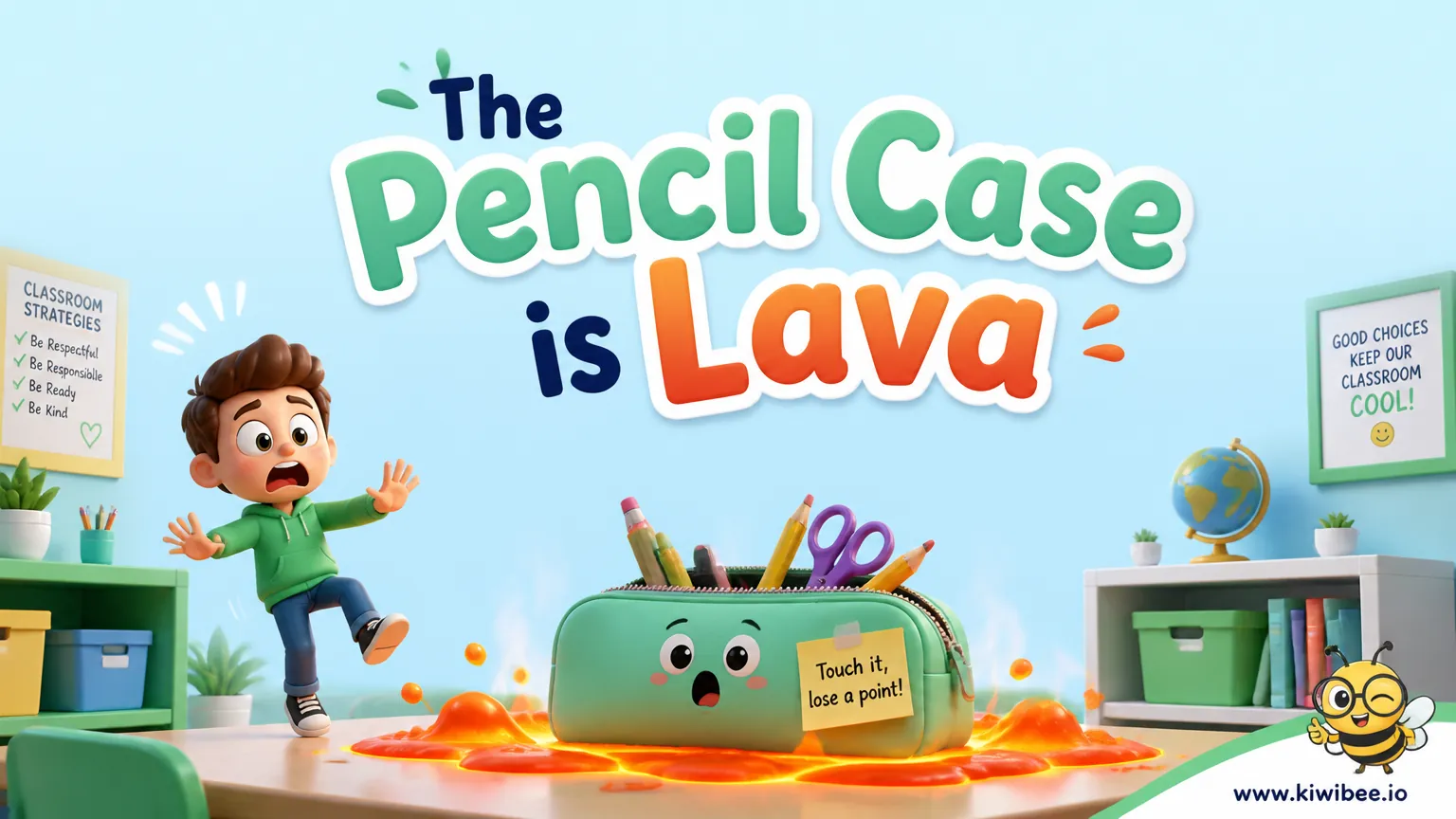
The Pencil Case Is Lava: a tiny technique that ended my biggest daily friction
If you teach primary and you have ever lost ten minutes of a lesson to a student rummaging through their pencil case, swapping pens with a friend, or picking up other people's stationery, this post is for you. The technique below — invented by my colleague Teacher Ali — solved my single biggest source of classroom friction in under a week. It is dumb. It works.
The problem
Primary students treat the pencil case like a treasure chest. They open it to find one pencil. They take out three. They notice a colourful pen belonging to a tablemate. They pick that up too. They drop it. They lean across to retrieve it. The kid behind them now wants the colourful pen. Within thirty seconds, half the row is rummaging in stationery, and I have lost the lesson.
I tried lecturing. I tried point penalties. I tried banning extra stationery on desks. Nothing worked because the underlying behaviour was a frame problem — the kids genuinely did not perceive what they were doing as wrong. They were just borrowing a pen.
The technique
The pencil case is lava. Once it is on a desk, no one is allowed to touch any pencil case except their own. Touching another pencil case — even brushing it, even leaning on the desk near one — counts as 'the lava got you'. The student who touches another pencil case loses a small privilege or a behaviour point.
The reframing is the entire trick. The kids already know The Floor Is Lava from the playground game. They understand the rule instantly. The pencil case is no longer a treasure chest — it is a hazard zone. Their natural reflex shifts from 'reach across and grab' to 'avoid'. The actual behaviour I wanted is now intuitive because the metaphor reframes the cost.
How I introduce it
Day one: I play a short Floor Is Lava game in the classroom as a brain break. The kids run around avoiding the floor. Two minutes. I let them have fun with it.
Day two: I tell the class that for the rest of the year, the same rule applies — but to pencil cases. I make it dramatic. I do a slow-motion demonstration of a hand reaching for a pencil case, then 'getting burned' by the lava. The kids laugh. The rule is now in the room.
Day three onward: the moment a student touches someone else's pencil case, I point and say 'lava got you.' Half the time they catch themselves before I have finished the sentence. The point penalty is small but consistent. Within a week, the behaviour is extinct.
Why this works when other approaches do not
Three reasons. First, it is a game frame, not a discipline frame — the kids enforce it on each other because it is fun, not because they fear punishment. Second, the rule is concrete and binary (touched / did not touch) rather than fuzzy ('be respectful of others' belongings'). Third, the metaphor does the cognitive lifting — the kids' brains already understand 'avoid the lava' as a complete pattern.
Two variations worth trying
Variation 1: extend the lava to other classroom objects that cause friction. The whiteboard markers are lava (no one but the teacher touches them). The lunch box on Mia's desk is lava. The expensive electronics on the side bench are lava. Any object you want kids to leave alone can be reframed.
Variation 2: tie the lava rule to a wider behaviour layer. Kids who avoid the lava all week earn a Friday reward. I pair it with ClassSpark points — every day of avoidance earns a participation point, redeemable in the class shop. Tiny consistent rewards beat occasional big ones.
The broader principle
Most classroom management problems are reframe problems, not discipline problems. The kid who is 'distracted' is reacting normally to a frame that allows distraction. The kid who is 'reaching for the wrong thing' is reacting normally to a frame where the wrong thing is reachable. Reframe the floor, the pencil case, the marker — and the behaviour follows.
This year I am also routing more of these tiny micro-routines through ClassSpark, which gives the consistent reward layer at zero teacher cost, and the parent portal so parents see the small daily wins at home rather than only hearing about the big incidents. The pencil case becoming lava is a small win. Small wins, repeated, are the entire teaching of behaviour.
Where this fits in KiwiBee
If you want a behaviour layer behind these little routines, KiwiBee adds ClassSpark to reward the small wins, a class shop that gives the points purpose, and a parent portal that shows the routines at home. Try it free at app.kiwibee.io.
Explore the platform
Continue with KiwiBee
Choose the KiwiBee workspace or resource library that fits what you need next.
Related posts
Quick Classroom Management Board Ideas
Explore four classic classroom management boards, from happy face charts to star systems, and learn how to digitize them with ClassSpark for real-time parent visibility.
Top Gadgets to Use in the Classroom for Kindergarten and Primary Teachers
From laser pointers to self-inking stamps, discover five affordable gadgets that help kindergarten and primary teachers manage attention, deliver lessons, and give instant feedback.
Classroom management strategies that actually work in elementary (2026)
Most classroom-management advice is theoretical Pinterest content. This is what actually works in a real elementary classroom in 2026 — ten concrete strategies, the principle behind each, the way each one usually fails, and the free tool that supports it.
 For big organisations
 For schools
 For centers
 For team leaders
 For teachers
 AI and resources
 Printable worksheets
 Teacher tools
 AI studio
 Ideas and research