Designing Classroom Roles and Routines for an AI-Rich School
A practical framework for deciding what teachers should keep, what software may assist with, and where schools need firm boundaries
 By KiwiBee· KiwiBee
Last updated July 11, 2026
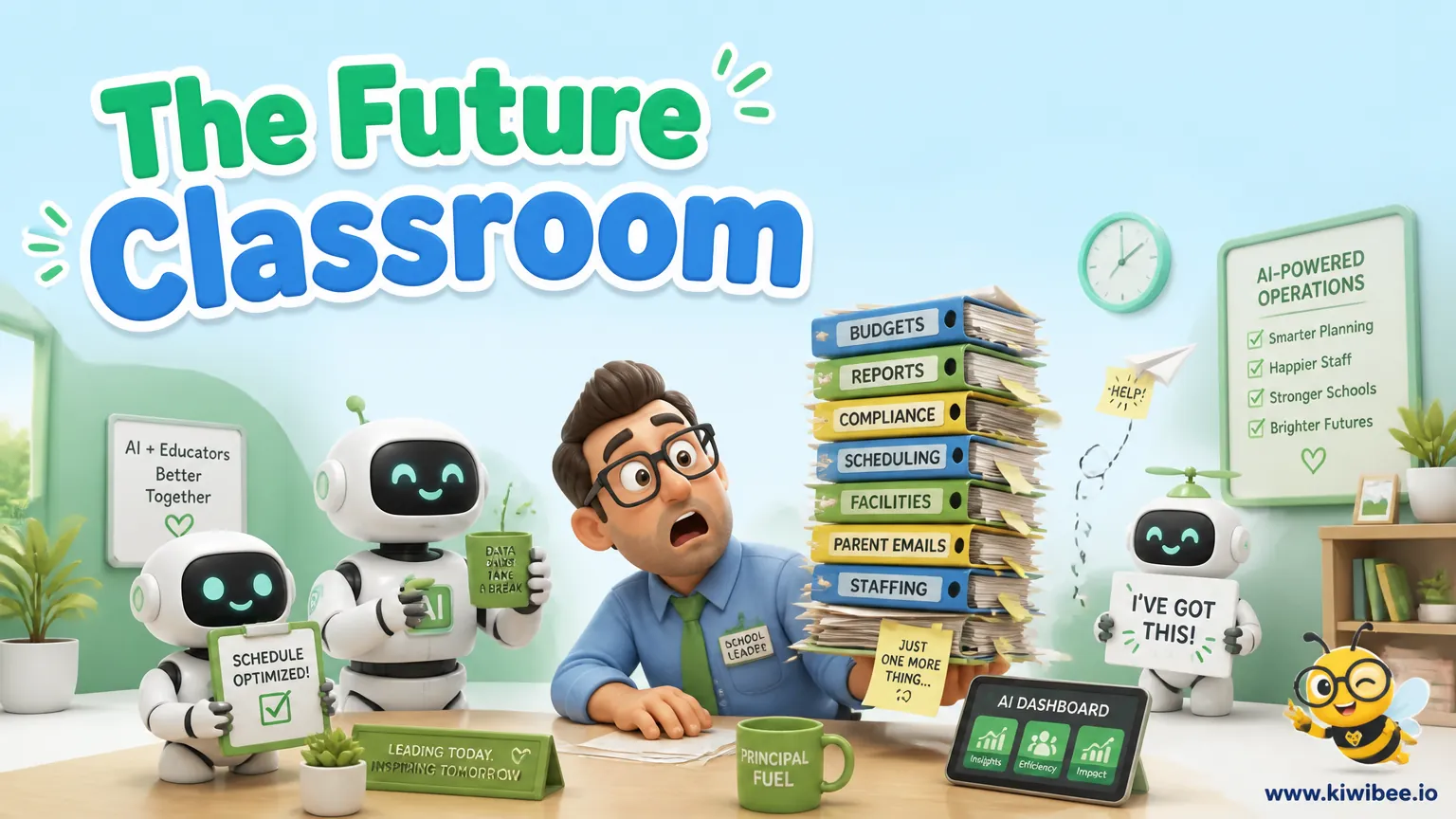
Schools are being asked to make sense of AI at the same time that teachers are still managing behaviour, assessment, feedback, family communication, and lesson flow. Much of the conversation is framed as either excitement or alarm. Neither helps with day-to-day decisions.
A more useful starting point is this: AI may handle some knowledge and administrative tasks quickly, but teaching is not only the delivery of information. Classrooms still depend on relationships, judgement, timing, and trust.
That means the real question is not whether AI will appear in school routines. It is how to separate tasks that may be assisted by software from responsibilities that should remain firmly human-led. Once that distinction is clear, schools can make calmer, more practical choices.
Begin with the parts of teaching that should remain human
When people describe AI as being good at explanations, summaries, or answer generation, they are usually describing a narrow part of the teacher's role. A classroom also depends on noticing confusion, reading social tension, building confidence, and deciding when a student needs encouragement, challenge, privacy, or a conversation with home.
Those actions are not interchangeable with automated output. Even if a system can flag patterns, it does not know the student's history in the way a teacher, year-level leader, or pastoral team might. It does not repair trust after conflict. It does not create a sense of belonging. It does not hold professional responsibility for a difficult judgement call.
For school leaders, this distinction matters because it affects procurement, policy, and staff expectations. AI should be evaluated first as support for routine work, not as a substitute for professional relationships or teacher judgement.
- List the tasks in a teacher's week and separate them into human judgement, routine administration, and mixed tasks that need both.
- Protect time for observation, feedback conversations, and relationship-building before adding new reporting or dashboard expectations.
- Treat any AI recommendation about students as a prompt for staff review, not as a final decision.
- Write policy language that identifies teacher judgement as the final step in behaviour, assessment, and safeguarding decisions.
Look for workload reduction in mechanical tasks first
The strongest near-term case for AI in schools is not a dramatic reinvention of teaching. It is the reduction of repetitive work that pulls attention away from students. Marking simple tasks, drafting routine communications, formatting resources, generating question variations, or organising records are common examples.
That does not mean every task should be handed over. It means schools should identify work that is repetitive, rule-based, and easy to review. These are the areas where assistance may be useful because staff can quickly check the output and correct errors without rebuilding the work from scratch.
This approach also avoids a common implementation mistake: adopting ambitious systems before staff have solved ordinary friction points. If teachers still struggle with basic workflows, adding complex AI features may increase cognitive load rather than reduce it.
- Start with one routine task that consumes staff time every week, such as drafting quiz questions or organising rubric comments.
- Choose a task where errors are easy to spot during review rather than a task where mistakes may go unnoticed.
- Set a short review process so staff check outputs for accuracy, tone, and suitability before use.
- Measure success by time saved and reduction in friction, not by claims of transformation.
Use a decision test before automating assessment
Assessment is attractive for automation because marking takes time, but it also carries academic and relational consequences. Before automating any part of it, schools should ask what exactly is being judged, how visible the criteria are, and how easily a teacher can review the output.
Some forms of marking are more suitable for partial automation than others. Work with clear right-or-wrong answers or tightly defined rubrics is easier to check. Open-ended writing, complex reasoning, creative work, and oral performance usually require more professional interpretation. Even where AI can sort, score, or comment, the final judgement should remain reviewable and contestable.
This is especially important for speaking and presentation tasks. Fluency, structure, and vocabulary may be partially described by software, but audience awareness, nuance, originality, and context often need a human ear. Schools should be cautious about treating machine-generated feedback as complete.
- Use automation first for low-stakes or clearly structured assessment tasks where criteria are explicit.
- Require teachers to review a sample of auto-marked work before releasing grades or feedback.
- Keep rubrics simple enough that staff can explain and defend each criterion to students and families.
- Avoid fully automated grading for complex oral, creative, or interpretive work without a clear moderation process.
Be careful with behaviour monitoring and real-time alerts
Some of the most ambitious classroom AI ideas involve tracking participation, movement, speech, or incidents in real time. The promise is easy to understand: one adult cannot watch every interaction, and early warning may prevent escalation. But these uses also raise some of the most serious concerns.
In practice, behaviour data can be ambiguous. A student who is quiet may be focused, anxious, disengaged, or simply tired. Movement may reflect restlessness, sensory need, classroom design, or a task requirement. Automated alerts can help adults notice patterns, but they can also overinterpret normal behaviour or create a culture of constant surveillance.
Schools considering these systems need clear boundaries before rollout. Staff should know what is being captured, why it is being captured, who can see it, how long it is kept, and what decisions it can and cannot influence. Families and students will also need plain-language explanations.
- Define the specific problem a monitoring tool is meant to solve before considering any purchase or pilot.
- Limit alerts to high-priority situations that require human follow-up, rather than flooding staff with minor signals.
- Review false alarms and missed incidents regularly to judge whether the tool is helping or distracting.
- Check privacy, consent, data storage, and access rules before using cameras, audio analysis, or behavioural dashboards.
Treat participation data as incomplete, not objective truth
A common temptation with AI dashboards is to assume that because a pattern is measurable, it is meaningful. Counts of hand raises, speaking turns, proximity, or time on task may offer useful clues, but they are not neutral descriptions of learning on their own.
Participation looks different across age groups, subjects, and student profiles. A lively discussion in one lesson may be productive; in another it may be off-task. A student who speaks less may still be thinking deeply, writing carefully, or contributing well in paired work rather than whole-class talk.
If schools use participation data at all, it should support teacher reflection rather than replace it. The best use is often to ask better questions: Who has not had an entry point into discussion? Which routines favour confident speakers? Where might I need another way for students to show understanding?
- Use participation indicators to prompt teacher reflection, not to rank students mechanically.
- Compare dashboard signals with actual classroom context before acting on them.
- Offer multiple ways for students to contribute so quiet participation is not mistaken for disengagement.
- Review whether the metrics reward compliance more than learning.
Build implementation around routines, not novelty
Even useful tools fail when they demand too much setup, too many logins, or too many disconnected workflows. Teachers are unlikely to sustain systems that save time in one place but create extra steps in three others.
For leaders, this means implementation planning matters as much as feature lists. Staff need clarity about where an AI-assisted workflow begins, what they are expected to check, where records are stored, and how the process fits existing systems. If those questions are unanswered, adoption will be patchy and frustration will rise.
A modest, stable routine is often better than an ambitious pilot with unclear ownership. For example, a team might agree to use AI only for drafting low-stakes quiz items, summarising meeting notes into actions, or producing first-draft parent communications that teachers then edit. That kind of routine is easier to train, review, and improve.
- Map the full workflow before rollout, including setup, review, storage, and follow-up.
- Reduce the number of steps and platforms involved in any new staff routine.
- Pilot one bounded use case per team instead of launching many AI uses at once.
- Name who is responsible for quality control, staff support, and policy review.
A hypothetical way to start without overcommitting
Consider a hypothetical middle school team choosing one manageable AI-assisted routine for a term. They decide not to begin with behaviour tracking or grading. Instead, they focus on administrative and preparation tasks that are easier to review.
In this scenario, teachers use AI to generate first-draft quiz questions from existing lesson content, prepare reading passages at different levels for teacher review, and draft routine family messages about upcoming deadlines. Department heads sample the outputs, note common errors, and agree on a short checklist for quality control. Staff then discuss whether the workflow saved time, where editing was still heavy, and what should or should not be expanded next term.
This kind of start does not settle every long-term question about AI in education. It does, however, create evidence from ordinary practice inside the school's own routines without making exaggerated promises.
- Choose a low-risk starting point where staff can easily compare the old workflow with the new one.
- Label outputs as drafts until a staff member has reviewed them.
- Create a simple review checklist covering accuracy, clarity, tone, bias, and student appropriateness.
- End the pilot with a decision: stop, refine, or expand only one step further.
Questions school leaders should settle early
The most avoidable problems in school AI use are often governance problems rather than technical ones. If staff are unclear about acceptable use, data handling, quality control, or parent communication, inconsistency appears quickly.
A school does not need a perfect answer to every future scenario before beginning. It does need enough clarity that teachers know where the boundaries are and students are treated consistently. This includes the difference between drafting and decision-making, between assistance and surveillance, and between convenience and acceptable risk.
- Decide which uses are approved, which require case-by-case approval, and which are not permitted.
- Set expectations for human review before any student-facing feedback, report language, or grades are released.
- Clarify whether student data may be entered into any system and under what conditions.
- Prepare plain-language explanations for families about what AI is and is not being used for.
The useful shift is not replacement, but reallocation
AI may become part of ordinary school operations, but that does not reduce teaching to content delivery. If anything, it makes the human parts of the role easier to see. Explaining, sorting, drafting, and processing may be assisted in many settings. Knowing when a child is discouraged, when a conflict is brewing, or when feedback needs tact is still the work of people.
For teachers and leaders, the practical path is to make smaller decisions well. Keep high-judgement responsibilities human-led. Use caution with monitoring and behaviour tools. Test automation first on repetitive, reviewable tasks. Build routines that staff can actually sustain. Those choices are less dramatic than predictions about the future classroom, but they are more likely to produce responsible practice now.
Explore the platform
Continue with KiwiBee
Choose the KiwiBee workspace or resource library that fits what you need next.
Related posts
How Teachers Are Turning AI Into a Classroom Superpower
From AI coloring books to animated student drawings, teachers around the world are finding inventive ways to bring artificial intelligence into daily lessons. Here are six practical ideas you can try this week.
How AI Can Make an English Teacher's Job Easier
From auto-drafting reports to building 4x4 pair-work mats and vocabulary colouring books, here are seven AI uses that save English teachers real time.
The AI Teaching Assistant That Sits in Every Lesson
Most AI tools help before or after class. This one helps during. Voice recognition picks up my explanations and flags when students might be confused. It suggests real-time interventions I'd never think of mid-lesson.
 For big organisations
 For schools
 For centers
 For team leaders
 For teachers
 AI and resources
 Printable worksheets
 Teacher tools
 AI studio
 Ideas and research