Effective Exit Tickets and End-of-Class Assessments
Practical methods for checking understanding before students walk out the door.
 By KiwiBee· KiwiBee
Last updated July 11, 2026
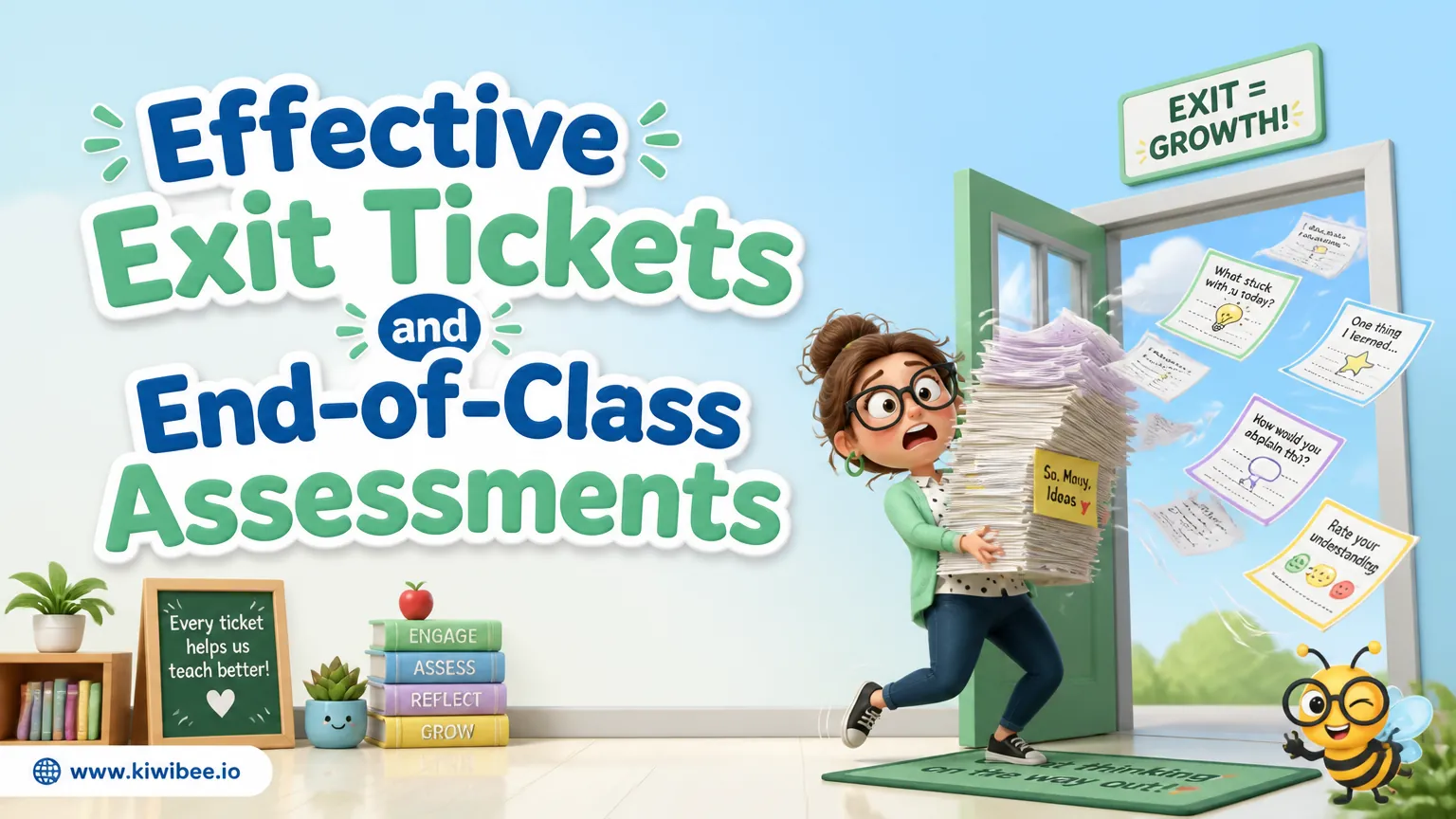
Four exit ticket formats I rotate through every week
Exit tickets used to feel like extra paperwork. After a few years of running them seriously, I realised they are the cheapest, fastest signal I have about what actually stuck. Here are the four formats I rotate between, what each one is good for, and the one mistake that nearly made me give up on them.
Hand-raising — the 30-second pulse check
'Raise your hand if you understand photosynthesis. Raise your hand if you can explain the difference between a noun and a verb. Raise your hand if you feel confident with quadratic equations.' Quick, free, no prep, immediate read. The trade-off: some kids raise their hands to look smart, some refuse to raise their hands even when they understand.
How I mitigate the social pressure: anonymous hand-raising — eyes closed, heads down, hands up. Or varied questioning, where I mix levels so the same kids don't always raise their hands. Or follow-up — when ten hands go up, I call on two of them to actually explain. The follow-up keeps the format honest.
Team games — assessment dressed up as fun
Jeopardy, Quiz Bowl, Pictionary, Think-Pair-Share. Same content, gamified. The kids think they are competing, I think I am assessing, everyone wins. My favourite is Think-Pair-Share for the last five minutes: pose one question, students discuss with a partner, then share with the room. I learn more from listening to the partner discussions than from the share-out.
Rules I always set: clear scoring, monitor who is actually contributing, give feedback on both the content and the teamwork. Otherwise the loudest kid in each team carries the score and the silent kid stays silent.
Short quizzes — the formal version
Three to five questions, mixed format (multiple choice, true/false, one short answer), completed in the final three minutes of class. Quick to grade, easy to compare across days, gives me a defensible data point if a parent asks how I know their child does or does not understand a concept.
Recall questions — the one-minute paper
Give students one minute. Ask them to write down the three most important things they learned today. Or one minute to write everything they remember about a specific concept. Or have them think-aloud — explain their understanding to a partner. This is the format that surfaces misconceptions I would never have caught otherwise. The kids who 'understand' but cannot articulate are the ones whose understanding is shallowest.
The mistake I made for a year
I used to collect exit tickets, plan to look at them after school, and then never look at them. They piled up. They were useless. The moment exit tickets became valuable was when I started reading them in the five-minute break between classes — not as a homework grading exercise but as live feedback for the next lesson. If three kids wrote 'I still don't understand X', tomorrow's lesson opens with X.
What changed when the loop closed
Explore the platform
Continue with KiwiBee
Choose the KiwiBee workspace or resource library that fits what you need next.
Related posts
Generating Student Reports with ClassDojo and Formative Assessments
Learn the complete workflow for exporting ClassDojo data, combining it with formative assessments, and using ChatGPT to generate professional student reports, including the clever doppelganger class strategy.
Quick Classroom Management Board Ideas
Explore four classic classroom management boards, from happy face charts to star systems, and learn how to digitize them with ClassSpark for real-time parent visibility.
Mastering ClassDojo: Smart Strategies for Engagement and Classroom Management
Go beyond the basics with advanced ClassDojo strategies including avatar customization as rewards, the Challenge Character concept for class-wide goals, and strategic attendance features that drive real behavior change.
 For big organisations
 For schools
 For centers
 For team leaders
 For teachers
 AI and resources
 Printable worksheets
 Teacher tools
 AI studio
 Ideas and research