Your privacy choices

KiwiBee uses optional Google Analytics, Google Ads, and Meta Pixel cookies to understand adult visitors, measure completed sign-ups, and improve campaigns. Essential cookies always stay on. OpenAI’s ChatGPT Ads Pixel also measures page views and completed enquiries after advertising consent, and may use hashed contact details for matching. Privacy policy

Skip to main content

VSEPR Molecular Shapes

About this simulation

VSEPR Molecular Shapes is a hands-on 3D chemistry simulation that brings Valence Shell Electron Pair Repulsion theory to life. Students control the number of bonding pairs (1 to 6) and non-bonding lone pairs (0 to 3) around a central atom and watch electron domains arrange themselves on a sphere to minimize mutual electrostatic repulsion. Dragging any ligand atom or translucent golden lone-pair lobe perturbs the molecule in real time, causing neighbouring domains to recoil before relaxing back to canonical geometries including Linear, Trigonal planar, Bent, Tetrahedral, Trigonal pyramidal, See-saw, T-shaped, Octahedral, and Square planar. Clicking a bonding atom cycles between single, double, and triple bonds while live readouts display electron geometry, molecular shape, compressed bond angles, steric number, and net molecular dipole.

What students can explore

  • Set Bonding pairs to 4 and Lone pairs to 0 to inspect a symmetric Tetrahedral molecule with 109.5 degree bond angles and zero net dipole.
  • Keep Steric Number at 4 by changing to 3 Bonding pairs and 1 Lone pair (ammonia-like AX3E) and observe how the lone pair compresses the bond angle to 107 degrees.
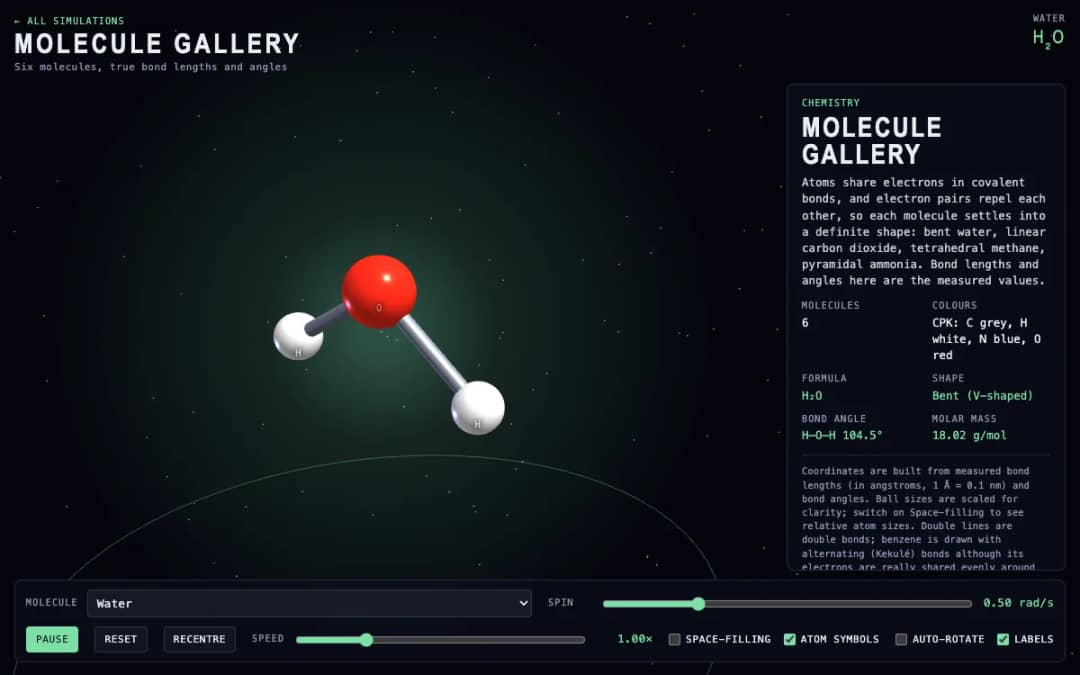
  • Switch to 2 Bonding pairs and 2 Lone pairs (water-like AX2E2) to see a Bent molecular shape with a 104.5 degree angle and a strong net dipole vector.
  • Drag any outer ligand sphere across the central atom and watch the remaining electron domains repel away in real time before relaxing back.
  • Set Bonding pairs to 4 and Lone pairs to 2 (AX4E2, xenon tetrafluoride) to see why lone pairs take opposite trans positions to form a Square planar shape.

Learning objectives

  1. 1Distinguish between total electron-domain geometry and the resulting molecular shape when lone pairs are present.
  2. 2Explain why lone pair-lone pair repulsion is stronger than lone pair-bonding pair and bonding pair-bonding pair repulsion.
  3. 3Predict bond angles and molecular polarity for steric numbers 2 through 6 using AXnEm VSEPR notation.
  4. 4Identify why lone pairs occupy equatorial positions in trigonal bipyramidal (SN=5) geometries and trans positions in octahedral (SN=6) geometries.

Questions teachers ask

What is the main principle of VSEPR theory?

Valence Shell Electron Pair Repulsion (VSEPR) theory states that valence electron domains around a central atom—whether shared in covalent bonds or held as unshared lone pairs—repel one another electrostatically and orient themselves as far apart in 3D space as possible.

Why do lone pairs reduce bond angles compared to ideal geometries?

A bonding pair of electrons is attracted by two nuclei and stays relatively localized between them, whereas a non-bonding lone pair is attracted only by the central nucleus. It spreads out closer to the central atom and exerts stronger repulsion on neighbouring bonding pairs, pushing them closer together by about 2 to 2.5 degrees per lone pair.

Why is electron geometry different from molecular shape?

Electron geometry describes the spatial arrangement of all electron domains (both bonding pairs and lone pairs), whereas molecular shape describes only the positions of the atomic nuclei. For example, water (H2O) has four electron domains in a tetrahedral electron geometry, but its three atoms form a bent molecular shape.

How do multiple bonds affect VSEPR molecular geometry?

In VSEPR counting, a double bond or triple bond between the central atom and one outer atom counts as a single electron domain because all shared electrons in that bond lie along the same internuclear axis, though its higher electron density slightly widens adjacent angles.

Embed this simulation

Drop it into your LMS, blog, or class site — free.

<iframe src="https://kiwibee.io/en/simulations/vsepr-molecular-geometry-3d-simulation/embed" title="VSEPR Molecular Shapes | KiwiBee" loading="lazy" allowfullscreen style="width:100%;height:min(70vh,620px);min-height:420px;border:0;border-radius:16px"></iframe>

Continue exploring

From model to evidence

Use a worksheet to capture predictions, observations, and explanations after students explore.

Bring interactive science into your classroom

KiwiBee's free teacher workspace brings lesson planning, worksheets, classroom tools, and gradebook together in one place.

Start free and create your first class

or explore the teacher workspace →