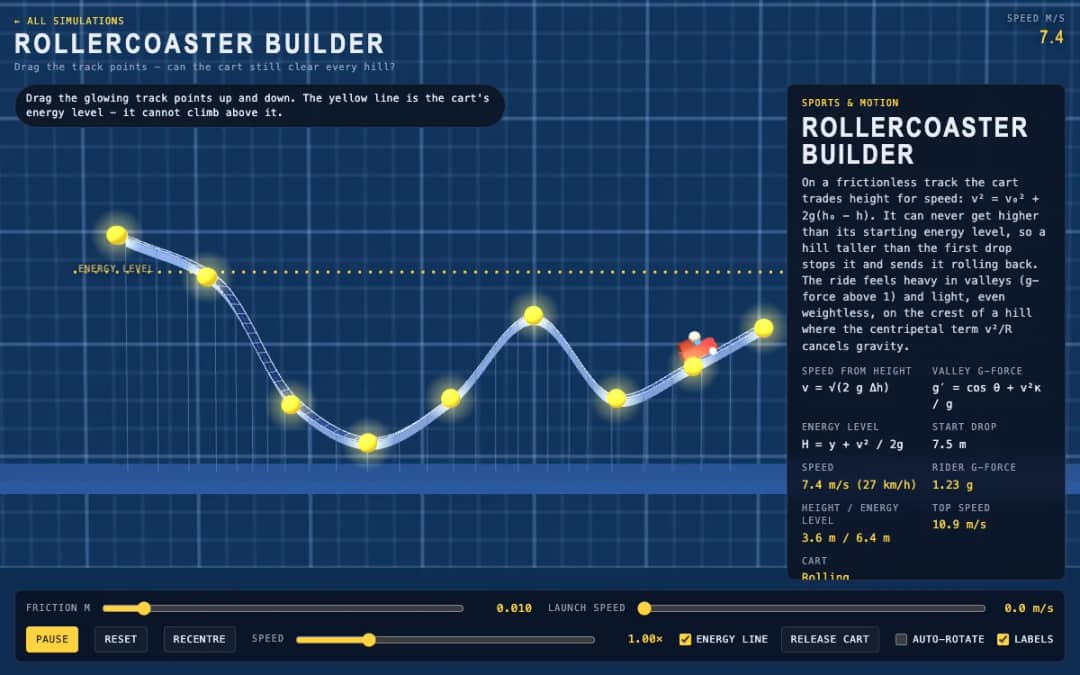
A smooth coaster track runs through glowing control points. Students drag points up and down to reshape hills, press Release cart, and see whether the cart can clear every hill below the yellow energy line.
—
KiwiBee uses optional Google Analytics, Google Ads, and Meta Pixel cookies to understand adult visitors, measure completed sign-ups, and improve campaigns. Essential cookies always stay on. OpenAI’s ChatGPT Ads Pixel also measures page views and completed enquiries after advertising consent, and may use hashed contact details for matching. Privacy policy
This simulation models the mat as a spring with damping. The jumper stores energy in the stretched mat and gets it back as speed, but real mats lose some energy, so each peak is lower by the factor e squared, where e is the restitution. Students drag the jumper to set a drop height and read drop height, last peak, first peak ratio, mat depth and force over weight. Sliders set restitution, mat stiffness, mass and gravity, so students can bounce on the Moon. Teachers can use it for springs and energy loss.
Yes. It is free, needs no sign-up, and runs in any modern browser, including whiteboards, tablets and phones.
The mat and jumper lose some energy as heat. With coefficient of restitution e, each peak is lower than the previous one by a factor of e squared.
Drag the jumper up and let go, or push them down into the mat and release. The Last peak marker shows the height reached after each bounce.
It pushes back with force F equals k times the depth x. A stiffer mat has a larger k, so it compresses less under the same load and the rest sag is mass times g over k.
Drop it into your LMS, blog, or class site — free.
<iframe src="https://kiwibee.io/en/simulations/trampoline-bounce-3d-simulation/embed" title="Trampoline Bounce | KiwiBee" loading="lazy" allowfullscreen style="width:100%;height:min(70vh,620px);min-height:420px;border:0;border-radius:16px"></iframe>Continue exploring
A smooth coaster track runs through glowing control points. Students drag points up and down to reshape hills, press Release cart, and see whether the cart can clear every hill below the yellow energy line.
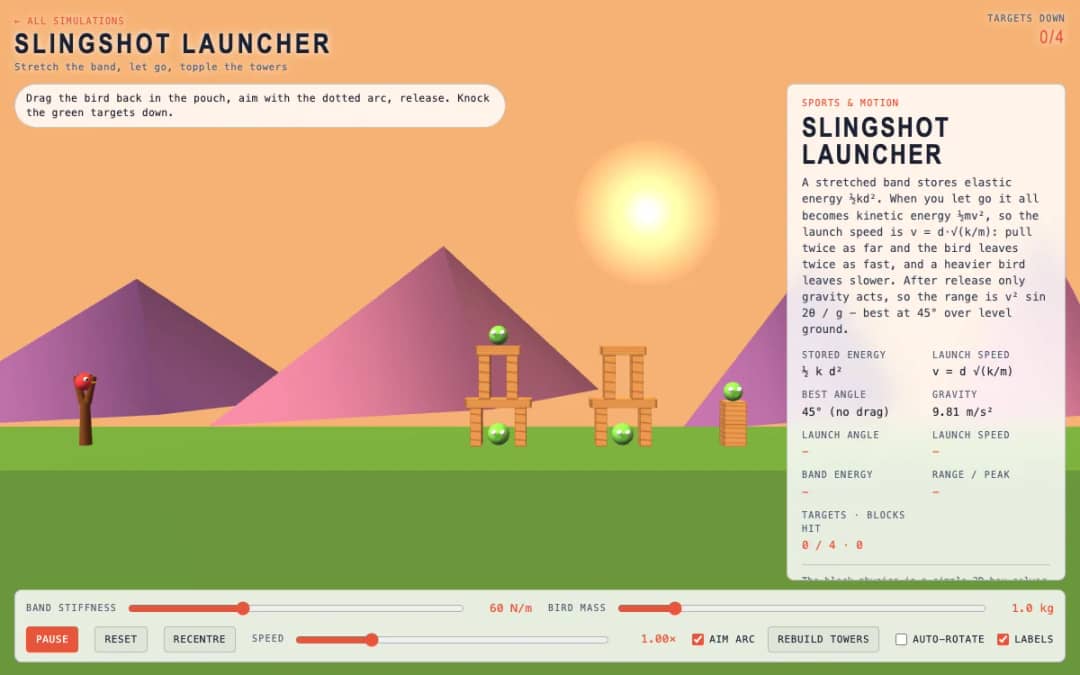
A slingshot faces towers with green targets. Students drag the bird back in the pouch, follow the dotted aim arc, release, and try to knock down the targets using the right stretch and angle.
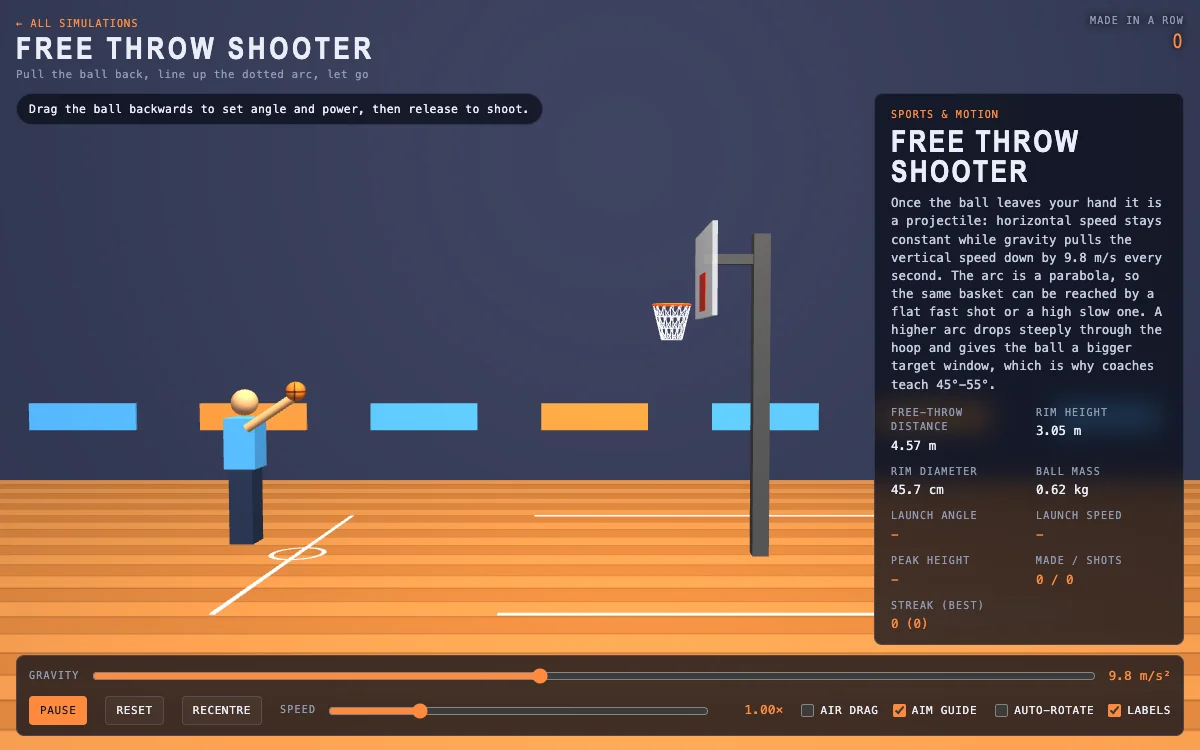
A basketball court shows the free throw line, hoop and a dotted aim arc. Students drag the ball backward to set launch angle and power, release to shoot, and read speed, peak height and streak.
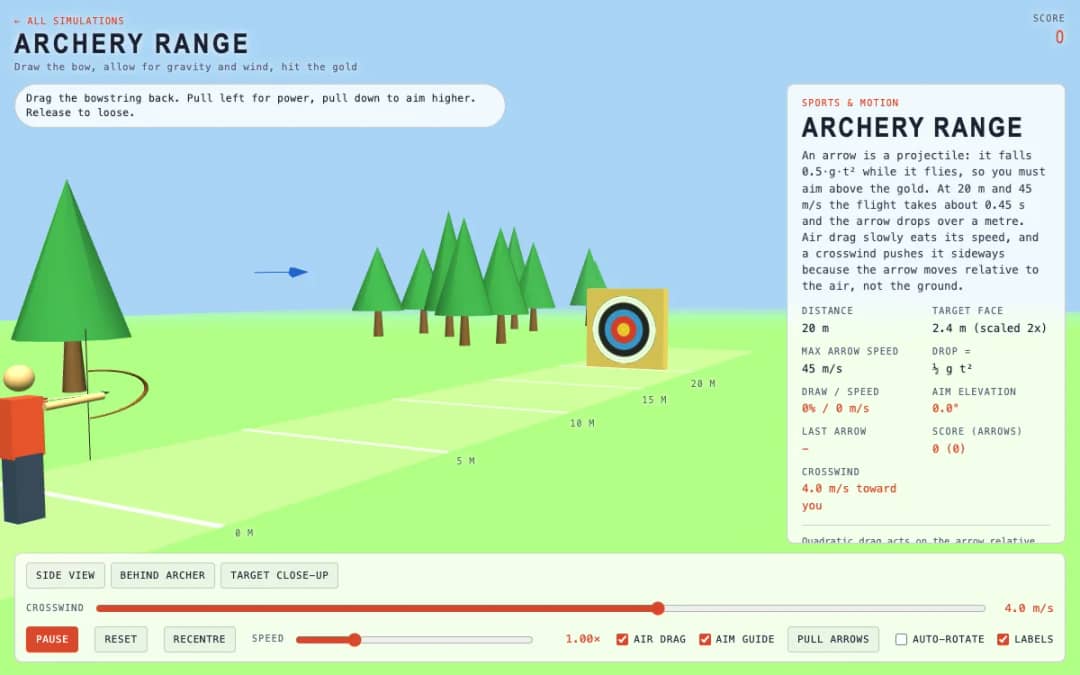
An archery range with a target 20 meters away lets students drag the bowstring back to set power and aim, then loose six arrows while allowing for gravity, drag and a crosswind.
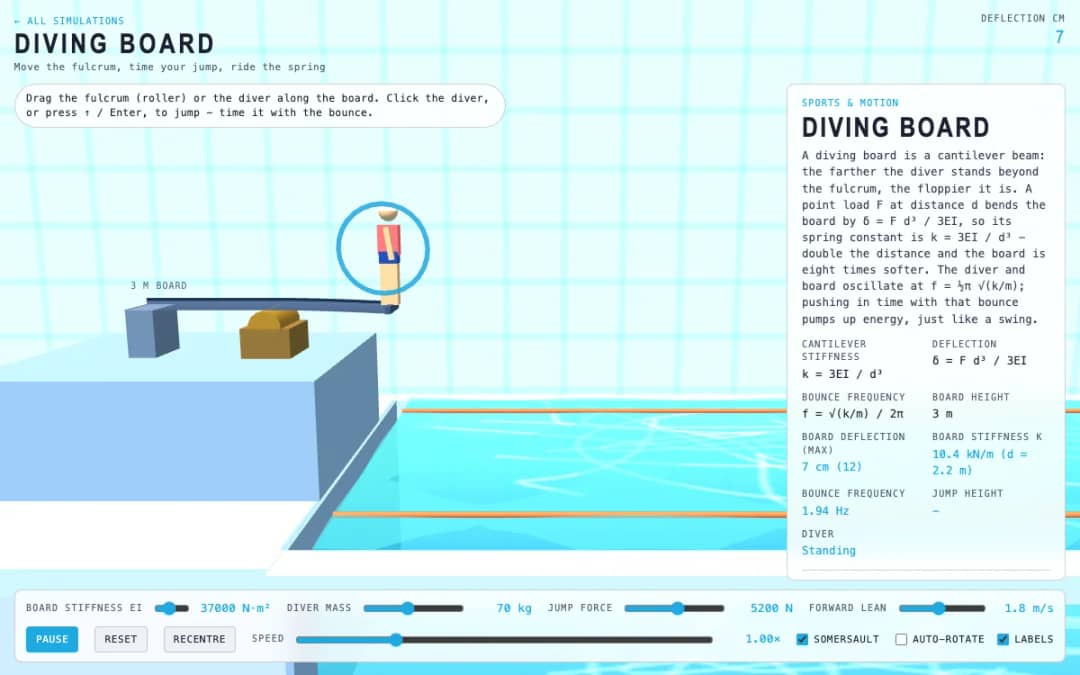
A diving board hangs over a pool at three meters. Students drag the fulcrum roller or the diver along the board, click the diver or press Enter to jump, and time pushes with the board's bounce.
KiwiBee's free teacher workspace brings lesson planning, worksheets, classroom tools, and gradebook together in one place.
Start free and create your first class Home
 All solutions
 Pricing
 About us
 KiwiBee for Non-profits
 Events & webinars
 For big organisations
 For schools
 For centers
 For team leaders
 For teachers
 AI and resources
 Resources
 Printable worksheets
 Lesson Packs
 Interactive simulations
 Teacher tools
 AI studio
 Ideas and research