
Explore an adult male reference body in 3D. Reveal 14 anatomical systems, search thousands of named structures, isolate organs, and pull 2,209 modeled pieces apart to see how the body is organized.
—
KiwiBee uses optional Google Analytics, Google Ads, and Meta Pixel cookies to understand adult visitors, measure completed sign-ups, and improve campaigns. Essential cookies always stay on. OpenAI’s ChatGPT Ads Pixel also measures page views and completed enquiries after advertising consent, and may use hashed contact details for matching. Privacy policy
Ozone Layer & UV Shield is a 3D atmospheric chemistry simulation of the stratospheric ozone column between 15 and 35 km altitude. Incoming solar radiation is separated into lethal UV-C (100 to 280 nm), sunburn-causing UV-B (280 to 315 nm), and low-energy UV-A (315 to 400 nm). Students watch triatomic ozone (O3) molecules split and recombine in the Chapman cycle to block 100% of UV-C and nearly all UV-B. Dragging or clicking chlorofluorocarbon (CFCl3) molecules releases reactive chlorine radicals (Cl and ClO) that catalytically strip oxygen atoms from ozone, dropping column thickness below the 220 Dobson Unit ozone-hole threshold and letting UV-B penetrate to the ground.
Stratospheric ozone (O3) absorbs 100% of high-energy UV-C rays and about 95% of UV-B rays from the Sun. Without this shield, intense UV-B radiation would reach the ground, damaging DNA, causing skin cancer and cataracts, and harming crops and plankton.
Ultraviolet light breaks a chlorine atom (Cl) off a CFC molecule. That Cl atom steals an oxygen atom from O3 to form ClO and O2, and then a free oxygen atom regenerates the Cl atom. Because the chlorine catalyst is recycled, one Cl atom can destroy up to 100,000 ozone molecules.
A Dobson Unit measures the total thickness of the overhead ozone column if all the ozone were compressed to standard sea-level temperature and pressure. Normal stratospheric ozone is about 300 DU (a 3 mm thick layer), and values below 220 DU define an ozone hole.
Yes. Since the 1987 Montreal Protocol phased out CFC production, stratospheric chlorine peaked in the late 1990s and has been steadily declining. Scientists project the global ozone layer will recover to 1980 levels around the middle of the 21st century.
Drop it into your LMS, blog, or class site — free.
<iframe src="https://kiwibee.io/en/simulations/stratospheric-ozone-uv-shield-3d-simulation/embed" title="Ozone Layer & UV Shield | KiwiBee" loading="lazy" allowfullscreen style="width:100%;height:min(70vh,620px);min-height:420px;border:0;border-radius:16px"></iframe>Continue exploring
Explore an adult male reference body in 3D. Reveal 14 anatomical systems, search thousands of named structures, isolate organs, and pull 2,209 modeled pieces apart to see how the body is organized.
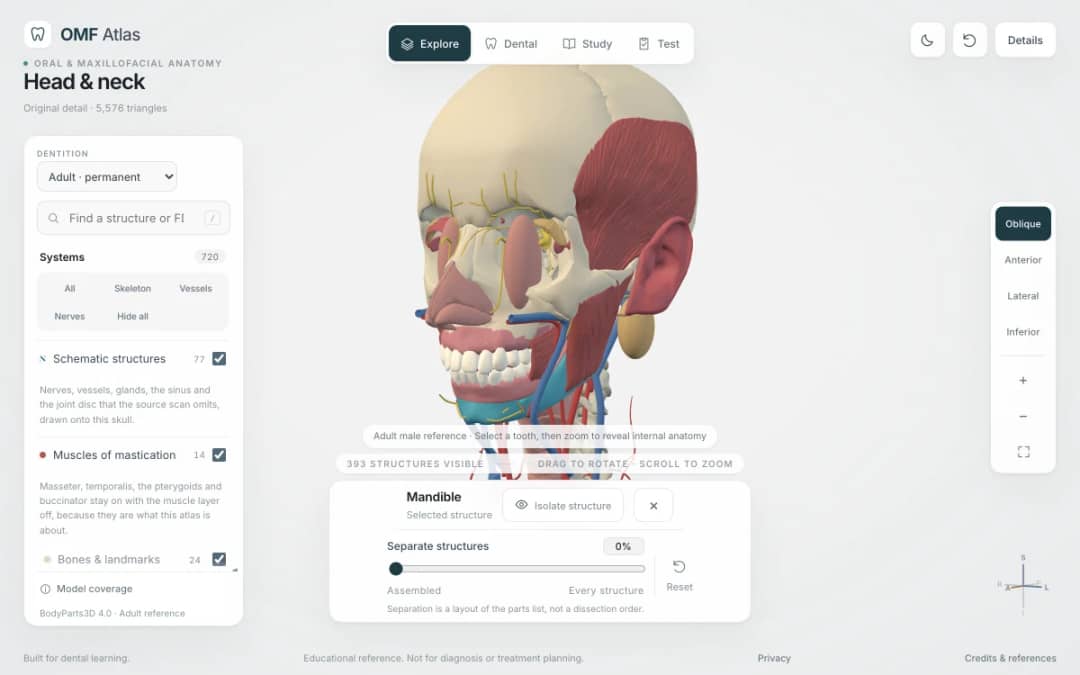
Explore the head and neck in 3D: 643 source meshes across 14 layers, 47 facial and masticatory muscles, and 77 drawn nerves, vessels and glands the source scan omits. Open any tooth onto its own pulp canal, and follow the seven stages of tooth development.

Free interactive photosynthesis simulation. Explore photosynthesis hands-on online — great for whole-class or independent practice.

Free interactive states of matter simulation. Explore states of matter hands-on online — great for whole-class or independent practice.

Free interactive shadows simulation. Explore shadows hands-on online — great for whole-class or independent practice.
KiwiBee's free teacher workspace brings lesson planning, worksheets, classroom tools, and gradebook together in one place.
Start free and create your first class Home
 All solutions
 Pricing
 About us
 KiwiBee for Non-profits
 Events & webinars
 For big organisations
 For schools
 For centers
 For team leaders
 For teachers
 AI and resources
 Resources
 Printable worksheets
 Lesson Packs
 Interactive simulations
 Teacher tools
 AI studio
 Ideas and research