
Solar Orrery
- Earth Science
Comments
Related to this simulation
Picked by meaning from games, worksheets, simulations, teacher tools and videos.
About this simulation
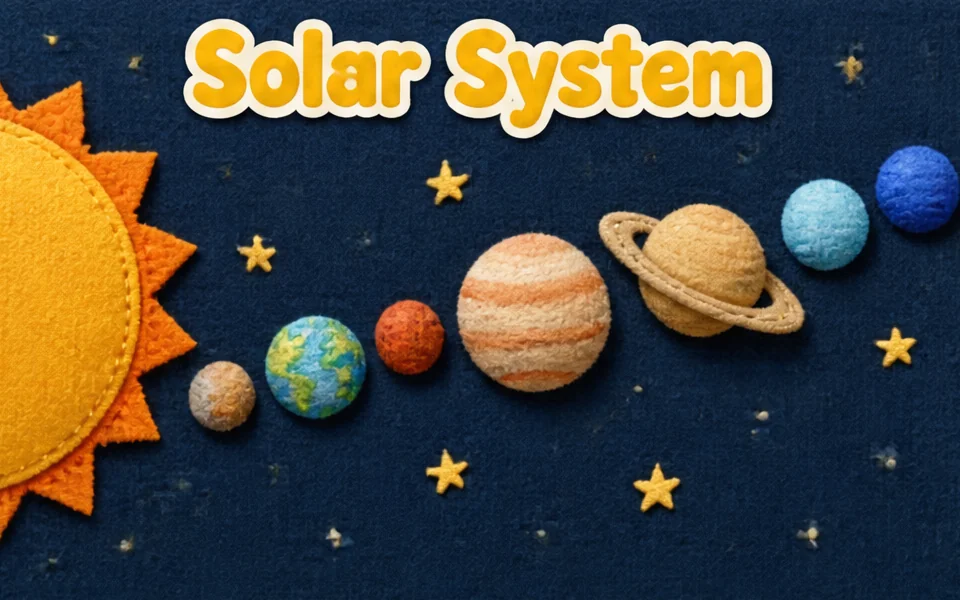
Solar Orrery is a 3D model of the Solar System built from real orbital elements, so every planet sits where it really is on today's date and moves at its true orbital period. Students drag to orbit the view, pick a planet to follow it, and change the simulation speed from one day per second to one year per second. A card gives each planet's orbital period, rotation, diameter and moons, plus its live distance from the Sun and how long sunlight takes to reach it. Sizes are enlarged and distances compressed so every planet fits on screen.
What students can explore
- Run the speed at one year per second and count how many orbits Mercury makes while Earth completes one.
- Select Neptune and compare its orbital period with Earth's.
- Watch Mars as its distance from the Sun changes around its eccentric orbit.
- Follow Venus and notice that it spins in the opposite direction to most planets.
- Switch the orbit lines and labels off, then name each planet from its size and colour.
Learning objectives
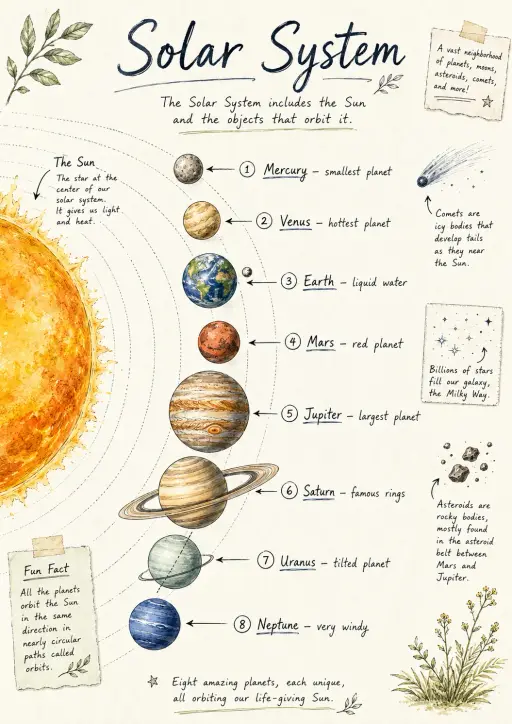
- 1Describe the order of the eight planets from the Sun.
- 2Explain why outer planets take longer to orbit than inner planets.
- 3Compare planet sizes, rotation periods and distances using the data card.
- 4Recognise that orbits are ellipses and not perfect circles.
Questions teachers ask
Is the Solar Orrery free to use?
Yes. It runs in any modern browser, including interactive whiteboards, tablets and phones, with no sign-up or download.
Are the planet positions real?
Yes. Orbit shapes, periods and starting positions come from real orbital elements, so the planets start where they are today. Sizes are enlarged and distances compressed so everything fits on screen.
How long does sunlight take to reach Earth?
About 8 minutes and 20 seconds. Select Earth to see the live figure, and select Neptune to see that sunlight takes about 4 hours to arrive there.
How do I speed up time?
Use the speed slider, or choose one of the presets for one day, one month or one year per second. Pause stops the motion so you can study one moment.
Embed this simulation
Drop it into your LMS, blog, or class site — free.
<iframe src="https://kiwibee.io/en/simulations/solar-orrery-3d-simulation/embed" title="Solar Orrery | KiwiBee" loading="lazy" allowfullscreen style="width:100%;height:min(70vh,620px);min-height:420px;border:0;border-radius:16px"></iframe>Curriculum standards
Cambridge
- 6ESs.01Describe the relative position and movement of the planets, the Moon and the Sun in the Solar SystemCambridge Primary Science (0097) — Stage 6 › Earth and Space › Earth in space
Learning objectives © UCLES (Cambridge University Press & Assessment), quoted with attribution.
Bring interactive science into your classroom
KiwiBee's free teacher workspace brings lesson planning, worksheets, classroom tools, and gradebook together in one place.
Start free and create your first classWatch KiwiBee on YouTube
Short KiwiBee videos for teachers and schools. Subscribe, or follow KiwiBee wherever you are.
 Home
 All solutions
 Pricing
 About us
 KiwiBee for Non-profits
 Events & webinars
 For big organisations
 For schools
 For centers
 For team leaders
 For teachers
 Resources
 Printable worksheets
 Interactive simulations
 Teacher tools
 Ideas and research


