Your privacy choices

KiwiBee uses optional Google Analytics, Google Ads, and Meta Pixel cookies to understand adult visitors, measure completed sign-ups, and improve campaigns. Essential cookies always stay on. OpenAI’s ChatGPT Ads Pixel also measures page views and completed enquiries after advertising consent, and may use hashed contact details for matching. Privacy policy

Skip to main content

Seismic Waves

About this simulation

This model traces rays through a simplified layered Earth so students can see how earthquake waves travel. Fast P waves and slower S waves leave the focus, and S waves vanish behind the liquid outer core while P waves bend, leaving shadow zones. Students set magnitude from 4 to 9.5, station distance from 5 to 180 degrees and quake depth to 700 km, and can show ray paths or press Quake again. Readouts give P and S arrival times and the gap between them, plus a schematic seismogram. It shows how scientists found Earth's inner structure.

What students can explore

  • Set Station distance to 75 degrees and compare the P wave arrives and S wave arrives readouts.
  • Increase Station distance past 104 degrees and watch the S wave disappear.
  • Read the S minus P gap at three distances and see how it grows with distance.
  • Raise Magnitude from 5 to 9 and see how the seismogram and energy readout change.
  • Turn Show ray paths on and follow how the waves bend inside the core.

Learning objectives

  1. 1Distinguish P waves from S waves by speed and type of motion.
  2. 2Explain why S waves cannot pass through the liquid outer core.
  3. 3Use the S minus P arrival gap to estimate distance to an earthquake.
  4. 4Describe how shadow zones provide evidence for Earth's layers.

Questions teachers ask

Is the seismic waves simulation free?

Yes. It is free and runs in any modern browser, including whiteboards and tablets. There is no sign-up and nothing to install.

Why do S waves not pass through the core?

S waves are shear waves, and liquids cannot support shear. Because S waves stop at the liquid outer core, seismologists concluded that part of Earth's core is liquid.

How can a station tell how far away a quake was?

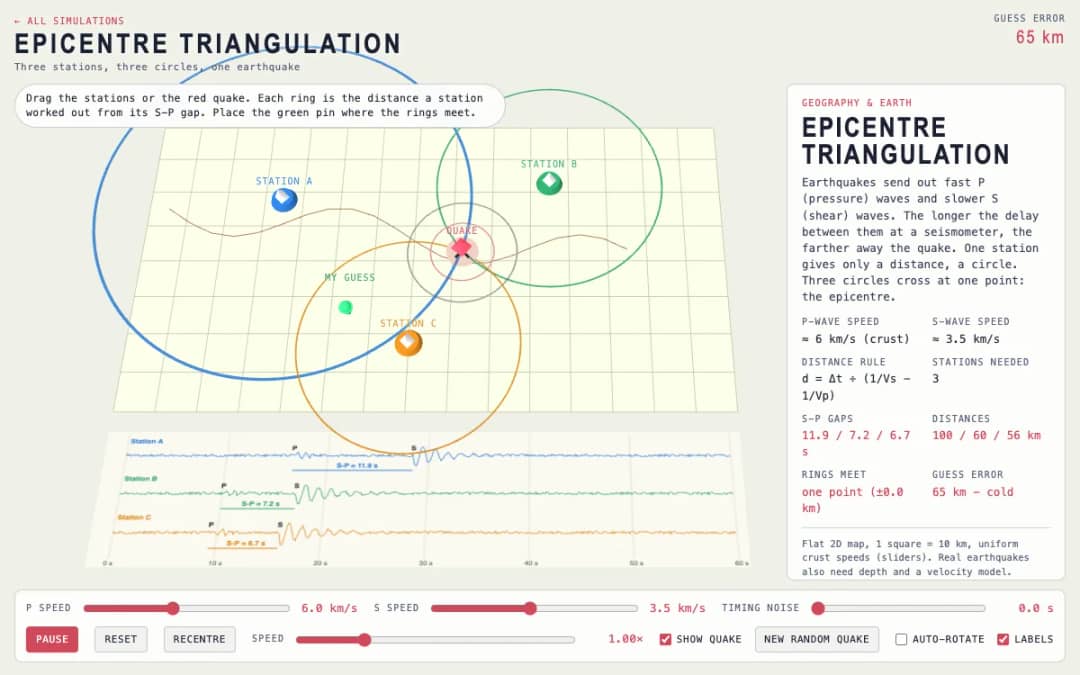
P waves travel faster than S waves, so the further the quake, the longer the gap between their arrivals. Reading the S minus P gap gives the distance.

Is the timing real?

The arrival times come from a simplified one-dimensional Earth model, and the animation runs 100 times faster than real time. The seismogram is a schematic built from those times.

Embed this simulation

Drop it into your LMS, blog, or class site — free.

<iframe src="https://kiwibee.io/en/simulations/seismic-waves-3d-simulation/embed" title="Seismic Waves | KiwiBee" loading="lazy" allowfullscreen style="width:100%;height:min(70vh,620px);min-height:420px;border:0;border-radius:16px"></iframe>

Continue exploring

From model to evidence

Use a worksheet to capture predictions, observations, and explanations after students explore.

Bring interactive science into your classroom

KiwiBee's free teacher workspace brings lesson planning, worksheets, classroom tools, and gradebook together in one place.

Start free and create your first class

or explore the teacher workspace →