
Pythagoras Squares
- Math
Comments
Related to this simulation
Picked by meaning from games, worksheets, simulations, teacher tools and videos.
About this simulation
Pythagoras Squares builds a square on each side of a right triangle and shows the areas as a squared, b squared and c squared. Students drag the two round handles to stretch the legs in half-unit steps and read the sum of the leg squares against the hypotenuse square. A Rearrange toggle and a Proof camera view cut a big (a+b) square into four triangles plus either one c square or the two leg squares, which makes the theorem visible. Use it to introduce the theorem, check the 3-4-5 triple, or support a proof discussion.
What students can explore
- Drag the two round handles to change leg a and leg b and watch the three square areas update.
- Press the 3-4-5 button and check that 9 plus 16 equals 25 in the Areas readout.
- Switch on Rearrange and follow how the four triangles and squares fit inside the big square.
- Use the Proof camera view to look at the rearrangement from a better angle.
- Try unequal legs such as 1 and 4 and compare the Hypotenuse c readout with your estimate.
Learning objectives
- 1State the Pythagorean theorem for a right triangle as a squared plus b squared equals c squared.
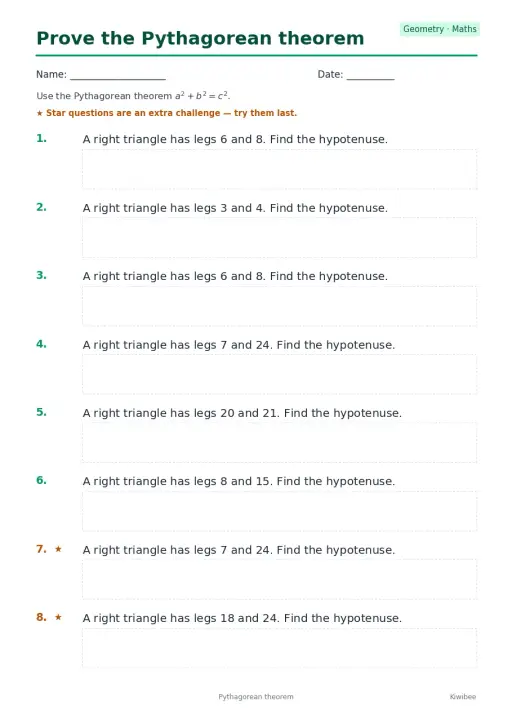
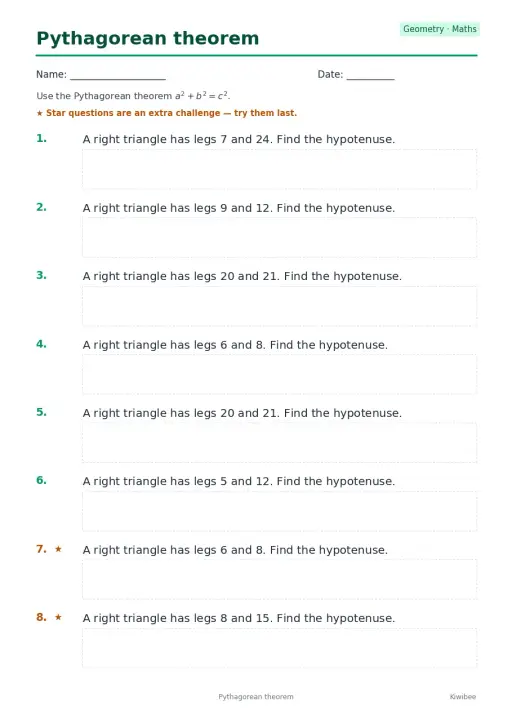
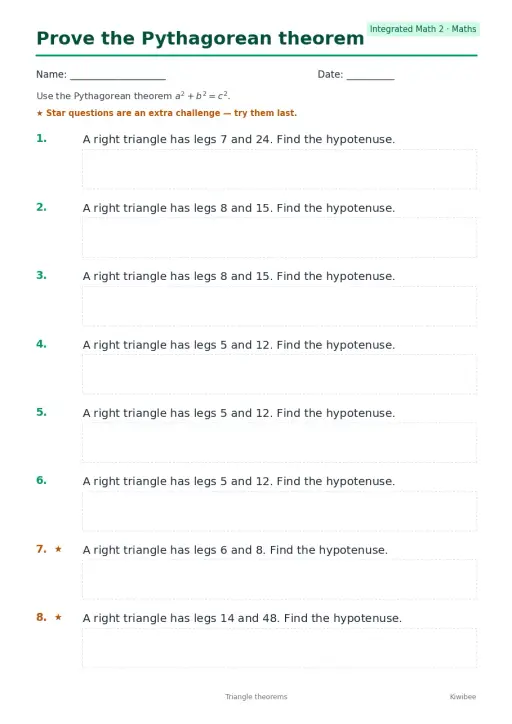
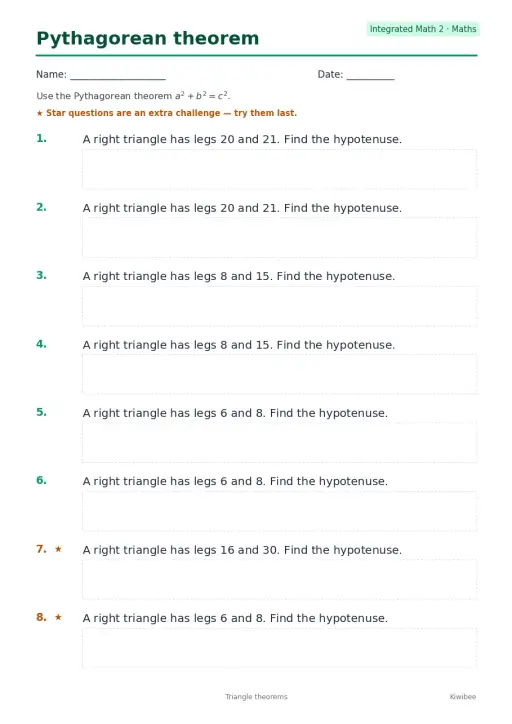
- 2Calculate the hypotenuse from two given legs and check it against the readout.
- 3Explain how the rearrangement proof shows that the square areas must be equal.
- 4Recognize the 3-4-5 triple as a whole-number right triangle.
Questions teachers ask
Is it free?
Yes. It is free, needs no sign-up and runs in any modern browser, including classroom whiteboards, tablets and phones.
What does the Rearrange toggle show?
It cuts a large square of side a plus b into four copies of the triangle plus either one square on the hypotenuse or the two leg squares. Since the big square and the triangles are the same, the squares must have equal area.
Does the theorem work for any triangle?
No. It holds only for right triangles. The simulation keeps the legs perpendicular for that reason, and c is always the side opposite the right angle.
How do I use it in class?
Ask students to predict the hypotenuse for a pair of legs, drag the handles to test it, then compare the Areas readout. Finish with Rearrange so they can see the proof.
Embed this simulation
Drop it into your LMS, blog, or class site — free.
<iframe src="https://kiwibee.io/en/simulations/pythagoras-squares-3d-simulation/embed" title="Pythagoras Squares | KiwiBee" loading="lazy" allowfullscreen style="width:100%;height:min(70vh,620px);min-height:420px;border:0;border-radius:16px"></iframe>Curriculum standards
Cambridge
- 9Gg.10Know and use Pythagoras’ theorem.Cambridge Lower Secondary Mathematics (0862) — Stage 9 › Geometry and Measure › Geometrical reasoning, shapes and measurements
Learning objectives © UCLES (Cambridge University Press & Assessment), quoted with attribution.
Bring interactive science into your classroom
KiwiBee's free teacher workspace brings lesson planning, worksheets, classroom tools, and gradebook together in one place.
Start free and create your first classWatch KiwiBee on YouTube
Short KiwiBee videos for teachers and schools. Subscribe, or follow KiwiBee wherever you are.
 Home
 All solutions
 Pricing
 About us
 KiwiBee for Non-profits
 Events & webinars
 For big organisations
 For schools
 For centers
 For team leaders
 For teachers
 Resources
 Printable worksheets
 Interactive simulations
 Teacher tools
 Ideas and research


