
Explore an adult male reference body in 3D. Reveal 14 anatomical systems, search thousands of named structures, isolate organs, and pull 2,209 modeled pieces apart to see how the body is organized.
—
KiwiBee uses optional Google Analytics, Google Ads, and Meta Pixel cookies to understand adult visitors, measure completed sign-ups, and improve campaigns. Essential cookies always stay on. OpenAI’s ChatGPT Ads Pixel also measures page views and completed enquiries after advertising consent, and may use hashed contact details for matching. Privacy policy
Capacitor & Dielectric Lab is a 3D electrostatics simulation where students manipulate the geometry and dielectric material of a parallel-plate capacitor. Two metallic plates are wired to an adjustable DC battery while red (+) and blue (−) surface charges accumulate on the inner faces and cyan vector arrows display the uniform electric field E = V / d. Students can drag the top plate up or down to change separation d, change plate area A, and drag an amber dielectric slab horizontally into the gap. Inside the slab, molecular dipole dumbbells visibly rotate to align with the field, illustrating why a dielectric increases capacitance according to C = kappa epsilon_0 A / d.
The external electric field polarizes molecules inside the insulating dielectric, aligning their positive ends toward the negative plate and negative ends toward the positive plate. This creates a small opposing electric field inside the slab, allowing the battery to push kappa times as much charge onto the plates at the same voltage.
Capacitance C = kappa epsilon_0 A / d and electric field E = V / d are both inversely proportional to separation d. Bringing the plates closer together strengthens the attraction between opposite charges on the two plates, increasing C, Q, U, and E.
Because stored charge Q = C V is itself proportional to voltage V, each additional unit of charge must be pushed onto the plate against an increasingly higher potential difference, giving U = 1/2 Q V = 1/2 C V².
No conduction current crosses the insulating air or dielectric gap. Instead, charging current flows through the external battery wires until the voltage across the plates equals the battery voltage.
Drop it into your LMS, blog, or class site — free.
<iframe src="https://kiwibee.io/en/simulations/parallel-plate-capacitor-3d-3d-simulation/embed" title="Capacitor & Dielectric Lab | KiwiBee" loading="lazy" allowfullscreen style="width:100%;height:min(70vh,620px);min-height:420px;border:0;border-radius:16px"></iframe>Continue exploring
Explore an adult male reference body in 3D. Reveal 14 anatomical systems, search thousands of named structures, isolate organs, and pull 2,209 modeled pieces apart to see how the body is organized.
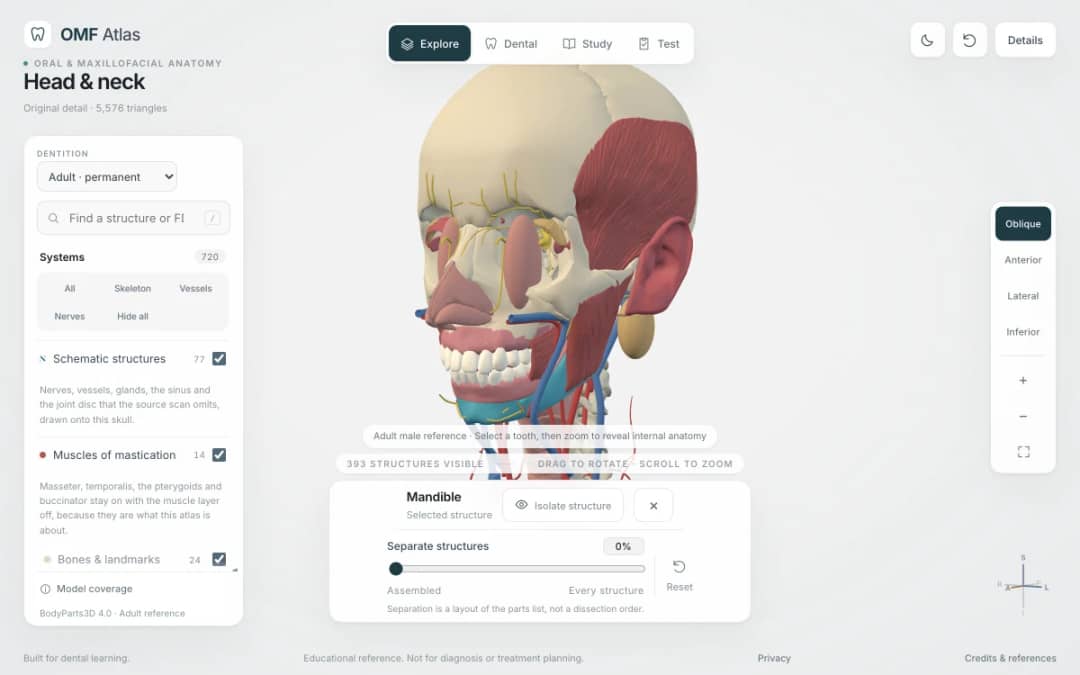
Explore the head and neck in 3D: 643 source meshes across 14 layers, 47 facial and masticatory muscles, and 77 drawn nerves, vessels and glands the source scan omits. Open any tooth onto its own pulp canal, and follow the seven stages of tooth development.

Free interactive photosynthesis simulation. Explore photosynthesis hands-on online — great for whole-class or independent practice.

Free interactive states of matter simulation. Explore states of matter hands-on online — great for whole-class or independent practice.

Free interactive shadows simulation. Explore shadows hands-on online — great for whole-class or independent practice.
From model to evidence
Use a worksheet to capture predictions, observations, and explanations after students explore.
KiwiBee's free teacher workspace brings lesson planning, worksheets, classroom tools, and gradebook together in one place.
Start free and create your first class
 Home
 All solutions
 Pricing
 About us
 KiwiBee for Non-profits
 Events & webinars
 For big organisations
 For schools
 For centers
 For team leaders
 For teachers
 AI and resources
 Resources
 Printable worksheets
 Lesson Packs
 Interactive simulations
 Teacher tools
 AI studio
 Ideas and research