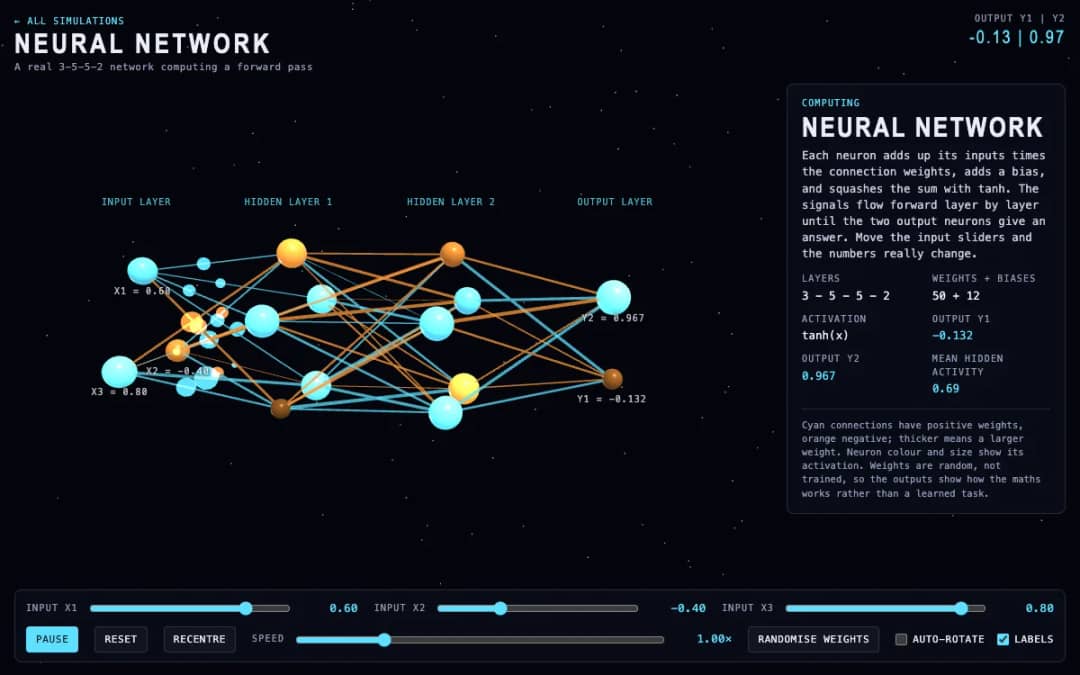
A small neural network with three inputs, two hidden layers of five neurons and two outputs is drawn in 3D. Students move the input sliders and watch neuron colors, connection weights and the two outputs change.
—
KiwiBee uses optional Google Analytics, Google Ads, and Meta Pixel cookies to understand adult visitors, measure completed sign-ups, and improve campaigns. Essential cookies always stay on. OpenAI’s ChatGPT Ads Pixel also measures page views and completed enquiries after advertising consent, and may use hashed contact details for matching. Privacy policy
This model shows a nerve impulse moving along an axon, colored by membrane voltage: blue at rest, cyan at threshold and yellow at the peak. Students press Stimulate or leave Auto-fire on, switch the myelin sheath on and off, and change the axon diameter from 1 to 20 micrometers. Readouts show the voltage at a probe, the phase of the action potential, the conduction speed and when the signal reaches the terminal. It helps explain resting potential, depolarization and repolarization, and why myelinated fibers conduct impulses much faster.
Yes. It is free and runs in any modern browser, including interactive whiteboards and tablets. There is no sign-up and nothing to install.
It is a brief reversal of the voltage across a neuron's membrane, from about -70 mV to about +40 mV and back. Sodium channels open first, then potassium channels restore the resting voltage.
Myelin insulates the axon, so the impulse regenerates only at the gaps called nodes of Ranvier and effectively jumps between them. This saltatory conduction can reach 60 to 120 m/s in thick fibers.
No. The animation is slowed about 40 times, and node spacing is exaggerated. The speeds in the readout come from standard approximations for myelinated and unmyelinated axons.
Drop it into your LMS, blog, or class site — free.
<iframe src="https://kiwibee.io/en/simulations/neuron-signal-3d-simulation/embed" title="Neuron Signal | KiwiBee" loading="lazy" allowfullscreen style="width:100%;height:min(70vh,620px);min-height:420px;border:0;border-radius:16px"></iframe>Continue exploring
A small neural network with three inputs, two hidden layers of five neurons and two outputs is drawn in 3D. Students move the input sliders and watch neuron colors, connection weights and the two outputs change.
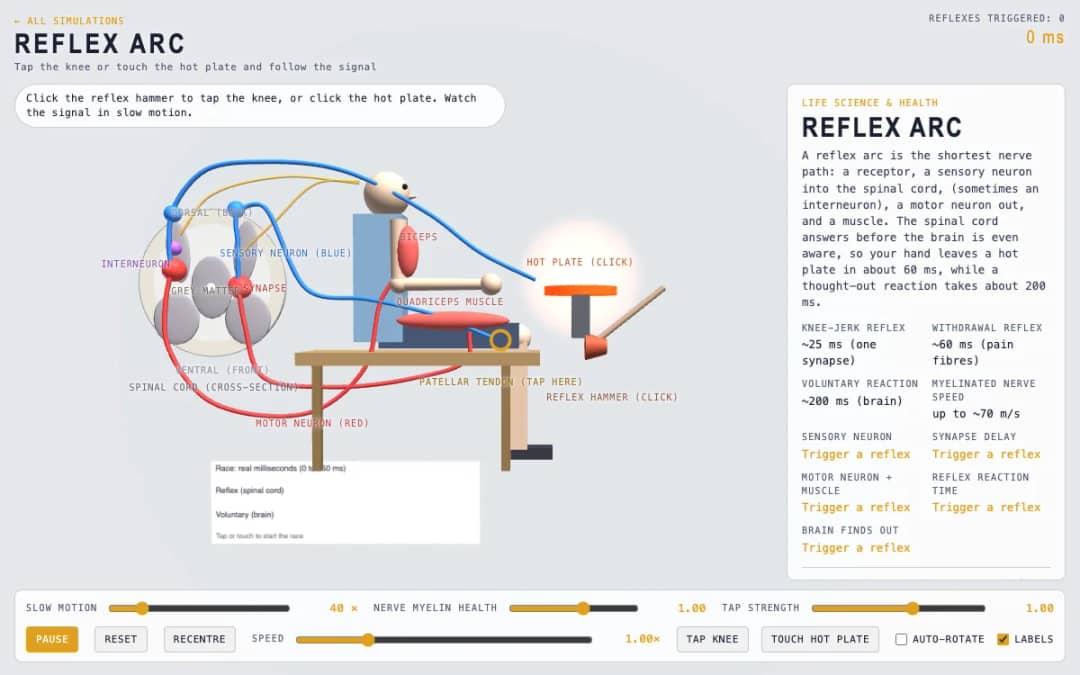
A leg and a hand show the path of a reflex. Students click the hammer or the hot plate and watch the signal travel through neurons and the spinal cord in slow motion.

Explore an adult male reference body in 3D. Reveal 14 anatomical systems, search thousands of named structures, isolate organs, and pull 2,209 modeled pieces apart to see how the body is organized.

Explore the head and neck in 3D: 643 source meshes across 14 layers, 47 facial and masticatory muscles, and 77 drawn nerves, vessels and glands the source scan omits. Open any tooth onto its own pulp canal, and follow the seven stages of tooth development.

Free interactive photosynthesis simulation. Explore photosynthesis hands-on online — great for whole-class or independent practice.
KiwiBee's free teacher workspace brings lesson planning, worksheets, classroom tools, and gradebook together in one place.
Start free and create your first class Home
 All solutions
 Pricing
 About us
 KiwiBee for Non-profits
 Events & webinars
 For big organisations
 For schools
 For centers
 For team leaders
 For teachers
 AI and resources
 Resources
 Printable worksheets
 Lesson Packs
 Interactive simulations
 Teacher tools
 AI studio
 Ideas and research