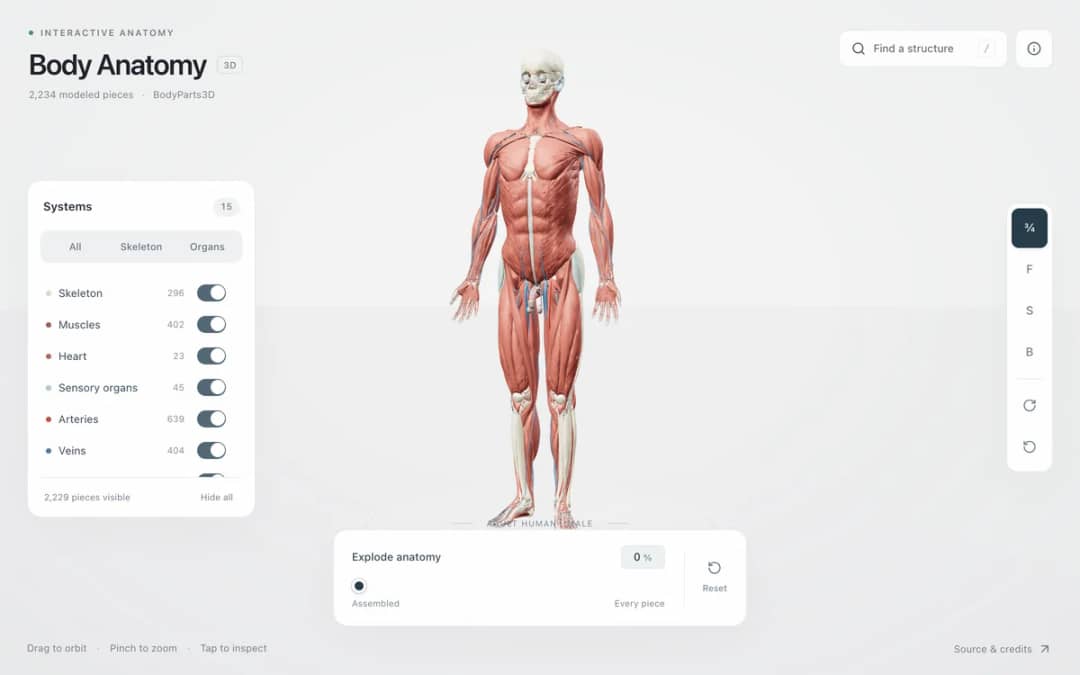
Explore an adult male reference body in 3D. Reveal 14 anatomical systems, search thousands of named structures, isolate organs, and pull 2,209 modeled pieces apart to see how the body is organized.
—
KiwiBee uses optional Google Analytics, Google Ads, and Meta Pixel cookies to understand adult visitors, measure completed sign-ups, and improve campaigns. Essential cookies always stay on. OpenAI’s ChatGPT Ads Pixel also measures page views and completed enquiries after advertising consent, and may use hashed contact details for matching. Privacy policy
Fractional Distillation is an interactive 3D industrial chemistry simulation of a crude-oil fractionating tower. Crude petroleum enters a heated furnace at the base (up to 400 degrees Celsius) and passes into a tall vertical column with a steady temperature gradient cooling toward 25 degrees Celsius at the top dome. Six internal bubble-cap collection trays capture condensing hydrocarbon fractions as rising vapour molecules reach a tray cooler than their boiling range. Students can drag the glowing furnace heat knob, vary crude feed rate, highlight individual carbon chain lengths from C1 to C35+, and click any tray or outlet flask to compare boiling ranges, intermolecular London dispersion forces, and industrial uses.
Crude oil is heated in a furnace until most hydrocarbons vaporize and enter the bottom of a fractionating tower that is hot at the base and cool at the top. As vapours rise through trays, each hydrocarbon fraction cools and condenses into liquid at the height where the tray temperature matches its boiling point.
Longer alkane chains contain more electrons and have a larger molecular surface area, creating stronger temporary dipole-induced dipole (London dispersion) attractions between molecules. More thermal energy is required to overcome these attractions and separate the molecules into a gas.
Bitumen and heavy residue molecules contain 30 to over 50 carbon atoms per chain with boiling points above 350 degrees Celsius. They do not boil at normal furnace temperatures and are drawn off as a thick hot liquid from the bottom tray for road surfacing and roofing.
Bubble caps cover the vapour risers on each tray and force rising hot gas to bubble through the cooler liquid already pooled on that tray, ensuring efficient heat exchange and clean condensation of high-boiling components.
Drop it into your LMS, blog, or class site — free.
<iframe src="https://kiwibee.io/en/simulations/fractional-distillation-column-3d-simulation/embed" title="Fractional Distillation | KiwiBee" loading="lazy" allowfullscreen style="width:100%;height:min(70vh,620px);min-height:420px;border:0;border-radius:16px"></iframe>Continue exploring
Explore an adult male reference body in 3D. Reveal 14 anatomical systems, search thousands of named structures, isolate organs, and pull 2,209 modeled pieces apart to see how the body is organized.
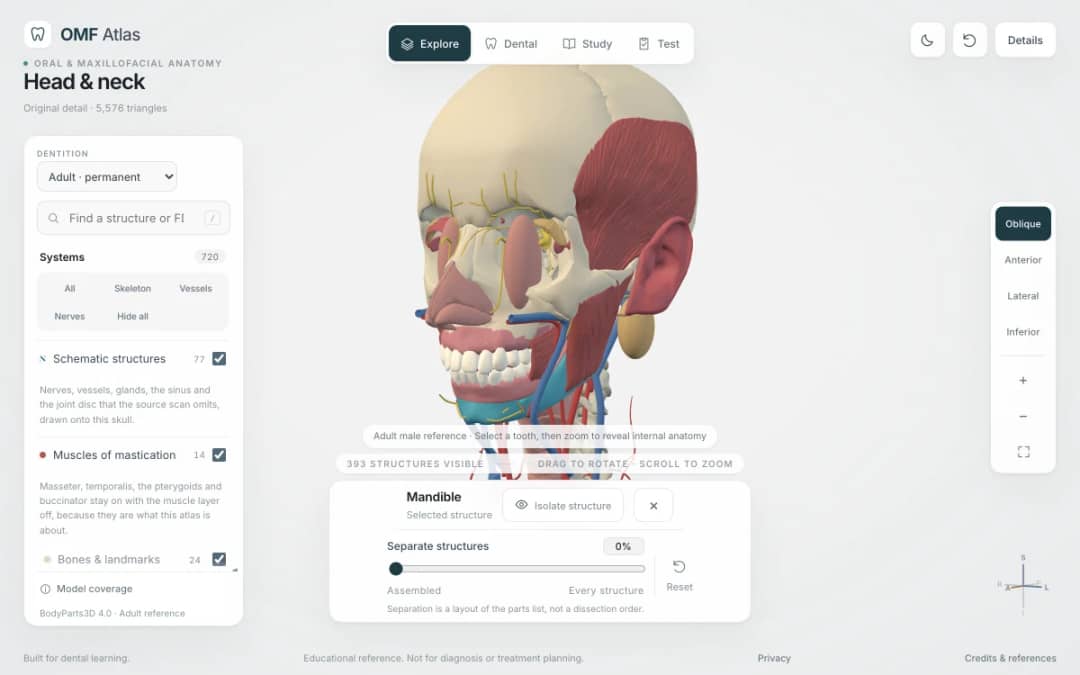
Explore the head and neck in 3D: 643 source meshes across 14 layers, 47 facial and masticatory muscles, and 77 drawn nerves, vessels and glands the source scan omits. Open any tooth onto its own pulp canal, and follow the seven stages of tooth development.

Free interactive photosynthesis simulation. Explore photosynthesis hands-on online — great for whole-class or independent practice.

Free interactive states of matter simulation. Explore states of matter hands-on online — great for whole-class or independent practice.

Free interactive shadows simulation. Explore shadows hands-on online — great for whole-class or independent practice.
KiwiBee's free teacher workspace brings lesson planning, worksheets, classroom tools, and gradebook together in one place.
Start free and create your first class Home
 All solutions
 Pricing
 About us
 KiwiBee for Non-profits
 Events & webinars
 For big organisations
 For schools
 For centers
 For team leaders
 For teachers
 AI and resources
 Resources
 Printable worksheets
 Lesson Packs
 Interactive simulations
 Teacher tools
 AI studio
 Ideas and research