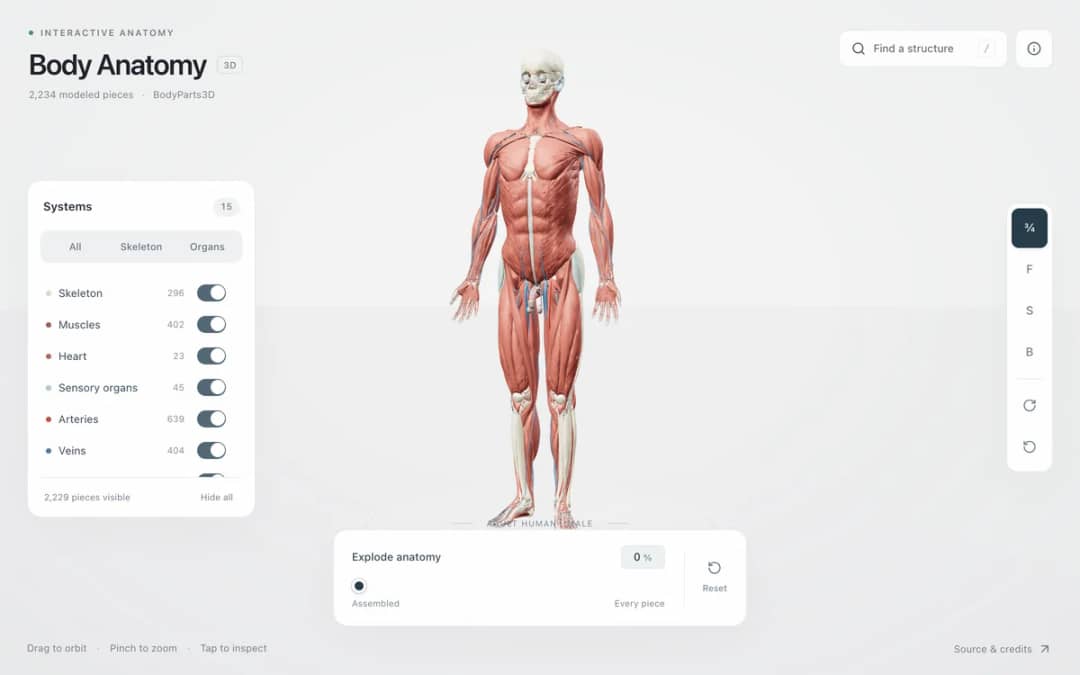
Explore an adult male reference body in 3D. Reveal 14 anatomical systems, search thousands of named structures, isolate organs, and pull 2,209 modeled pieces apart to see how the body is organized.
—
KiwiBee uses optional Google Analytics, Google Ads, and Meta Pixel cookies to understand adult visitors, measure completed sign-ups, and improve campaigns. Essential cookies always stay on. OpenAI’s ChatGPT Ads Pixel also measures page views and completed enquiries after advertising consent, and may use hashed contact details for matching. Privacy policy
Codon Protein Builder lets students type an mRNA sequence by clicking the bases A, U, G and C or pressing the keys. Each time three bases are entered, the ribosome reads the codon, a tRNA with the matching anticodon delivers an amino acid, and the protein chain grows. Translation begins at AUG for methionine and stops at UAA, UAG or UGA. Readouts show the last codon, the protein so far, its length and approximate mass. A random gene button, an Undo base button and a fast ribosome toggle help. It teaches translation and the genetic code.
Yes, completely free with no login. Any modern browser will run it, so it works on school tablets, whiteboards and personal phones.
There are 64 possible codons, since three bases each have four choices. They code for 20 amino acids plus a stop signal, so several codons can code for the same amino acid.
Translation starts at AUG, which codes for methionine. It ends at a stop codon, UAA, UAG or UGA, which do not code for any amino acid.
Click the base buttons A, U, G and C or press those keys. The Next codon readout shows what you have typed so far, and Undo base removes the last base.
Drop it into your LMS, blog, or class site — free.
<iframe src="https://kiwibee.io/en/simulations/codon-protein-builder-3d-simulation/embed" title="Codon Protein Builder | KiwiBee" loading="lazy" allowfullscreen style="width:100%;height:min(70vh,620px);min-height:420px;border:0;border-radius:16px"></iframe>Continue exploring
Explore an adult male reference body in 3D. Reveal 14 anatomical systems, search thousands of named structures, isolate organs, and pull 2,209 modeled pieces apart to see how the body is organized.
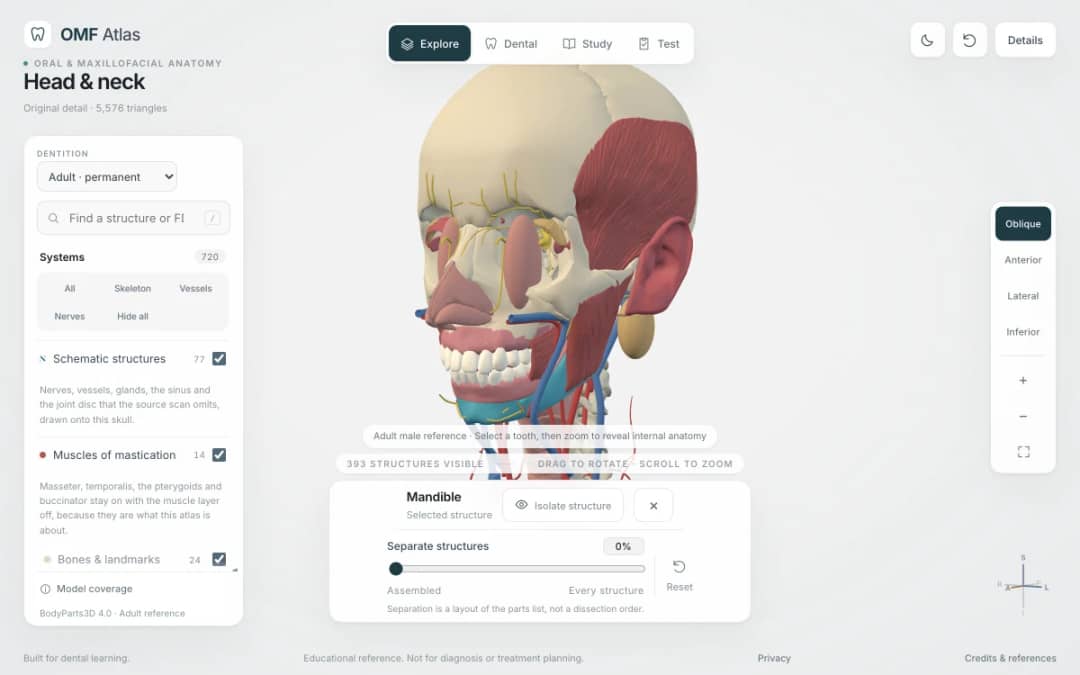
Explore the head and neck in 3D: 643 source meshes across 14 layers, 47 facial and masticatory muscles, and 77 drawn nerves, vessels and glands the source scan omits. Open any tooth onto its own pulp canal, and follow the seven stages of tooth development.

Free interactive photosynthesis simulation. Explore photosynthesis hands-on online — great for whole-class or independent practice.

Free interactive states of matter simulation. Explore states of matter hands-on online — great for whole-class or independent practice.

Free interactive shadows simulation. Explore shadows hands-on online — great for whole-class or independent practice.
From model to evidence
Use a worksheet to capture predictions, observations, and explanations after students explore.
KiwiBee's free teacher workspace brings lesson planning, worksheets, classroom tools, and gradebook together in one place.
Start free and create your first class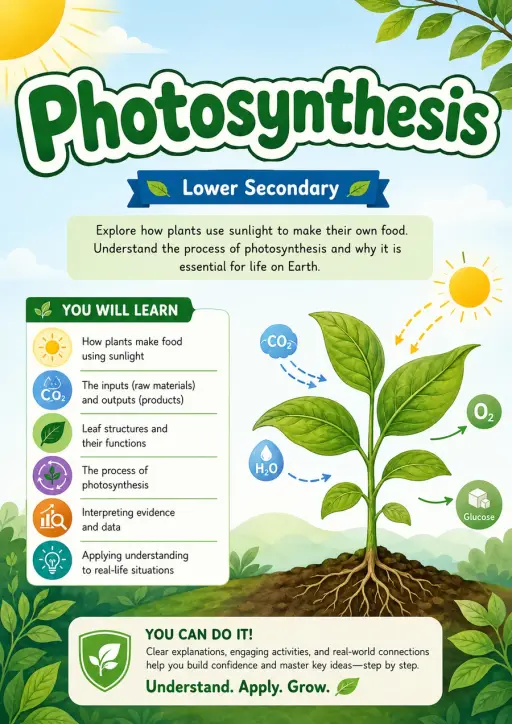
 Home
 All solutions
 Pricing
 About us
 KiwiBee for Non-profits
 Events & webinars
 For big organisations
 For schools
 For centers
 For team leaders
 For teachers
 AI and resources
 Resources
 Printable worksheets
 Lesson Packs
 Interactive simulations
 Teacher tools
 AI studio
 Ideas and research