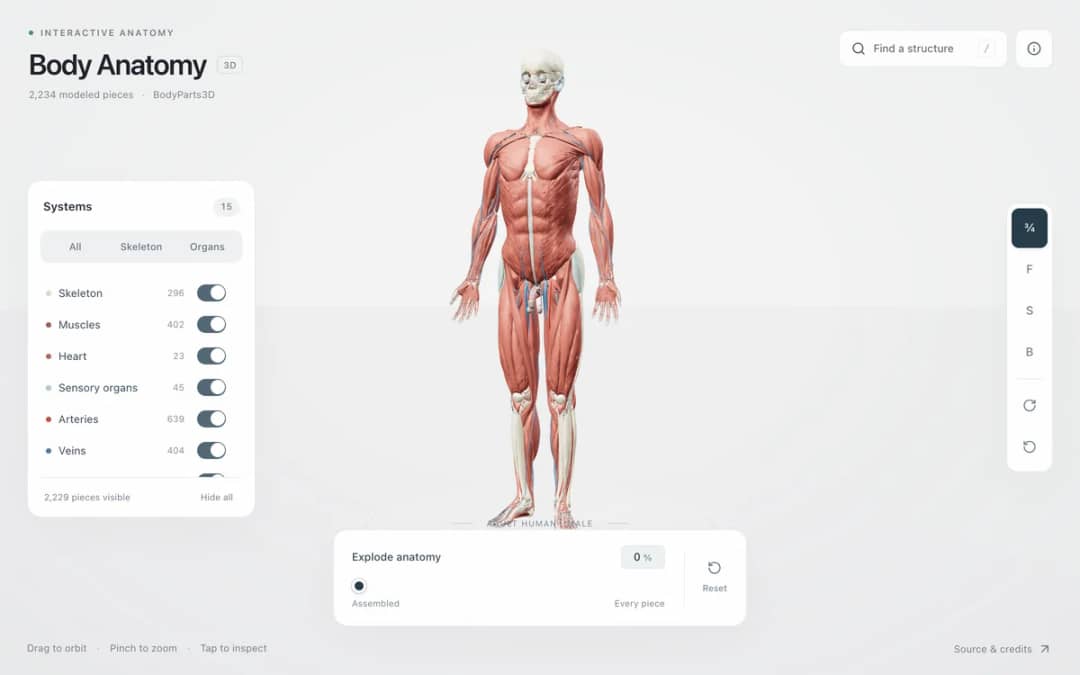
Explore an adult male reference body in 3D. Reveal 14 anatomical systems, search thousands of named structures, isolate organs, and pull 2,209 modeled pieces apart to see how the body is organized.
—
KiwiBee uses optional Google Analytics, Google Ads, and Meta Pixel cookies to understand adult visitors, measure completed sign-ups, and improve campaigns. Essential cookies always stay on. OpenAI’s ChatGPT Ads Pixel also measures page views and completed enquiries after advertising consent, and may use hashed contact details for matching. Privacy policy
Calorimetry & Enthalpy Lab is an interactive 3D thermal chemistry simulation where students perform coffee-cup calorimetry experiments. A cutaway insulated calorimeter holds a chosen mass of water at 20.0 degrees Celsius equipped with a motorized stirring rod and digital thermometer probe. Suspended above is a heated cylindrical metal sample (Aluminium, Iron, Copper, or Gold) whose mass and initial temperature are controlled by sliders. When the sample is immersed in the water bath, glowing thermal energy packets radiate from the metal into the water while a real-time 3D Temperature vs Time graph plots both cooling and warming curves converging on the exact equilibrium temperature Tf.
Specific heat capacity (c) is the amount of thermal energy in joules required to raise the temperature of 1 gram of a substance by 1 degree Celsius (or 1 Kelvin). Liquid water has an unusually high specific heat capacity of 4.184 J/(g·°C) due to extensive hydrogen bonding.
Assuming no heat is lost to the surroundings, heat lost by the hot metal equals heat gained by the cooler water: m_metal · c_metal · (T_initial_metal - Tf) = m_water · c_water · (Tf - T_initial_water). Solving for Tf gives the weighted average of the initial temperatures weighted by each object's heat capacity (m · c).
Aluminium atoms are much lighter (27 g/mol) than Gold atoms (197 g/mol), so 80 grams of Aluminium contains over seven times as many atoms storing vibrational thermal energy as 80 grams of Gold. Consequently, Aluminium has a much higher specific heat per gram (0.897 vs 0.129 J/g·°C).
The insulated wall prevents heat exchange with the outside room so all thermal energy stays inside the system, while the motorized stirrer circulates the water so the thermometer measures a uniform bath temperature.
Drop it into your LMS, blog, or class site — free.
<iframe src="https://kiwibee.io/en/simulations/calorimetry-specific-heat-lab-3d-simulation/embed" title="Calorimetry & Enthalpy Lab | KiwiBee" loading="lazy" allowfullscreen style="width:100%;height:min(70vh,620px);min-height:420px;border:0;border-radius:16px"></iframe>Continue exploring
Explore an adult male reference body in 3D. Reveal 14 anatomical systems, search thousands of named structures, isolate organs, and pull 2,209 modeled pieces apart to see how the body is organized.
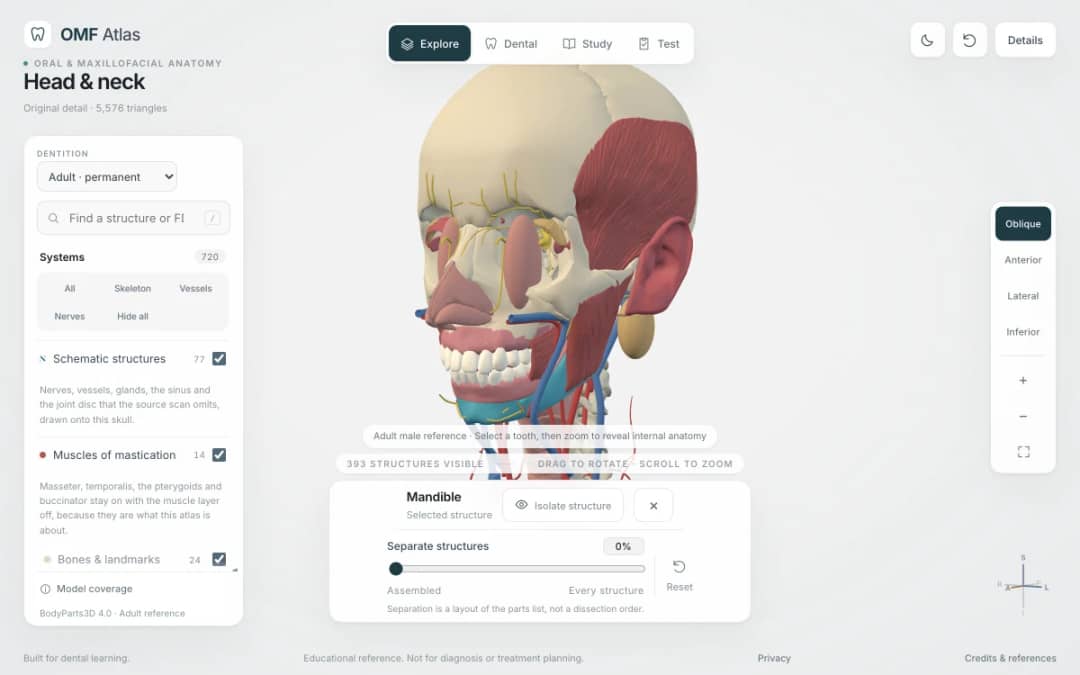
Explore the head and neck in 3D: 643 source meshes across 14 layers, 47 facial and masticatory muscles, and 77 drawn nerves, vessels and glands the source scan omits. Open any tooth onto its own pulp canal, and follow the seven stages of tooth development.

Free interactive photosynthesis simulation. Explore photosynthesis hands-on online — great for whole-class or independent practice.

Free interactive states of matter simulation. Explore states of matter hands-on online — great for whole-class or independent practice.

Free interactive shadows simulation. Explore shadows hands-on online — great for whole-class or independent practice.
KiwiBee's free teacher workspace brings lesson planning, worksheets, classroom tools, and gradebook together in one place.
Start free and create your first class Home
 All solutions
 Pricing
 About us
 KiwiBee for Non-profits
 Events & webinars
 For big organisations
 For schools
 For centers
 For team leaders
 For teachers
 AI and resources
 Resources
 Printable worksheets
 Lesson Packs
 Interactive simulations
 Teacher tools
 AI studio
 Ideas and research