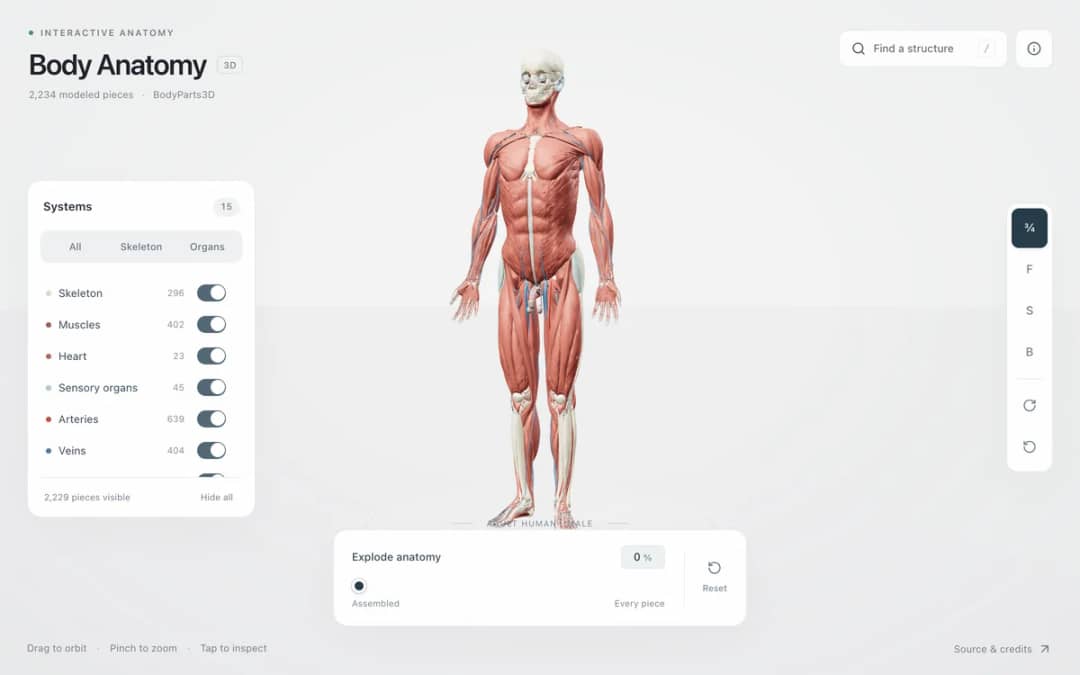
Explore an adult male reference body in 3D. Reveal 14 anatomical systems, search thousands of named structures, isolate organs, and pull 2,209 modeled pieces apart to see how the body is organized.
—
KiwiBee uses optional Google Analytics, Google Ads, and Meta Pixel cookies to understand adult visitors, measure completed sign-ups, and improve campaigns. Essential cookies always stay on. OpenAI’s ChatGPT Ads Pixel also measures page views and completed enquiries after advertising consent, and may use hashed contact details for matching. Privacy policy
Archimedes' Buoyancy Tank is an interactive 3D fluid-statics laboratory where students test Archimedes' principle by hand. A test block hangs from a calibrated overhead spring scale above an overflow tank filled to the spout. As students drag the block down into the fluid or click sample materials on the rack, water pours from the spout into a catch beaker on a digital balance. Live 3D vector arrows compare upward buoyant force F_b = rho_f g V_sub against downward gravity mg, while readouts display apparent weight on the spring scale, displaced water weight, buoyant force in newtons, and whether the object floats or sinks when released.
Archimedes' principle states that any object partially or fully submerged in a fluid experiences an upward buoyant force equal in magnitude to the weight of the fluid displaced by the object.
Buoyant force depends only on the density of the surrounding fluid and the submerged volume (F_b = rho_f g V_sub). Since two-liter blocks of aluminum, iron, and gold displace the exact same two liters of water, they receive the exact same upward buoyant force.
A hollow boat hull encloses a large volume of air, making its average density (total mass divided by total displaced outer volume) much lower than the 1000 kg/m³ density of water. It sinks only until the displaced water weight matches the ship's weight.
As the block enters the water, the upward buoyant force supports part of its weight, so the spring scale reading (apparent weight W_app = mg - F_b) decreases by the exact weight of the water collected in the catch beaker.
Drop it into your LMS, blog, or class site — free.
<iframe src="https://kiwibee.io/en/simulations/archimedes-buoyancy-tank-3d-simulation/embed" title="Archimedes' Buoyancy Tank | KiwiBee" loading="lazy" allowfullscreen style="width:100%;height:min(70vh,620px);min-height:420px;border:0;border-radius:16px"></iframe>Continue exploring
Explore an adult male reference body in 3D. Reveal 14 anatomical systems, search thousands of named structures, isolate organs, and pull 2,209 modeled pieces apart to see how the body is organized.
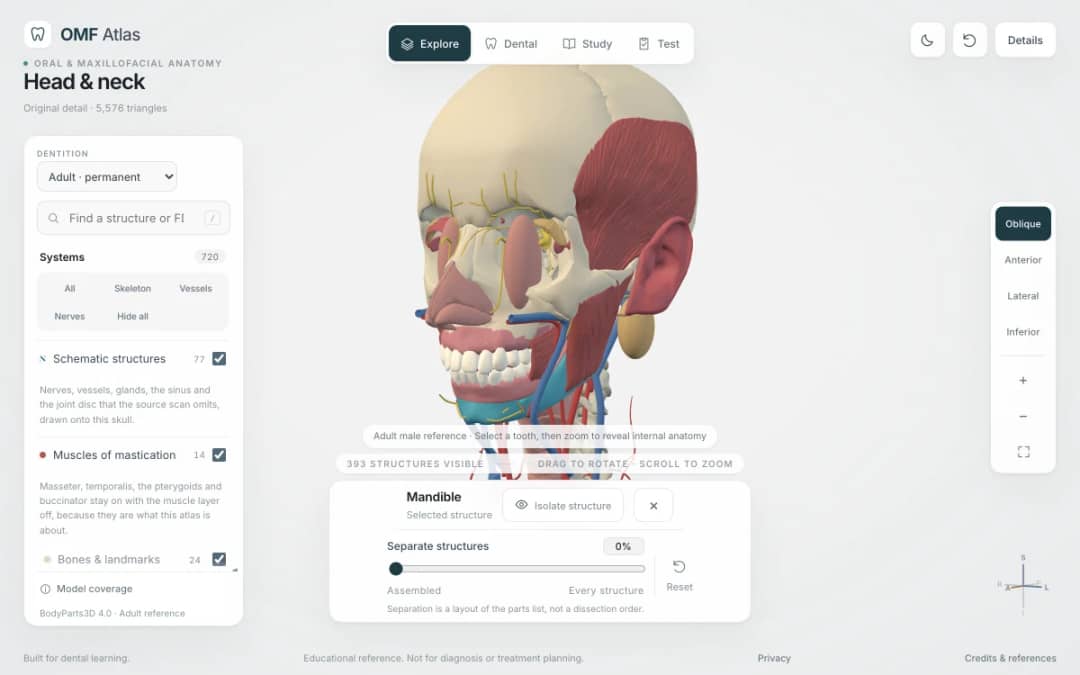
Explore the head and neck in 3D: 643 source meshes across 14 layers, 47 facial and masticatory muscles, and 77 drawn nerves, vessels and glands the source scan omits. Open any tooth onto its own pulp canal, and follow the seven stages of tooth development.

Free interactive photosynthesis simulation. Explore photosynthesis hands-on online — great for whole-class or independent practice.

Free interactive states of matter simulation. Explore states of matter hands-on online — great for whole-class or independent practice.

Free interactive shadows simulation. Explore shadows hands-on online — great for whole-class or independent practice.
KiwiBee's free teacher workspace brings lesson planning, worksheets, classroom tools, and gradebook together in one place.
Start free and create your first class Home
 All solutions
 Pricing
 About us
 KiwiBee for Non-profits
 Events & webinars
 For big organisations
 For schools
 For centers
 For team leaders
 For teachers
 AI and resources
 Resources
 Printable worksheets
 Lesson Packs
 Interactive simulations
 Teacher tools
 AI studio
 Ideas and research