
Printable worksheet
The Moon and Its Phases
QuizScienceGrade 5English
Practise more with these
Picked by meaning from games, worksheets, simulations, teacher tools and videos.
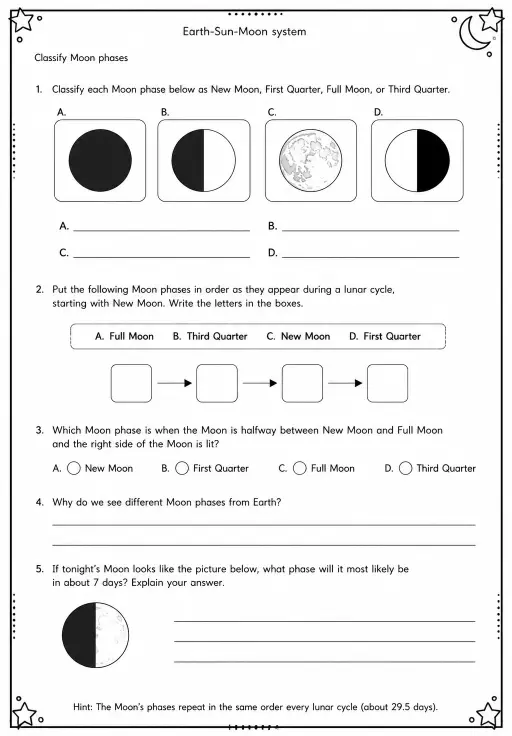
On this sheet
The words and questions from the game
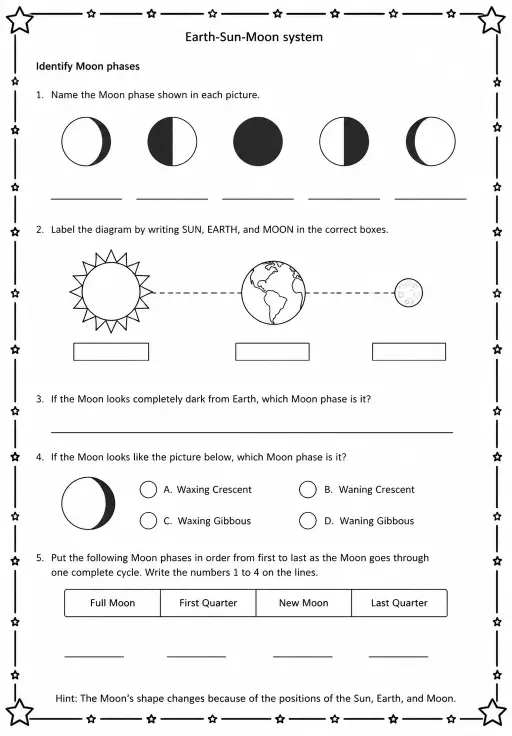
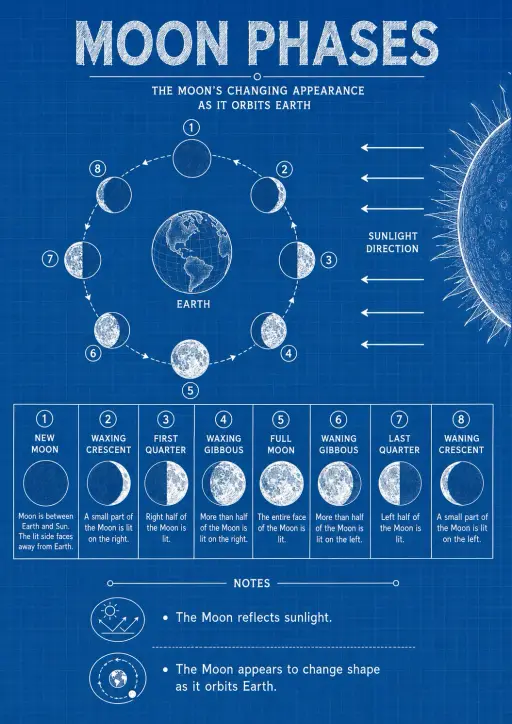
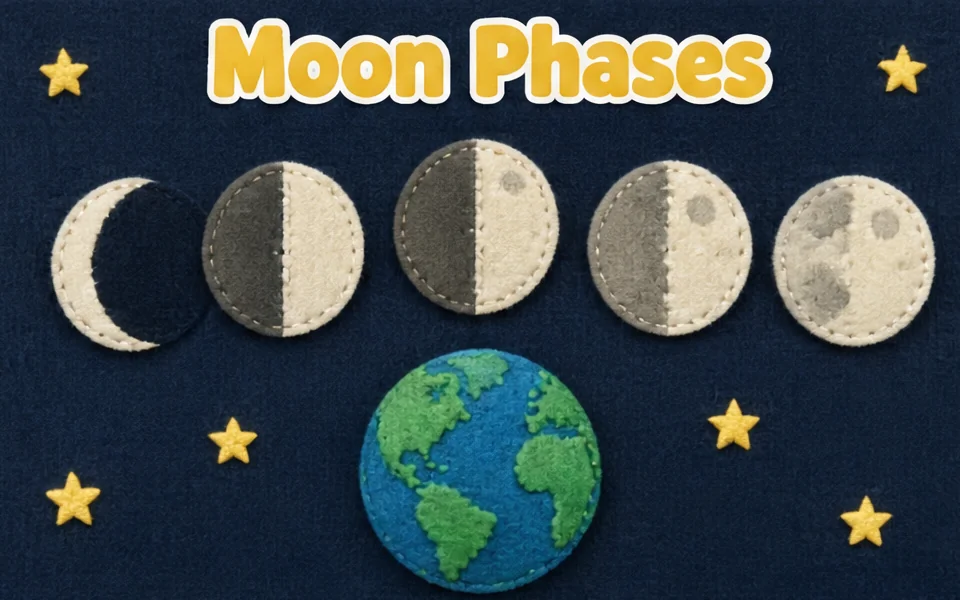
- 1This diagram uses an upright Northern Hemisphere view. Which phase is shown?Waxing crescent · Waning crescent · Full Moon · Last quarter
- 2In this upright Northern Hemisphere diagram, which phase is shown?New Moon · First quarter · Full Moon · Last quarter
- 3What phase shows the whole visible lunar face illuminated?New Moon · Waning crescent · Full Moon · First quarter
- 4In this upright Northern Hemisphere diagram, which phase is shown?Waxing crescent · First quarter · Waxing gibbous · Last quarter
- 5Ordinary Moon phases are caused by Earth's shadow covering different parts of the Moon.True · False
- 6The Moon shines mainly by reflecting light from which star?
- 7When the visible illuminated part grows from night to night, the Moon is ___.
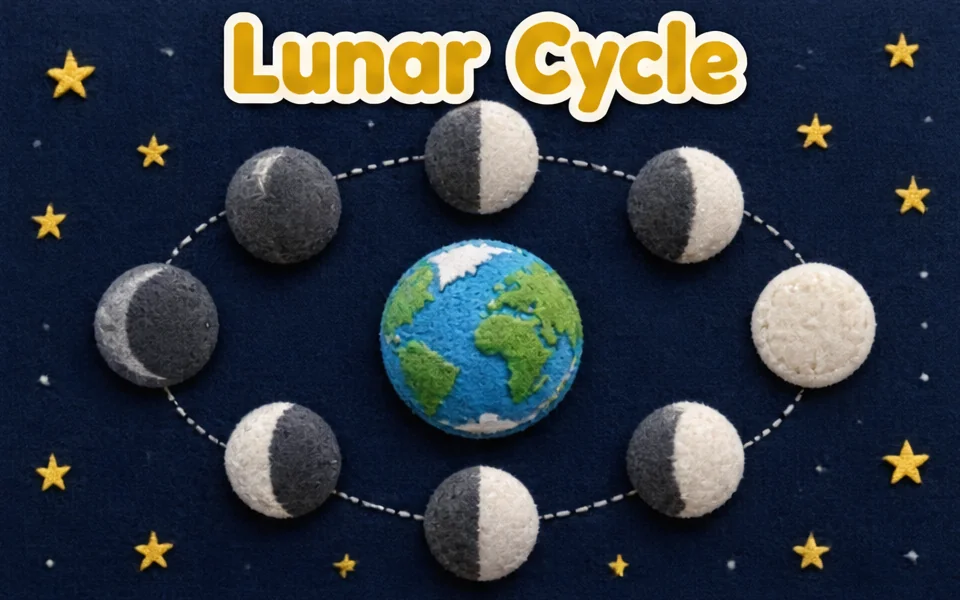
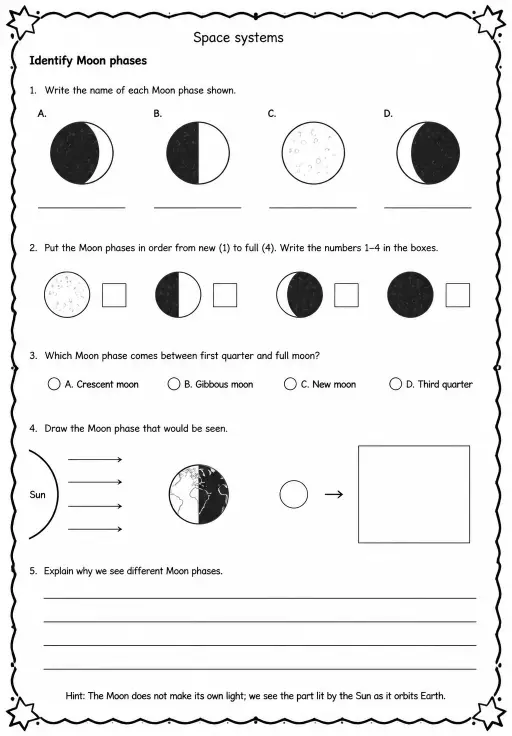
- 8Order these phases through one cycle, starting at new Moon.
- 9Which pictured phase lies between waxing crescent and waxing gibbous?Diagram A · Diagram B · Diagram C · Diagram D
- 10About how long is the cycle from one new Moon to the next?7 days · 29.5 days · 365 days · 24 hours
- 11During an ordinary first-quarter phase, half of the entire Moon is sunlit even though we see only half of the visible disc lit.True · False
- 12At full Moon, approximately what percentage of the visible disc is illuminated? Set the percentage.
- 13What word means that the visible illuminated part is getting smaller?
- 14At ___ Moon, the Moon lies roughly in the Sun's direction in our sky and its sunlit side mostly faces away from Earth.
- 15Why is a lunar eclipse rarer than a full Moon?The Moon usually stops orbiting · The Moon loses its sunlight permanently · The Moon is never opposite the Sun · The Moon's tilted orbit usually carries it above or below Earth's shadow
- 16Why do we usually see the same side of the Moon from Earth?It never rotates · Earth blocks the far side from sunlight · The Moon stays still in space · It rotates once in about the time it takes to orbit Earth
About this worksheet
A printable worksheet made from the KiwiBee game “The Moon and Its Phases”. Open it in the free Worksheet Studio to choose the design and the sheet type, then print it or save a PDF.
Recognize lunar phases, trace a full cycle and explain reflected sunlight. Use clear Northern Hemisphere diagrams to solve common Moon misconceptions.
- moon phases quiz
- lunar cycle for kids
- waxing waning practice
- first quarter full moon
- moon sunlight science
- northern hemisphere phases
 Home
 All solutions
 Pricing
 About us
 KiwiBee for Non-profits
 Events & webinars
 For big organisations
 For schools
 For centers
 For team leaders
 For teachers
 Resources
 Printable worksheets
 Interactive simulations
 Teacher tools
 Ideas and research


Comments